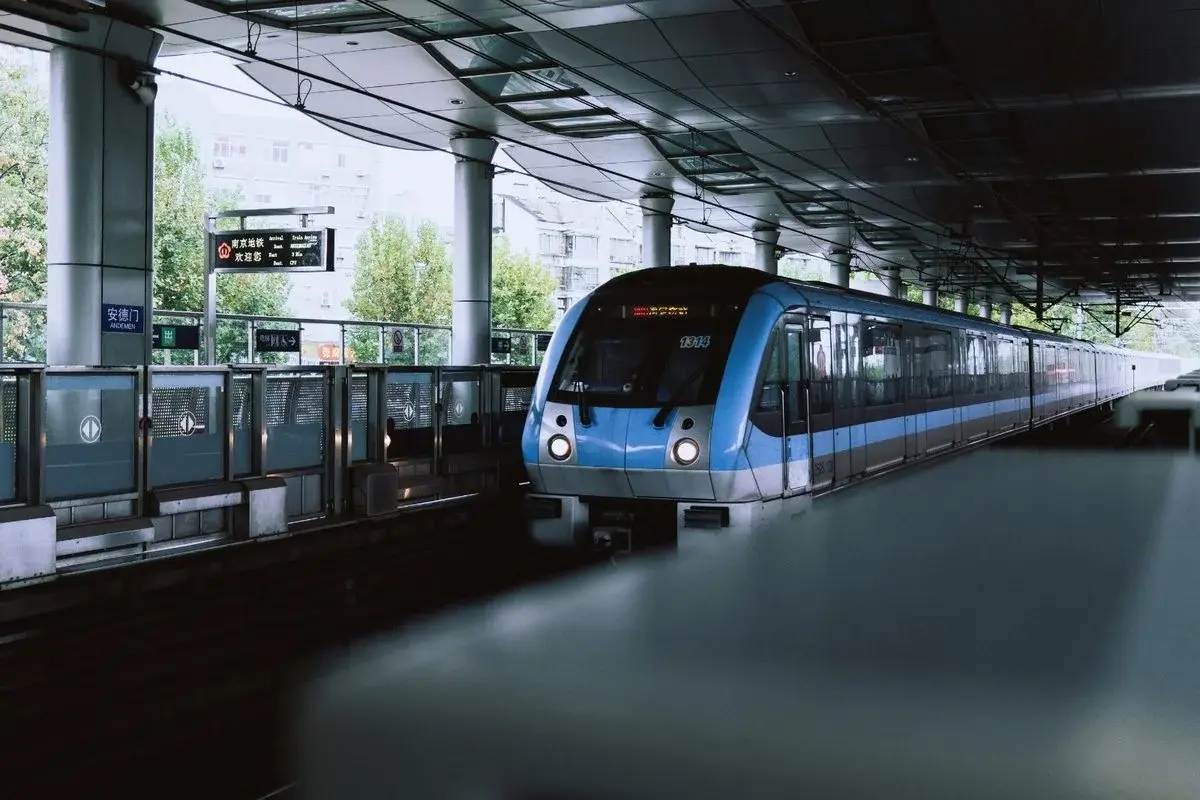
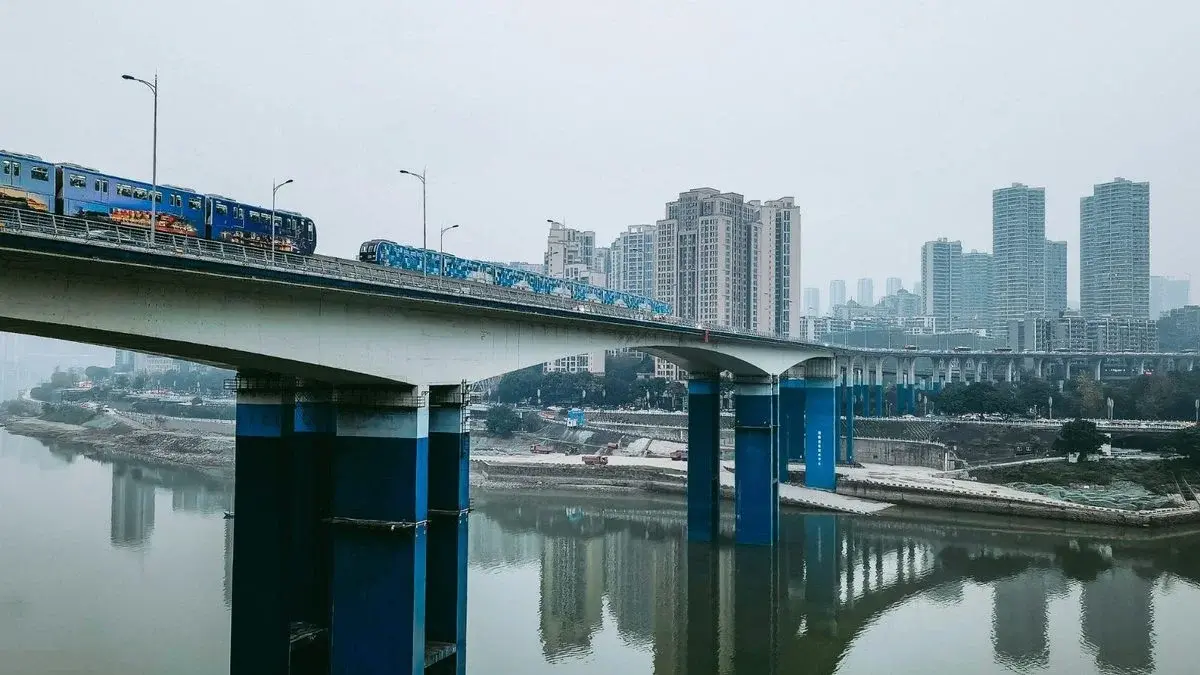
54 cities, 11,710 km of metro: the scale of China's urban transit.
Shanghai's metro fare tops out around 15 yuan — roughly two dollars — no matter how far you ride across a metro area with more people than the state of Texas. Most trips cost way less than that. You don't notice how weird this is until you compare it to what the same distance would cost, in money and in time, almost anywhere else: a system built to move tens of millions of people a day, priced like pocket change, and fast enough that for most of these trips, driving isn't even faster. That combination — cheap, fast, and enormous — is what this piece is really about, across the four ways people in Chinese cities actually get around: the metro, ride-hailing, the bus, and — increasingly — a shared bike for the last stretch nothing else covers. The real cost of cheap transit is settled elsewhere →
01 — The metro, one city at a time
Metro fares from ¥3: how 54 Chinese cities move 25 million people daily?
China's urban rail network spans 54 cities and 11,710 km of track, with fares starting at ¥3 and capping around ¥15 even for the longest trips.
When you land in a Chinese city, the easiest way to get almost anywhere is usually to find the nearest metro station — if nothing else, you skip the traffic. As of the end of 2025, mainland China had 54 cities operating urban rail transit, with a combined 11,710.3 km of track, according to China's Ministry of Transport.
Getting from an airport or high-speed rail station into the city center: five options, compared.
| Mode | Cost | What sets it apart |
|---|---|---|
| Metro | ¥3–10 | Fixed price, fixed time, no traffic to sit in |
| Ride-hailing | ¥20–80+ | Door to door, price locked in before you get in |
| Taxi | ¥20–100+ | Door to door, metered, sometimes a queue to reach one |
| Airport shuttle bus | ¥15–30 | Fixed route to a few central drop-off points, runs on a schedule |
| City bus | ¥1–2 | Cheapest option, but slowest and most exposed to traffic |
(Most airports, aside from a few exceptions, don't have city bus service directly to the terminal — but most high-speed rail stations do, usually through a bus hub right outside.)
One thing worth knowing before you land in any of these cities: in a growing number of them, the metro now runs straight into the airport and the high-speed rail station, so stepping off a flight or a train can mean walking right onto that platform. That's its own story, with its own standout examples — covered here →.
Top 10 cities by metro/rail-transit mileage, end of 2025. Cities with a published deep-dive on this site are linked. (Ranking order is solid; figures for ranks 6–10 are rounded — see Sources & Method below.)
| Rank | City | Mileage |
|---|---|---|
| 1 | Beijing | 909 km |
| 2 | Shanghai | ~900 km |
| 3 | Guangzhou | ~780 km |
| 4 | Chengdu | ~758 km |
| 5 | Shenzhen | 635 km |
| 6 | Wuhan | 500+ km |
| 7 | Nanjing | 525 km |
| 8 | Hangzhou | ~500 km |
| 9 | Chongqing | ~500 km |
| 10 | Xi'an | ~400 km |
Other published city pages with their own rail systems: Dalian and Harbin, both smaller networks outside the national top 10 but worth reading for how the system fits a mid-sized city rather than a megacity.
Whichever city's numbers you're looking at, actually getting through the gate works the same way everywhere.
Getting in the door: no ticket to buy, just a phone
The mechanics are basically the same everywhere. Open a payment app — Alipay or WeChat Pay, the two that matter — find the transit code (called "riding code," inside either app), and hold the QR code up to the scanner at the turnstile. It reads, the gate opens, and the fare is deducted automatically. No ticket window, no card top-up, no cash. Both apps also let a visitor link a foreign bank card for exactly this purpose, which is usually the easiest way for someone visiting from abroad to use the system without a Chinese bank account. Paper tickets and rechargeable transit cards still exist as a backup in every system, mostly for people without smartphones, but they're becoming the exception.
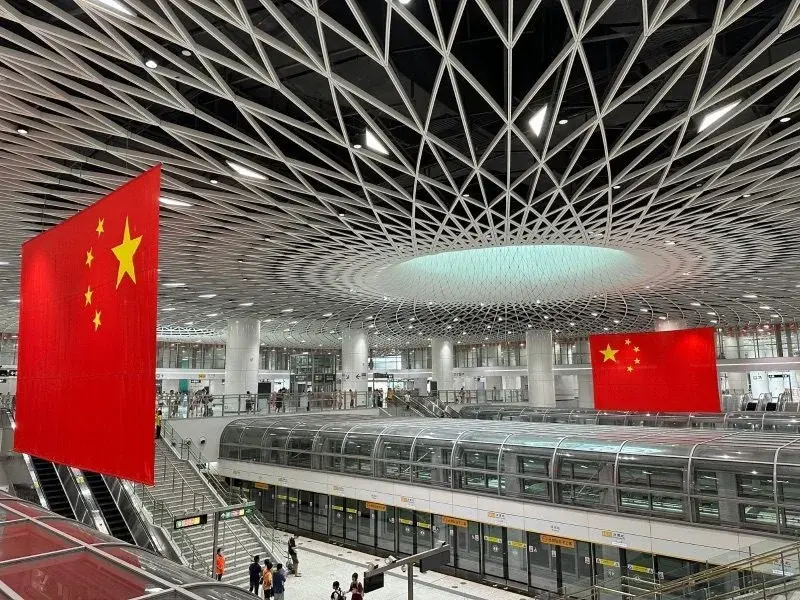
Not every rider on this network is commuting to an office, either — some of the system's edge cases are more telling than its averages.
The free line the vegetable farmers ride
Chongqing's Line 4 has its own nickname: the "basket-carrier line." Every morning at Shichuan station, on the city's rural northeastern edge, farmers from the villages around it — most of them over 65 — arrive with woven bamboo baskets full of that morning's vegetables strapped to their backs, some wheeling them in on small carts. China's free-transit policy for riders 65 and older means the ride costs them nothing. So instead of the hour-plus bus transfer it used to take to reach a city market, a seat on the first train gets them there in under half an hour. The operator noticed the pattern early enough to designate cars 1 through 5 of that first run as basket-carrier cars, and even moved the platform's opening time earlier — to roughly 6:00am — just to help farmers make the trip and still catch the morning market rush. When the line's western extension opened in February 2026, it was covered locally as the "basket-carrier line, now longer."
02 — Ride-hailing, priced upfront
Didi and map apps: fixed upfront prices for ride-hailing.
Ride-hailing in China uses a fixed upfront price model: the fare is locked before the ride starts, with no metered uncertainty.
Rail covers the trunk lines, but it can't get you door to door. That's where ride-hailing steps in. In China it works less like one company and more like a marketplace with a single front door. Didi is the dominant platform on its own, but most people now book rides through a map app — Amap or Baidu Maps — which has a ride-hailing tab that quotes and compares several providers at once for the same trip. Enter your start point and destination, and the app gives you a route, an estimated time, and a fixed price before a driver is even assigned.
That upfront price is the real difference from hailing a taxi off the street: the fare is locked in before the ride starts, not metered as you go. The route and driver details are visible the whole way. Payment happens automatically at the end through your linked account, with an electronic invoice for anyone who needs to file it. No cash, no paper receipt to keep track of. Traditional street-hail taxis still operate everywhere and remain the fallback in smaller cities or for a curbside pickup, but for most trips in a major city, the app has become the default.
03 — Buses: cheap, slow, full
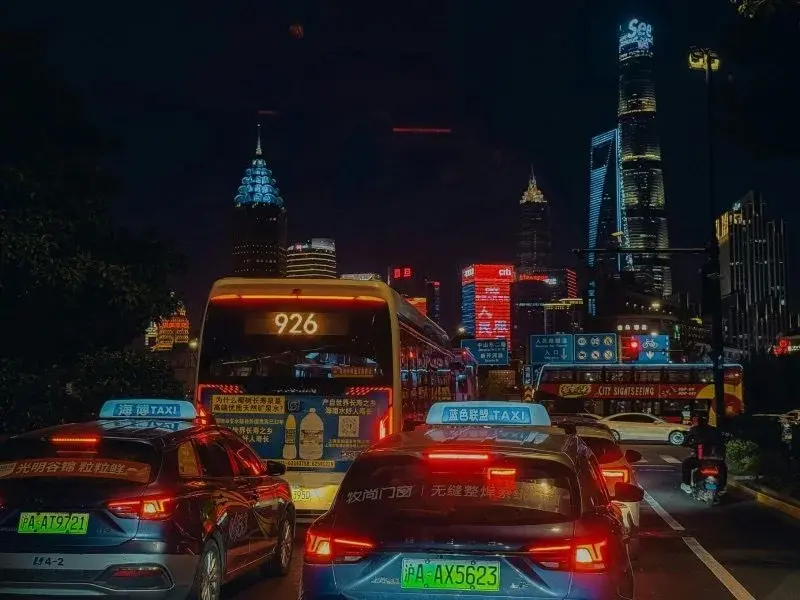
Buses: ¥1-2 fares, 20,500 km of dedicated lanes, and local order.
Ride-hailing gets you door to door, but it's not the cheapest option on this list. That honor still goes to the bus, running quietly underneath both it and the metro. Buses don't get the spotlight the metro does, but they cover most of what the metro doesn't reach: older neighborhoods, routes too short or too local to justify rail, the parts of a city a subway map never quite covers. Fares typically run 1–2 yuan, tap-to-pay like everything else.
"Most of" is doing real work there, though. Even bus routes thin out at the edges of a city, and that's where a shared bike tends to pick up the slack. For the stretch neither rail nor bus quite reaches, it's often faster to just unlock one and pedal than to wait for a connection.
Part of what keeps buses moving at all: dedicated bus-only lanes, painted right onto the pavement on most major roads in Chinese cities. What's easy to miss at first glance is that they're usually not full-time — the lane markings often have the enforcement window stenciled right onto the asphalt, usually something like 6:30–8:30 and 16:30–19:00, the two daily rush-hour blocks. Outside those hours, the same lane is ordinary traffic, open to any car. Enforcement is camera-based, not police-on-the-curb. Drifting into the lane during the restricted window is a ticketable offense caught on camera, not a judgment call.
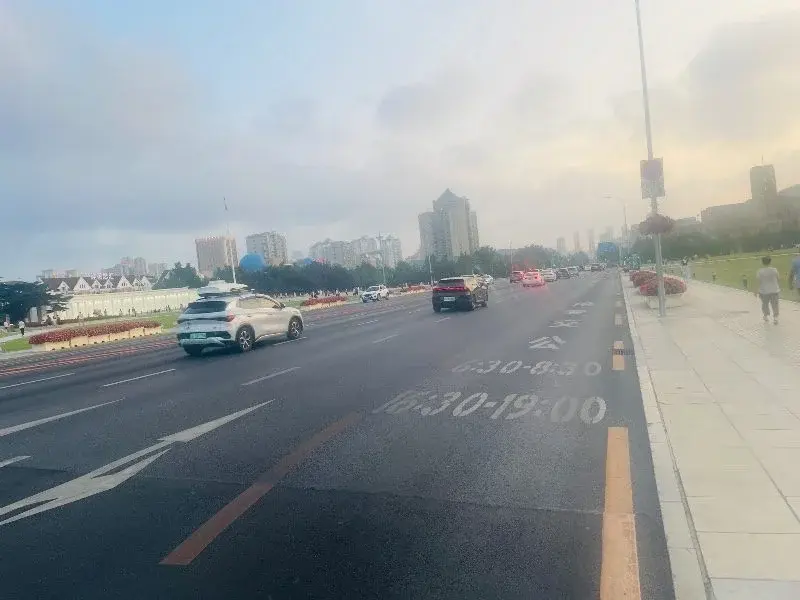
This isn't a handful of showcase corridors. By the end of 2025, China's dedicated bus lanes added up to roughly 20,500 km nationally, still growing by a couple hundred kilometers a year even this late in the buildout. Beijing got there first, opening the country's first bus lane on Chang'an Avenue in 1997. Its network has since grown to around 1,000 lane-km and is on track to pass 1,500 by 2035. The logic behind all of it is blunt and mostly about cost. Widening roads or building new rail is slow and expensive, but painting a lane and pointing a camera at it is cheap. And it buys the same thing: buses that don't get stuck in the traffic they're supposed to be an alternative to.
It isn't purely theoretical, either. Zhengzhou opened 22 dedicated-lane routes in 2018, and ridership on ground-level buses was measurably higher a year later. The one wrinkle: national rules for when a lane qualifies for dedicated status date to 2004 and set a fairly high passenger-volume bar. That fits big-city trunk roads better than the older, narrower corridors many mid-sized cities actually need to unclog. Which is part of why some cities have started loosening the rules instead of tightening them — opening lanes on weekends and letting high-occupancy shuttles and school buses in during the week.
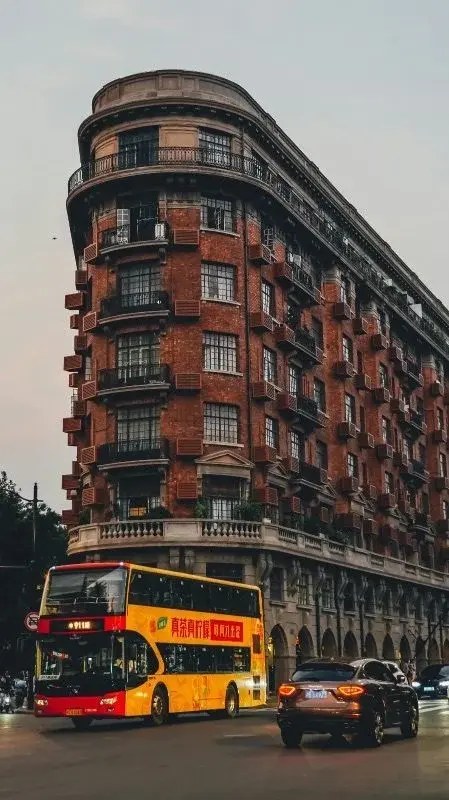
Buses in Chinese cities do more than move commuters, too. In the country's biggest tourist cities, a second fleet runs alongside the regular lines: open-top or double-decker sightseeing buses that loop past the landmarks instead of running a commute. Shanghai's red "Shanghai Jiushi" sightseeing buses run fixed touring routes with recorded commentary, letting a visitor hit a city's greatest hits from the top deck without ever hailing a cab. It's the same infrastructure, repurposed for an entirely different kind of passenger.
05 — Mobile payment ties together
One scan for all: mobile payment ties metro, buses, and ride-hailing together.
Look back at everything above and a pattern emerges — one only mentioned in passing at each stop. The metro turnstile that opens with a phone tap. The bus fare that clears before you've found a seat. The ride-hailing trip that's already priced, routed, and receipted before the car even arrives.
None of these are separate systems anymore. They're the same one, worn thin enough to disappear — a single account, a single scan, moving you from a rush-hour metro platform in Chongqing to a Dalian airport curb, without your wallet ever coming out of your pocket. Two apps run almost all of it — Alipay and WeChat Pay — and both let a visitor link a foreign card in a few minutes. That matters here more than almost anywhere else: without one set up, a surprising number of these systems have no easy fallback left. The full picture — how the two apps ended up splitting the country, what changed for the businesses that had to adapt, and exactly how to set one up before you land — is its own piece →
只要手机在手,天下一切我有。
As long as I have my phone in hand, I have everything the world has to offer.
06 — Questions people actually ask
Quick answers
How extensive is China's urban metro network?
54 cities have built metro systems, totaling roughly 11,710.3 km of track combined — and a ticket costing less than a dollar can carry you across a city of 25 million people.
How does ride-hailing pricing work in Chinese cities?
The price is set before you get in — one app connects you with several possible drivers at a fixed upfront price, removing the negotiation or metered-fare uncertainty some other countries have.
Are buses still useful in Chinese cities that already have a metro?
Yes — buses function as the capillaries reaching where the metro doesn't, and they're cheap, slow, and quietly full of local order rather than being an afterthought.
When do shared bikes make the most sense for getting around a Chinese city?
On flat terrain — shared bikes are the default choice for the last stretch of a trip almost everywhere the ground doesn't get in the way.
What ties together metro, buses, ride-hailing, and shared bikes in China?
Mobile payment — the same one-tap system runs through nearly every mode of transport, functioning as the connective thread across all of them.