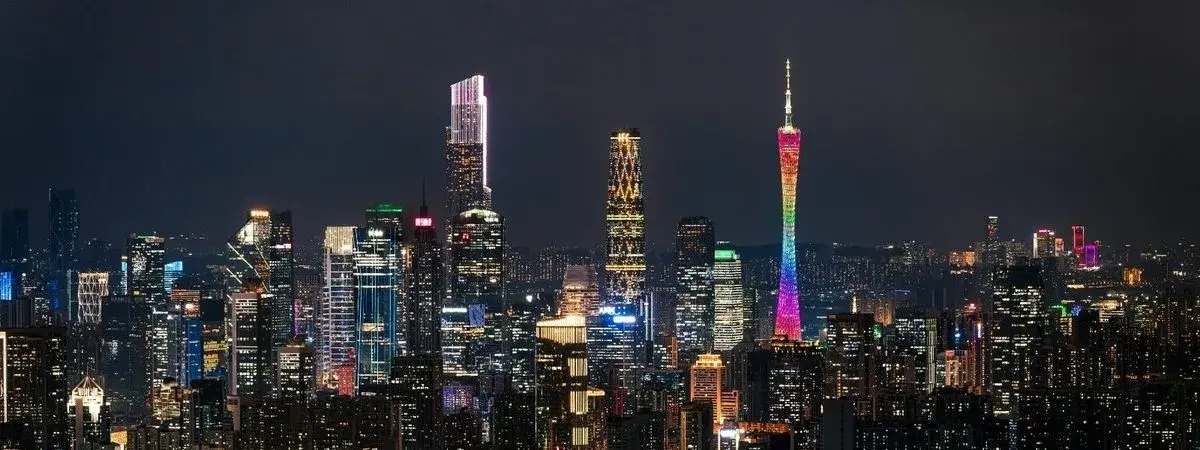
Living cost, at a glance
≈$595/mo
≈$272/mo
≈$554/mo
≈$1,149/mo
≈$826/mo
Rent from the §01 ledger. The non-rent line is Numbeo's own compiled "estimated monthly costs, excluding rent" for Guangzhou (single person, pulled Aug 2026) — it already folds in food, transport, utilities and everyday extras as one figure. Converted at ¥7.2 = $1.
Between 1757 and 1842, if you were a foreign merchant and you wanted to buy Chinese tea, silk, or porcelain, there was exactly one door in the entire country you were allowed to knock on. It was in Guangzhou. Every other port on the coast — Ningbo, Xiamen, the ones further north — had been closed to Western trade by imperial order. For eighty-five years, the whole of China's foreign commerce funneled through a strip of riverfront warehouses known as the Thirteen Factories, and Guangzhou got rich being the only city in a country of hundreds allowed to do it.
That monopoly ended in 1842, and it never came back. This is not a travel piece about the three days I spent here in 2005. It's an attempt to explain why a city that once cornered an entire nation's trade is today, by the numbers, the most unremarkable of China's four first-tier cities. And what that costs — and doesn't cost — the people living there now.
01 — The number, and what it says about the other three
Rent takes 44% of the median wage, the softest hit of any first-tier city in China.
The city-center rent number will hit you first. A one-bedroom in Guangzhou runs about $595 a month, roughly 44% of the median after-tax wage of $1,350. That makes it the softest rent burden of any first-tier Chinese city — Beijing, Shanghai, and Shenzhen all run harder. But if you stop there, you have missed what Guangzhou actually is. For 85 years, from 1757 to 1842, Guangzhou was the only Chinese port a foreign ship could touch. It held a monopoly on the country's entire foreign trade. That monopoly ended in a treaty, and the city has been finding a new identity ever since. Today it is the most average of China's four first-tier cities. Not the priciest, not the cheapest. Just wherever the tide left it after the monopoly ended.
A one-bedroom in central Guangzhou runs about ¥4,284 a month (≈$595). The median after-tax salary is around ¥9,720 (≈$1,350). Rent against wage works out to ≈44% — tighter than Harbin's 49%, but nowhere near Shanghai's 70% or Beijing's mid-70s. Stack it up against the other three cities that make up China's "first tier" — Beijing, Shanghai, Shenzhen, Guangzhou — and it's the most breathable number on the list, by a wide margin.
| City | 1-bed, center | After-tax median | Rent ÷ wage |
|---|---|---|---|
| Guangzhou | $595 | $1,350 | 44% |
| Shanghai | $972 | $1,391 | ~70% |
| Beijing | $1,042 | $1,431 | ~73% |
| Shenzhen | $720 | $900 | ~80% |
Rents and median wages: Wise and Numbeo, cross-checked, mid-2026, converted at ¥7.2 = $1. See sources below.
None of the other three cities on that table ever held the kind of trade monopoly Guangzhou once did. Beijing has always been the capital; Shanghai built its fortune after 1842, largely by taking the business Guangzhou lost; Shenzhen didn't meaningfully exist as a city before 1980. Guangzhou is the only one of the four with a real claim to having once been, commercially, more important than the other three combined. And it's the only one of the four where an ordinary salary still comfortably covers the rent.
That's the shape of the whole story here: the city that used to be the exception is now the closest thing China's first tier has to a baseline. Which kind of "cheap" this city belongs to →
The monthly numbers, item by item
These figures are the city-level baseline — but how you live day to day moves the final number more than the city itself. Three lifestyle budget tiers →
What the table above doesn't capture: the deposit, agency fee, visa medical, and household kit that hit before month one. The real bill in week one goes well beyond rent →
1-bed rent and meal figures: Wise, mid-2026, converted at ¥7.2 = $1. Wise doesn't track a 2-bed figure for Guangzhou — the 2-bed rows above are this site's own estimate, interpolated at the midpoint between Wise's 1-bed and 3-bed figures for the same location (center or outside it), not an independently sourced number. Treat it as directional. Utilities uses this site's own standardized calculation, not a Wise figure — see below.
What that ¥261 a month for electricity, water, and gas actually buys
All three are tiered. Unlike Beijing, Shanghai, Chongqing, or Dalian, Guangdong's electricity is billed monthly — and the tier bands themselves shift between a summer and non-summer schedule to reflect the province's much heavier air-conditioning season.
| Tier | Monthly usage | Rate |
|---|---|---|
| 1 | 0–200 kWhMay–Oct: 0–260 kWh | ≈¥0.589/kWh |
| 2 | 201–400 kWhMay–Oct: 261–600 kWh | ≈¥0.639/kWh |
| 3 | 401+ kWhMay–Oct: 601+ kWh | ≈¥0.889/kWh |
| Tier | Monthly usage | Rate |
|---|---|---|
| 1 | 0–26 m³ | ¥1.98/m³+ ¥0.95/m³ sewage |
| 2 | 27–34 m³ | ¥2.97/m³+ ¥1.43/m³ sewage |
| 3 | 34+ m³ | ¥3.96/m³+ ¥2.85/m³ sewage |
Water and sewage are billed as separate line items here, not bundled into one number. A new rate schedule has been under public hearing in 2026 — expect these figures to rise once it's finalized; we're reporting the currently effective rate, not the proposed one.
| Tier | Annual usage | Rate |
|---|---|---|
| 1 | 0–320 m³ | ¥3.45/m³ |
| 2 | 321–400 m³ | ¥4.14/m³ |
| 3 | 401+ m³ | ¥5.18/m³ |
These per-unit rates have been unchanged since 2016 and are unified across the whole city. A dynamic gas-pricing reform is under official review in 2026, the same year as the metro fare mechanism in §02 — two of the city's biggest household cost inputs are both up for revision at once.
Electricity: Guangdong provincial tiered residential rate (粤价〔2012〕135号 and subsequent notices), applied citywide, billed monthly. Water and sewage: Guangzhou central-districts residential schedule, current 2024–2026 policy; a 2026 rate-reform hearing is pending. Gas: Guangzhou municipal unified residential rate and tier thresholds, in effect since 2016, per Zengcheng District government's published citizen guide; a 2026 dynamic-pricing reform is under review. Converted at ¥7.2 = $1.
Standardized comparison figure, applied the same way across every city on this site: 220 kWh electricity + 15 m³ water + 25 m³ gas per month, a single-occupant baseline that excludes winter heating, run against each city's own published tiered rates above. At Guangzhou's rates that's ¥131 electricity + ¥44 water + ¥86 gas ≈ ¥261 (≈$36)/month. An earlier version of this figure (¥410) came from Wise's own bundled estimate, which reflects a larger household's typical usage rather than one person; ¥261 is this site's own calculation and supersedes it.
What the everyday basics cost, at the market
| Item | RMB | USD |
|---|---|---|
| Pork4-cut blend, retail average | ≈¥18.3/500g | ≈$2.54 |
| EggsRetail average | ≈¥6.2/500g | ≈$0.86 |
| Vegetables32-item basket, retail average | ≈¥4.3/500g | ≈$0.60 |
| Beef | Not shown — see note | |
| Norwegian salmonWholesale, dated — see note | ≈¥42–56/500g | ≈$5.83–7.78 |
Pork, eggs, and vegetables: City of Guangzhou's own weekly retail-price monitor (广州市重要民生商品零售价格动态), week of May 11–17, 2026 — genuinely city-specific, all three items the same week. We couldn't find a Guangzhou-specific retail beef figure and left the row blank rather than substitute a national or provincial number. Salmon is wholesale pricing from Huangsha Aquatic Products Market (黄沙水产交易市场) — one of Guangzhou's best-known seafood wholesale and retail hubs, reported November 2024, so treat it as directional rather than current-week; we're using this baseline rather than a January 2025 price-spike figure we also found for the same market, which wasn't representative of ordinary pricing. Converted at ¥7.2 = $1.
02 — Getting around the city
The cheapest metro ticket of any first-tier city, the same "most breathable" pattern, one layer down.
The rent ratio isn't the only place Guangzhou undercuts its three first-tier peers. Its metro fare starts at ¥2 for the first 4 km — cheaper than the ¥3 base fare in both Shanghai and Beijing — before stepping up in wider bands as distance grows. By early 2026 the network had grown to 19 lines, roughly 780 kilometers, and 316 stations. That's the third-largest system on the Chinese mainland, after Shanghai and Beijing. It's still expanding to link outlying districts and neighboring Foshan into the same fare zone.
| Distance | Fare |
|---|---|
| 0–4 km | ¥2 |
| 4–12 km | +¥1 / 4 km |
| 12–24 km | +¥1 / 6 km |
| 24 km+ | +¥1 / 8 km |
Guangzhou Metro fare schedule, current as of early 2026; a fare-mechanism review is due to conclude by the end of the year, so treat this table as subject to revision. Network stats: Guangzhou Metro Corporation / municipal transit reporting. Converted at ¥7.2 = $1.
We haven't been able to source a metro map for Guangzhou that we're confident redistributing. For the current network layout, go straight to the operator: Guangzhou Metro — official line map →
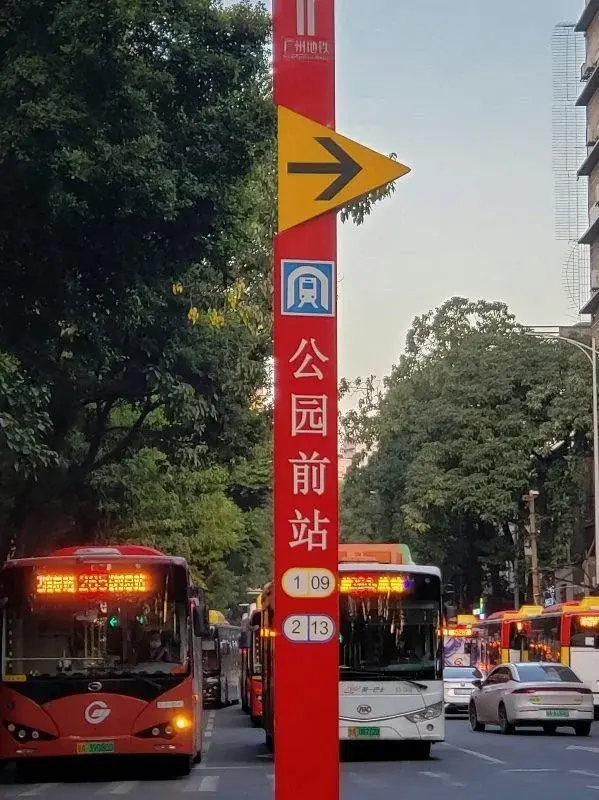
Outside the rail, the same shared-bike and ride-hailing apps found across the country — Meituan, Hello, Didi's Qingju — cover the streets, and buses fill in the routes the newer outer-district lines haven't reached yet. For the full national picture on fares, apps, and how the pieces fit together, see Getting Around a City; Baiyun Airport's own rail-metro integration is covered separately in Integrated Transit Hubs. The ¥2 base fare and the low utility rates in §01 don't happen by accident — they're the visible tip of decades of capital investment and permanent maintenance subsidy. The real cost behind these low prices → None of this — the trains, the fare bands, the bikes stacked on every corner — existed in any form twenty years ago, or two hundred. For most of the centuries that made Guangzhou matter, the only way in or out ran along the water beneath it.
03 — Eighty-five years, gone in a treaty
How one city held a monopoly on an entire country's foreign trade, and how it lost it
In 1757, the Qianlong Emperor closed the customs houses at Ningbo, Xiamen, and the other coastal ports that had briefly been open to Western ships, and left only one gate standing: the Yue Customs House at Guangzhou. From then until 1842 — a policy historians call the Canton System — every legal transaction between China and the West passed through a row of riverside trading houses known as the Thirteen Factories (十三行). Foreign crews weren't allowed into the walled city itself; they lived and traded in a narrow strip of warehouses along the Pearl River, dealing exclusively through a licensed guild of Chinese merchants who answered for them to the imperial court. Tea, silk, and porcelain went out; silver came in, in enormous quantities. For 85 years, Guangzhou was, commercially, the only door in the country.
The First Opium War ended that. The 1842 Treaty of Nanjing forced open four additional ports — Shanghai among them — and stripped Guangzhou of its exclusivity. Trade that had once been forced through one city could now go through five, and much of it, over the following decades, went to Shanghai instead. Guangzhou didn't collapse; it kept trading, kept growing, kept mattering. But it stopped being the only place a foreign ship could touch, and it never got that back.
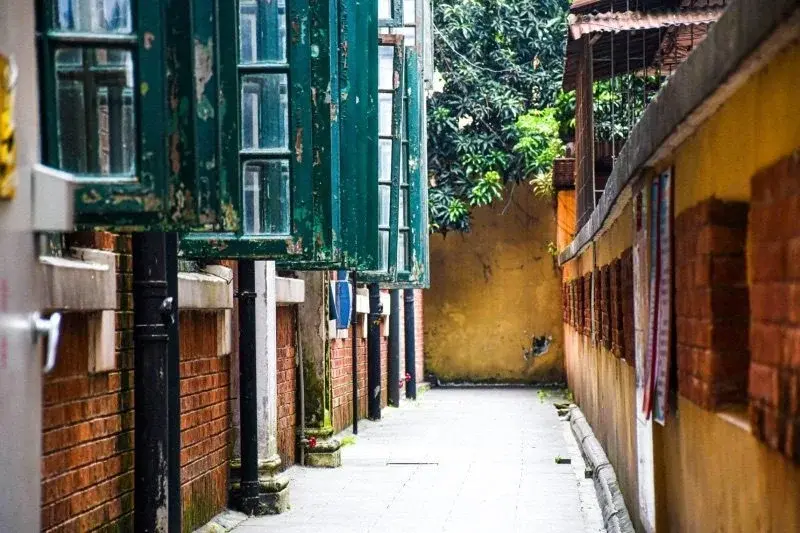
Shamian Island's colonnaded, European-facaded streets — postcard Guangzhou for most visitors, myself included — belong to a later chapter. They were built after the Second Opium War, once Britain and France leased the island as a foreign concession in the 1860s. That's roughly a century after the Thirteen Factories were established a short distance upriver. The two eras collapse easily into one mental image — "old Guangzhou, foreigners, the river" — but a century and an entirely different treaty regime separate them. Almost nothing of the original Thirteen Factories waterfront survives; it was largely destroyed by fire and war in the 19th century.
Think of how Chongqing's residents run smack into their own reconstructed memory of the 1937–46 wartime capital. Or how Xi'an's subway builders keep hitting tombs older than the country itself. Guangzhou's defining historical fact isn't a building you can walk into. It's an absence: a monopoly that ended, and a rank the city never fully reclaimed.
04 — What the city built for itself, after
Qilou: a building shaped by rain, sun, and a street that has to keep working
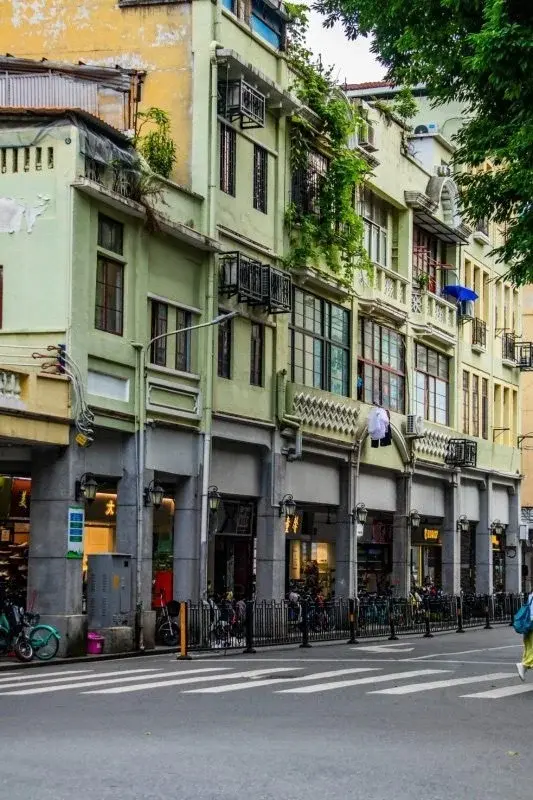
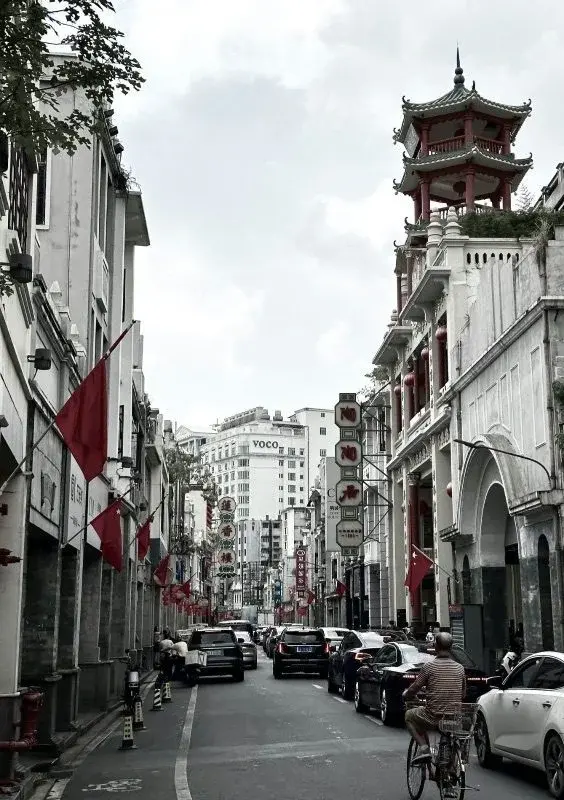
Walk the older commercial streets of Guangzhou today and the buildings tell a story that has nothing to do with treaties. The ground floor is set back several meters from the upper stories, forming a covered arcade held up by square columns — a colonnade you can walk the length of a block under without ever stepping into the sun or the rain. The floors above cantilever out over the sidewalk, so from street level a building's second story appears to hang in the air, supported by nothing you can see. This is qilou (骑楼) — literally "riding building." It's a form that spread across Lingnan's trading cities in the late 19th and early 20th centuries, purpose-built for a subtropical climate with punishing sun and a monsoon season that can drop rain for weeks.
It solved a specific, practical problem: a street-level shop needs foot traffic, and foot traffic needs shelter from weather that isn't optional here. The arcade gave shopkeepers a dry, shaded storefront and gave the street itself a covered walkway that functioned rain or shine — commerce and climate, solved with the same piece of architecture.
The through-line from the Thirteen Factories to qilou isn't architectural continuity — it's temperament. Both are a trading city's answer to a practical constraint: how do you keep commerce moving under conditions (an imperial gate, a monsoon) that you don't control? Guangzhou's history, more than its neighbors', reads like a long habit of building workarounds for whatever the sky or the emperor imposed that week.
05 — The gate never fully closed, it just moved
Who actually lives here, if you're arriving from North America
§03 and §04 are both, at bottom, about a city that has spent centuries managing a foreign presence by channeling it through one narrow, controllable place. First an imperial gate, then a covered arcade. There's a real, modern echo of that instinct, and it's worth calling out on its own terms. Guangzhou now hosts 69 foreign consulates — second-most of any city in the country. Roughly 80% of them sit inside a single district, Tianhe, concentrated overwhelmingly in one sub-area of it.
| Area | Why here | Who you'll find |
|---|---|---|
| Zhujiang New Town Tianhe District | The single densest consulate cluster in the city, anchored by the U.S. Consulate General's purpose-built 2013 complex — the only U.S. consulate on the mainland that processes immigrant visas | Consular staff and households, corporate management |
| Tianhe CBD broader district | 25% of Guangzhou's headquarters enterprises, 97% of its foreign banks, and roughly 3,000 foreign residents in the district's core alone | Finance and corporate professionals, a genuinely international coffee-shop scene |
| Huanshi Road East Yuexiu District | An older consulate row (Japan, Cambodia, Laos, the Philippines, Sri Lanka) that predates Tianhe's rise and never fully emptied out | A smaller, longer-settled diplomatic presence |
None of this is imperial policy this time — nobody's forbidding a foreign resident from living anywhere else in Guangzhou. But the pattern rhymes: a monopoly gate at the Thirteen Factories, a covered arcade built to control foot traffic in qilou, and now a modern foreign-resident population that has, on its own, clustered into one small patch of one district anyway. Some habits outlast the policies that created them.
This section describes where Guangzhou's foreign, largely North American, professional and diplomatic population is known to cluster and roughly who they are — compiled from municipal and consular reporting, not a formal nationality-specific census. Treat the figures as directionally right rather than a precise headcount.
06 — A note on temperament
Down jackets and flip-flops, and what that says about who spends on what
A cost-of-living page reports what things cost. It rarely captures what people choose to spend that money on, and that varies by region in ways no ledger will show. One small, personal data point, from two ends of the country and two ends of a decade:
07 — Where the budget actually goes
Yue cuisine: one of the country's oldest culinary traditions, still eating at the head of the table
That's not a small claim to make about a place I barely know, so it's worth backing up with something more solid than a wardrobe observation: Cantonese food is one of China's traditional Four Great Cuisines, alongside Shandong, Sichuan, and Huaiyang cooking. It's also one of the eight most widely recognized regional traditions in the country. It's built from three distinct local styles — Guangzhou (Cantonese proper), Chaozhou, and Hakka — each with its own repertoire. But it's the Guangzhou style that most of the world actually eats: Cantonese restaurants are the default "Chinese food" in a large share of the cities outside China, more than any other regional cuisine.
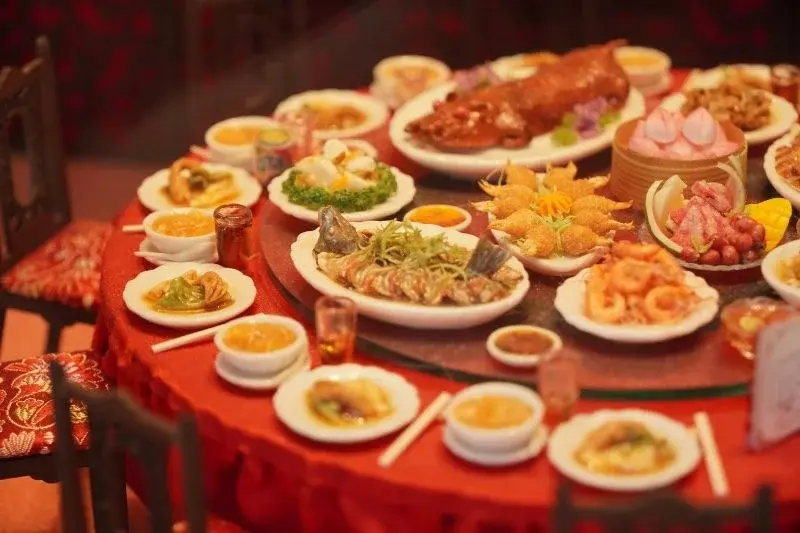
The signature dishes are less about heat or spice than about restraint and precision: white cut chicken , poached whole and served plain enough that the quality of the bird itself has nowhere to hide; roast goose and char siu, the glazed roasted meats hanging in restaurant windows across the city; and the roast suckling pig on the table above, reserved for banquets and celebrations rather than everyday eating. Alongside the cooked dishes sits an entire separate institution — yum cha, morning or midday tea taken with small steamer baskets of dim sum, unhurried and often stretched across hours rather than minutes. Guangzhou Restaurant, open since 1939, and Tao Tao Ju, one of the city's oldest teahouses, are still the reference points for much of this tradition.
08 — A twenty-year-old snapshot, not a current one
A shop assistant, a language, and a memory I can't update
Food is the easiest of a city's local markers to sample as an outsider — you sit down, you taste it, it's simply there. Language is trickier. You don't get to sample it on purpose; you only stumble into it. For anyone weighing whether Cantonese is a practical barrier to living here, this is worth including — with the dating problem stated up front, not buried in a footnote.
Twenty years is a long time in retail. Small independent shops — the kind most likely to default to a local language with a stranger — have been under sustained pressure from e-commerce and chain retail nationwide. And the newer service economy in a city this connected to the rest of the country skews heavily toward Mandarin as the default. I haven't properly walked a Guangzhou street since, so I won't pretend to know the current answer. Treat the above as a dated data point, not a current one.
09 — The honest brake
Three days, twenty years ago, and two layovers since
My actual time on the ground in Guangzhou is thin: three unplanned, unstructured days in December 2005, taken during a nine-day trip that also covered Shenzhen, Foshan, Zhaoqing, and Zhuhai. Then a brief airport transit years later. Then a work trip in 2022 that was cancelled before I ever left the subway platform. Everything in this piece about the Thirteen Factories, the Canton System, qilou architecture, the current transit system, and Cantonese cuisine's place in Chinese food culture is research. Cross-checked against public sources, not personal memory — I didn't know any of that history when I walked those streets, I've never ridden the metro network described above, and I didn't eat particularly well or memorably on that one trip either. The parts that are genuinely mine are narrow: a language encounter I can't verify still holds, a clothing contrast I noticed once, and a floating second story that looked strange to a first-time visitor from the north. Treat the history, the transit numbers, and the food section as the spine of this piece, and my own three days as the flesh on a much smaller, much more limited part of it.
09 — Questions people actually ask
Quick answers
How much does rent cost in Guangzhou?
A one-bedroom in the city center runs about ¥4,284/month (≈$595); outside the center it drops to about ¥1,958 (≈$272).
Is Guangzhou cheaper than China's other first-tier cities?
Yes — rent eats about 44% of the median wage here, the softest ratio of any first-tier Chinese city (Beijing, Shanghai, and Shenzhen all run harder).
How much does the Guangzhou metro cost?
A base fare of ¥2 for the first 4km — cheaper than the ¥3 base fare in both Shanghai and Beijing — before stepping up in wider bands as distance grows.
Was Guangzhou always this open to foreign trade?
For 85 years, Guangzhou held an effective monopoly as the only Chinese port open to foreign ships. That monopoly ended in a 19th-century treaty, and the city has been finding a new identity ever since.
What do utilities cost in Guangzhou?
About ¥261/month (≈$36) for electricity, water, and gas combined, on this site's standardized single-occupant estimate.
If you're thinking of going
Guangzhou, for someone earning here
- The ratio is the best of the first tier, not a bargain. 44% is far more breathable than Shanghai, Beijing, or Shenzhen — but it's still a first-tier city's cost of living, not a second-tier one's. Compare it to Xi'an's 29% before assuming "average for a first-tier city" means "cheap."
- Weather shapes the buildings, and it'll shape your budget too. Subtropical humidity and a real monsoon season mean cooling costs run most of the year, and older buildings — the same qilou-adjacent stock that gives the city its character — aren't always well insulated against either heat or damp. The monthly costs you won't find in the table →
- The three big Guangdong cities are not interchangeable. Guangzhou, Shenzhen, and Foshan sit close together geographically but differ sharply in language, cost, and civic character. Don't assume what's true of one holds for the others.
- This guide is thinner on lived detail than most on this site. Three days, twenty years old, is a real constraint — treat the historical and architectural sections as the load-bearing part of this piece, not the personal ones.
- Still deciding? Not sure this is the right fit? Try the city match tool → ; Answer 7 questions to find a better match →
The bottom line
Should you live in Guangzhou?
By the numbers, Guangzhou makes the easiest case of any first-tier Chinese city: a real metropolitan salary, a rent burden that leaves room to breathe, and a economic base (manufacturing, trade, logistics) that isn't purely speculative or purely government. What it doesn't have anymore, and hasn't had since 1842, is the singular status that made it briefly the most important trading city in the country. That's not a loss anyone living there today is likely to feel day to day. It's a loss you only see by looking backward — the way I only saw it by going and researching what I'd walked past without understanding, twenty years after the fact.
Still deciding?
Not sure if Guangzhou is the right fit?
Browse cities by what matters to you → or answer 7 questions to find your city →