Living cost, at a glance
≈$311/mo
≈$585–777/mo
≈$1,089/mo
Same figures as the ledger in §04 — rent, food, transit and utilities for one person. See that section for full sourcing.
In 1974, farmers digging a well east of Xi'an struck fired clay. What they had found, we now know, was the edge of an army: thousands of life-size terracotta soldiers, buried in formation for over two thousand years, guarding the tomb of China's first emperor. I stood at the edge of that pit in 2006, not yet thirty, and I want to be precise about what I felt — because it wasn't what the brochures promise.
It wasn't awe. It was the distinct sensation that I was not the one doing the visiting.
It didn't feel like I was visiting them. It felt like they were examining me.
Row after row of faces, each one individual, each one patient. I remember doing the arithmetic at the railing: fifty more years, give or take. It did not feel like a large number in that room. Hold that thought — we'll need it. Because Xi'an is a city best read in three depths: what's underground, what's at street level, and what it costs to live on top of it all. Most cost-of-living pages only do the last one. This city deserves all three.
If you earn dollars, about $585–777 a month covers a one-bedroom in the city center, food, transit and utilities for one person, in a metropolis of 13 million — among the cheapest 13% of cities in the world. If you earn a local salary, it's still affordable: city-center rent runs about 29% of average take-home pay — second only to Kunming's 28% among every city we've covered. That difference is the whole story. Read on.
01 — Depth one · Underground
Xi'an's underground: an empire you are guaranteed not to see.
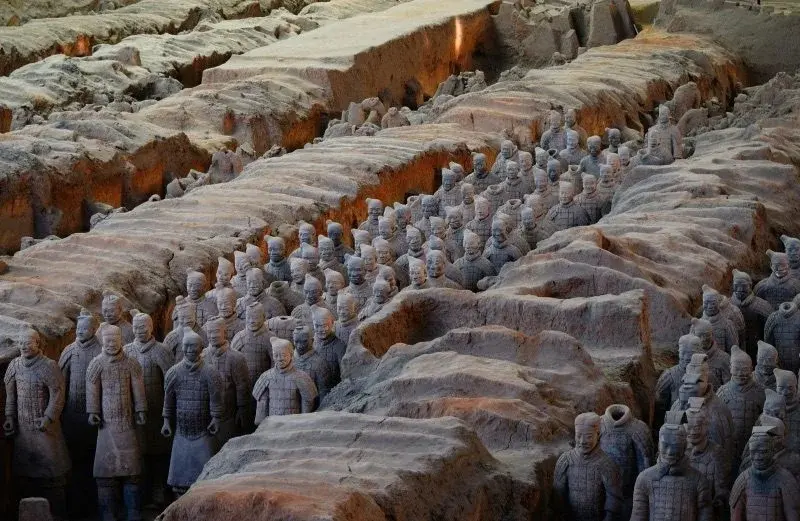
Two facts about the soldiers are repeated in every guidebook, and both happen to be true. First, no two faces are alike — a thousand soldiers, a thousand faces. Second, conservators have found the fingerprints of Qin dynasty craftsmen pressed into the clay. Some workman, twenty-two centuries ago, left the same smudge you leave on a phone screen.
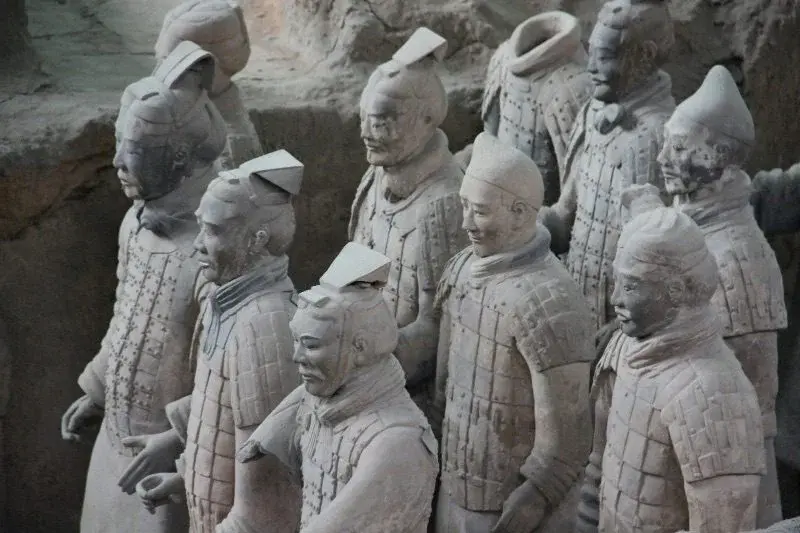
Here is the detail that reorganized my whole trip. The soldiers were originally painted — brightly, individually. Among the pigments is one now called Chinese purple: barium copper silicate, a fully synthetic compound that has to be fired at over a thousand degrees. Qin workshops were manufacturing it two millennia before modern chemistry described it. (It's also one of the two colors this page is set in. The other is the clay.)
And almost none of the paint survives excavation. How fast it goes is, interestingly, disputed — and I'd rather show you the dispute than flatten it. The dramatic version comes from the museum itself: Xia Yin, head of conservation at the Emperor Qin Shi Huang's Mausoleum Site Museum, has said that exposed paint begins changing within about 15 seconds of contact with air and can curl and flake off within four minutes. But there's pushback from the technical side. At least one detailed critique argues that lab tests show painted layers surviving 25, 65, even 100 days depending on humidity. The real mechanism, they say, isn't "pigment oxidizing on contact with air" at all. It's the aging and shrinking of the raw-lacquer base layer the pigment sits on. I'm not qualified to referee. What both sides agree on is the ending: with current methods, excavation kills the color. They only disagree about whether you'd watch it die in minutes or in months.
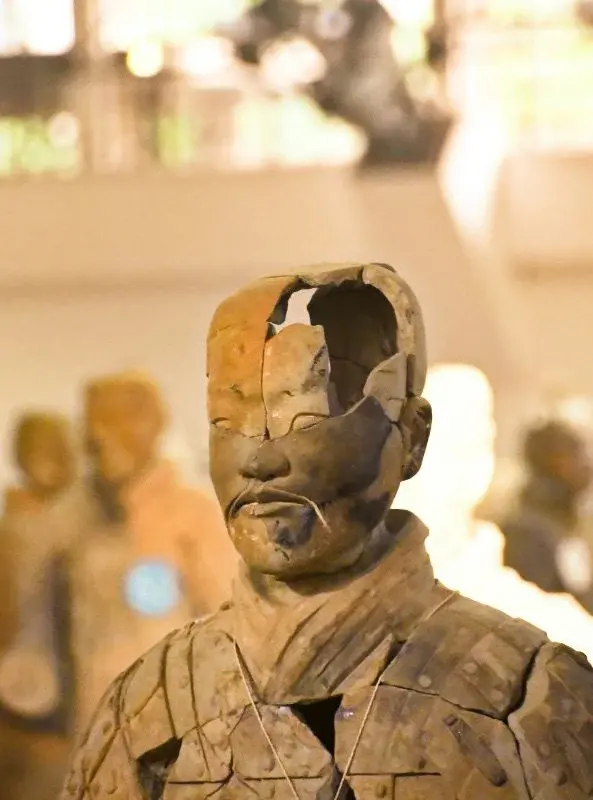
Which brings us to the tomb itself. The soldiers are the outskirts.
I did that arithmetic at the railing too. Standing a few kilometers from the most famous unopened tomb on Earth, I understood, calmly and completely, that I would never see the inside of it. Not "probably not." Never. It is a strange thing to be told by a hole in the ground: this is not for your lifetime.
Most travel is about seeing things. Xi'an is the rare place where the main event is the thing you are guaranteed not to see — and where that guarantee is, itself, the sight.
02 — Depth one and a half · What the metro keeps finding
Xi'an's metro keeps finding ancient tombs underground.
That guaranteed-shut tomb isn't the only thing under Xi'an. It's just the most famous. The city's transit authority has run pre-construction archaeological surveys on every metro project since the system began. Not as a courtesy — as policy. The ground genuinely won't allow anything else. Depot construction near Aerospace New City turned up 34 tombs spanning the Han through Qing dynasties in a single 2015 survey, producing 263 artifacts. A 2016 dig at Daminggong station found two more Han-era tombs. Early construction on Line 8 turned up Tang-dynasty pottery before the tunnel boring even reached full speed. This isn't folklore. It's the routine cost of building infrastructure on top of thirteen dynasties' worth of buried capital.
Around that same buried city, the metro itself has become one of the fastest-built systems in the country. As of end-2025: 12 lines, about 422 kilometers, and 246 stations. Over 1.5 billion rides that year — sixth-highest ridership of any Chinese system. Line 8, the ring line, is China's first fully driverless metro loop. Xi'an was also the first Chinese system to give every station its own emblem, tied to the historical or cultural theme of whatever sits above it.
We haven't been able to source a metro map for Xi'an that we're confident redistributing. For the current network layout, go straight to the operator: Xi'an Metro — official site →
Network size, station count, and 2025 ridership: Xi'an Metro Group / municipal transit reporting. Fare schedule per published Xi'an Metro fare rules. Tomb-excavation figures during metro construction: Xi'an Municipal Institute of Cultural Relics Protection and Archaeology, via Chinese press reporting (The Paper). Converted at ¥7.2 = $1.
Outside the rail, the national trio of shared-bike apps and ride-hailing cover the rest of the city the way they do everywhere else in urban China — the only local wrinkle is that any given bike lane might, on a given week, be rerouted around a fresh excavation. Those low fares hide the real cost of building and maintaining it all →
03 — Depth two · Street level
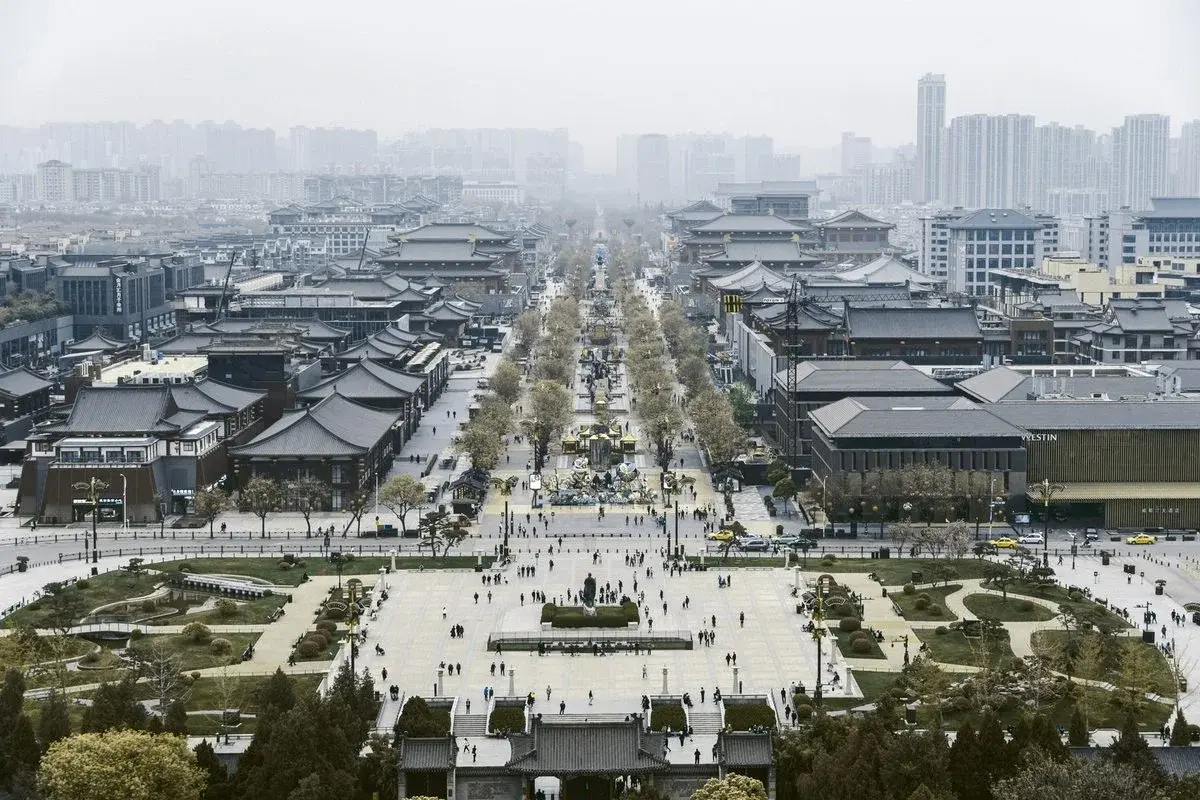
Xi'an's Ming wall: one wall between two millennia.
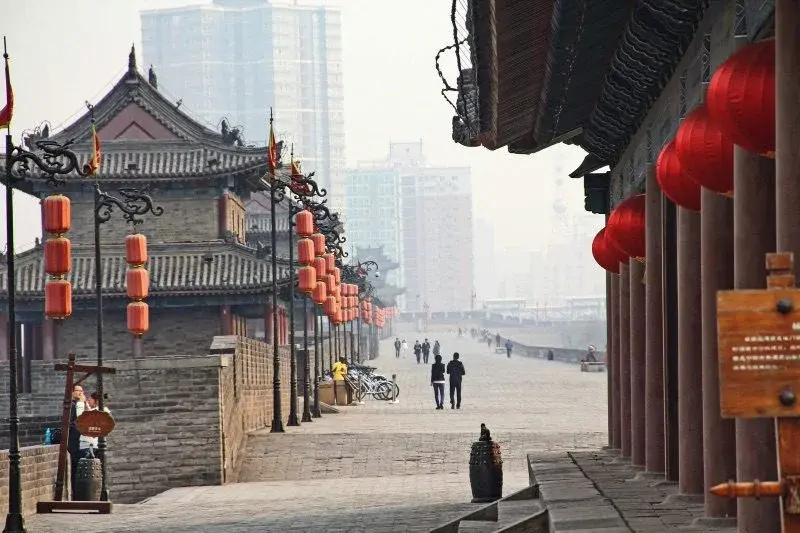
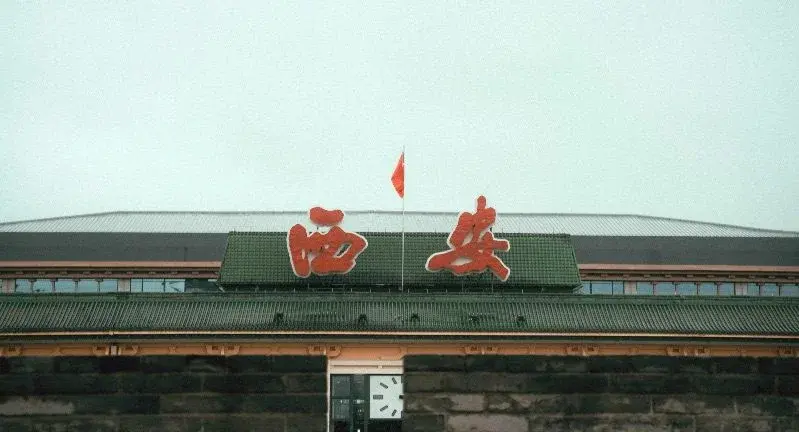
Back above ground, Xi'an is walled. Not "has ruins of a wall" — walled, fully, a rectangle of Ming dynasty masonry around the old city, wide enough on top to ride a bicycle.
So we rented bicycles, meaning to ride the full circuit. We didn't make it all the way around — a quarter of it was enough to learn the wall's one lesson: the ancient and the modern are exactly one wall apart. Inside, the old grid; outside, the towers going up. You pedal along the seam between them.
My wife's legs gave out a quarter of the way around, and that's the honest reason we turned back rather than finishing the full loop.
About that grid. The taxi drivers of Xi'an — every single one, unprompted — will tell you this was the capital of thirteen dynasties. I'm reporting the number the drivers use rather than certifying it. Historians slice the count differently, and the drivers mostly bring it up to settle scores with Luoyang and Nanjing, the other claimants to Great Ancient Capital status. But the underlying brag is solid. When this city was Chang'an, capital of the Tang, it was laid out as a vast checkerboard — and that checkerboard became the template for other capitals. Nara and Kyoto were both planned as copies of Chang'an. If you've ever admired Kyoto's tidy grid, you've admired Xi'an's export. The layout survives in the feel of the modern city: square, ordered, legible. You always know which way north is.
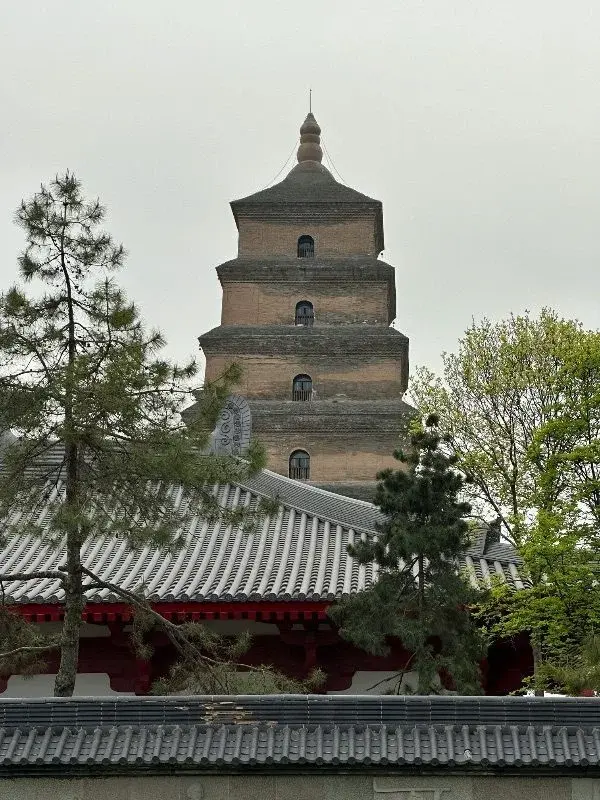
The food, honestly ranked
First place, and it isn't close: roujiamo, the Xi'an "burger" — chopped braised pork stuffed into a crisp flatbread.
The bread I had was slightly on the hard side; the meat juices soaking into it fixed everything. I would return to Xi'an for this alone.
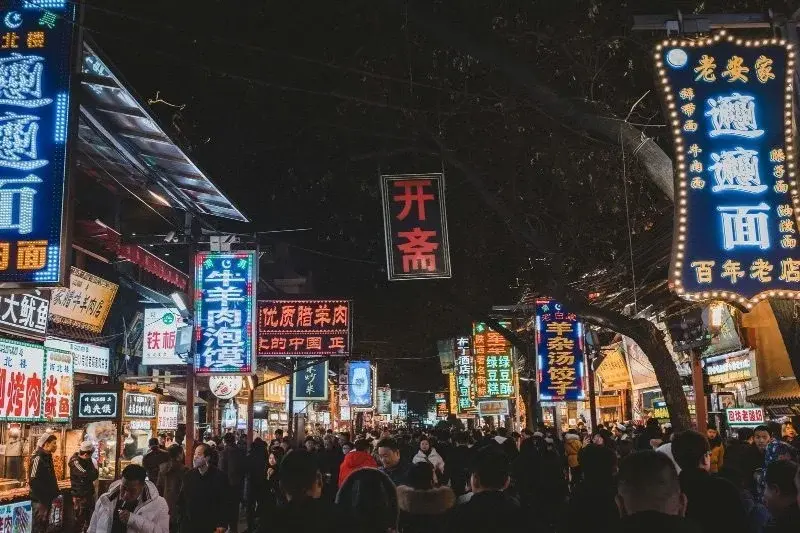
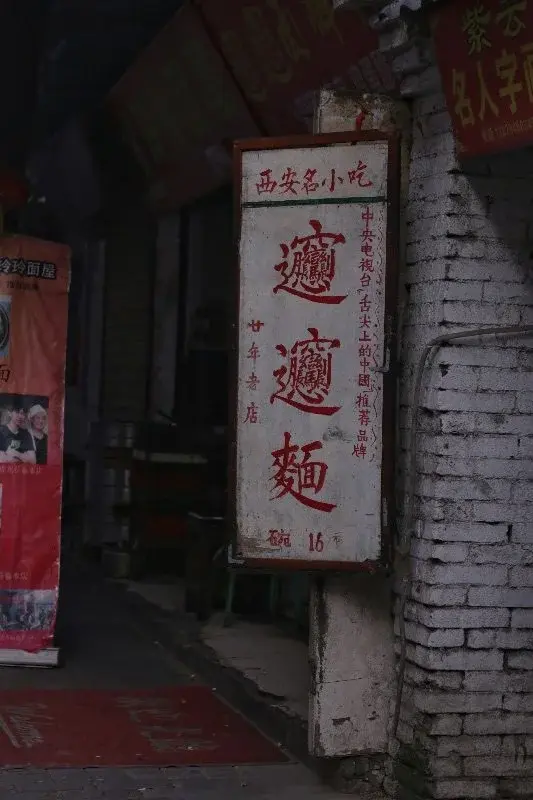
The Muslim Quarter at night is the city's second stomach — lamb everywhere, skewers, steam, crowds, noodle-makers pulling dough like stage performers. Go hungry. One noodle I never got to eat but should mention anyway, because it's become the dish outsiders know Xi'an by even more than roujiamo: biángbiáng noodles. Wide hand-slapped ribbons served under a name so obscure it needed its own invented character — commonly cited at 56 strokes in its traditional form, though accounts vary. There's no standard keyboard input for it, so restaurant signs either print it as an image or spell the sound out in pinyin. It's arguably done more for the city's food reputation on the internet than any dish I actually tried.
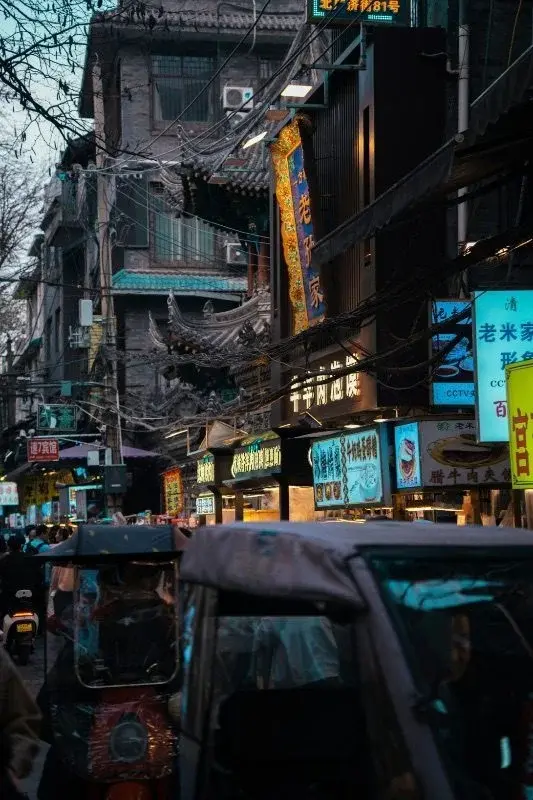
And then yangrou paomo, the famous mutton soup with hand-torn bread — the ritual is that you tear the dense little loaf into small pieces yourself before they ladle the soup over.
I'd been told this dish was the city's soul, and I have to report it was not as good as I'd imagined. The soup itself: excellent, deep, honest. But the bread, once soaked, goes soft and loses all its chew, and the chew was the part I wanted. I'm from China's Northeast, where tearing a flatbread is done with a certain swagger. I had none of it — I picked at that disc of bread with the tentative care of someone doing a thing for the very first time, which I was.
Two eras on one hot spring
Huaqing Pool, at the foot of Mount Li outside the city, stacks two eras on the same water. The Tang layer — the pools where Emperor Xuanzong bathed with his famous consort Yang Guifei, the romance every guide recites — felt to me like listening to a story. Pleasant, remote, a legend with landscaping. The 1936 layer felt real: this is where the Xi'an Incident happened, where Chiang Kai-shek was seized by his own generals in an event that changed the course of China's war and its century. I visited almost exactly seventy years after. The Tang is a poem there; 1936 is still a room.
04 — Depth three · The ledger
Xi'an cost of living: what one person actually spends.
Xi'an: $311/mo rent (29% of wage), $585–777/mo all-in. One of the healthiest rent-to-income ratios in this series — second only to Kunming's 28% — in a city of 13 million that actually pays its own rent. Now the part this site exists for. Here's what a single person typically spends in Xi'an, drawn from Wise's 2026 cost-of-living data. Dollar figures are the source data; yuan amounts are converted at roughly ¥7.2 to $1.
Source: Wise cost-of-living data (2026). RMB approximated from USD at ¥7.2 = $1. Meal figure is Numbeo's "Meal, Inexpensive Restaurant" for Xi'an, read early August 2026 — the same benchmark used across every city on this site. Numbeo's own bus-fare reading (¥2) runs a little below Wise's ¥3 shown above; both are shown as-sourced rather than averaged together.
The bills, itemized
The total-cost line above is good for planning, less good for understanding what you're actually paying. It buries three separate government-set price schedules underneath. Here's what's actually inside a Xi'an utility bill.
Electricity
Water
Gas — non-self-heating households
Gas — self-heating householdswall-mounted gas boiler for winter heat
Electricity: Shaanxi provincial tiered residential rate, in effect since July 2012. Water: Xi'an municipal terminal water price notice. Gas: Xi'an Municipal Development and Reform Commission notice, effective July 25, 2023.
Standardized comparison figure, applied the same way across every city on this site: 220 kWh electricity + 15 m³ water + 25 m³ gas per month, a single-occupant baseline that excludes winter heating, run against the non-self-heating tiers above. At Xi'an's rates that's ¥112 electricity + ¥58 water + ¥54 gas ≈ ¥224 (≈$31)/month. This is a separate calculation from the "¥4,200–5,600 total monthly cost" figure earlier on this page, which is a single Wise-sourced bundle that doesn't break out utilities on its own. What the ledger never shows: recurring costs that slip past the spreadsheet →
What's actually on the table
I didn't live in Xi'an long enough to shop for its groceries myself — five days as a tourist means restaurant food, not a home kitchen. So this part is researched, not lived, and I'm flagging that distinction the way this site always does. We also couldn't track down a Xi'an-specific weekly retail monitor the way some other cities in this series have one. What follows is the provincial-level Shaanxi price data that any city monitor would sit inside. We're labeling it explicitly as provincial rather than dressing it up as city-specific.
Put the bills and the groceries next to the rent line above, and the total-cost range stops looking like a black box. It's rent plus roughly this. Your daily choices shape the bill more than the city itself does →
Rent ÷ average take-home pay ≈ 29% — second only to Kunming's 28% in this series. City-center rent at $311 against a $1,089 after-tax salary. Not the cheapness of a place hollowing out, where prices are low because paychecks are lower — a local wage and a local rent that simply aren't at war with each other.
In Dalian, Chengdu, and Harbin, this series met three kinds of cheap. Xi'an is a fourth kind, and it's the best one. Xi'an is the "healthy" kind of cheap — read the full framework →
Xi'an is cheap, and it can afford to be.
Why? Part of the answer is policy with a two-decade runway. Since 2000, China's "Develop the West" program has pushed investment inland. As coastal wages rose, supply chains migrated to Chengdu, Wuhan — and Xi'an. Samsung built one of its major semiconductor fabs here. It's a city of 13 million — China's eighth largest — that makes real things for real wages. Housing here hasn't been bid into the stratosphere the way it has on the coast.
The multinational I worked for was making exactly this kind of go-inland decision around the time I visited. It chose Chongqing, not Xi'an. I mention it because that's what that era looked like from inside a company: a map of the Chinese interior on a conference table, and cities like Xi'an competing for the pin.
05 — Who's actually here, if you're arriving from North America
Xi'an's foreign community: Samsung, Huawei, and the International Community.
Samsung didn't just build a fab, as mentioned above. The $7 billion first-phase investment landed in the High-Tech Zone in 2012–2013, next to a district that already held ZTE, Huawei (whose Xi'an R&D staff alone had already passed 10,000), Intel's local R&D center, Microsoft's innovation center, and Ericsson. In 2013, the city built a dedicated residential answer to all of it: the Xi'an International Community. It sits right beside the Samsung site, purpose-built for a more international standard of housing and services as the zone's foreign presence grew.
One local account of living there put it plainly: this pocket of the High-Tech Zone is, Terracotta Army tour groups aside, the one part of the city where a foreign face draws no particular notice anymore. Xi'an's foreign-investment geography splits into a few distinct pockets beyond it. There's the Economic & Technological Development Zone (autos and heavy industry, Bosch and ABB among others). There's Qujiang New District (tourism and modern services, international hotel brands). And there's Chanba Ecological Zone (finance and tech). But the High-Tech Zone, anchored by Samsung and the community built beside it, is the one with an actual purpose-built residential answer to the question of where a foreign employee lives, not just where they work.
This section describes where Xi'an's foreign professional population is known to concentrate — compiled from local reporting and municipal development-zone materials, not a formal nationality-specific census. Treat the figures as directionally right rather than a precise headcount.
06 — A footnote I never checked
Xi'an's hidden history: a footnote about the well.
One more story, flagged clearly: this is something a classmate told me, and I have never verified it.
My university dorm had eight beds and, by some administrative poetry, eight provinces. One roommate was from Xianyang — Xi'an's neighbor, the actual seat of the Qin capital. He told us that back home, you could drill a well 300 meters down and not hit water. Another roommate, from Yingtan in the wet south, said that where he was from, the water was basically at the surface. The Shaanxi classmate had not eaten fish until he was nineteen.
I never checked any of it. I also never forgot it. Because whether or not the specific numbers hold, the two of them had sketched, across a dorm room, the hydrological history of China: the dry, deep-welled loess plateau that raised the first empires, and the water-logged south and coast where the wealth eventually went. The classmate from the driest hometown came from the oldest capital region. That is not a coincidence — it's just not a coincidence that runs in the direction you'd expect.
I'm from the Northeast myself, which gives me my own angle on Xi'an's age. Before the Qing dynasty, my home region sat outside the Chinese heartland entirely — frontier, other. Xi'an's neighborhood had been hosting capitals since the Shang and Zhou, three thousand years back. Walking that wall, I was a visitor in more ways than one: when Xi'an was already ancient, my part of the map hadn't yet joined the story.
07 — The ending
Xi'an's affordability: the ending.
In the little curio shops up on the city wall, they sell pixiu — a small bronze or jade beast, winged, snarling, sold as a wealth charm. The legend, which every shopkeeper will happily tell you, is that the pixiu has no anus. It eats and eats and never excretes. Money comes in; nothing goes out. You're meant to keep one facing the door.
It's a good souvenir, and an even better metaphor — though not the one the shopkeepers intend.
For roughly a thousand years, this city was the pixiu. Chang'an sat at the eastern terminus of the Silk Road: silk, paper and porcelain flowed out across the deserts, and the world's silver flowed in and pooled here, in what was for stretches of that millennium among the largest and richest cities on Earth. Money in. Money in. Money in.
Then the world changed its mind about geography. The caravan gave way to the ship, the center of gravity slid to the coast, and the wealth that had pooled at the end of the land road went to pool at the ports instead. Xi'an kept its wall, its grid, its dynasties' worth of tombs — and lost the river of silver. The greatest terminus in the world became an inland city that history had already visited.
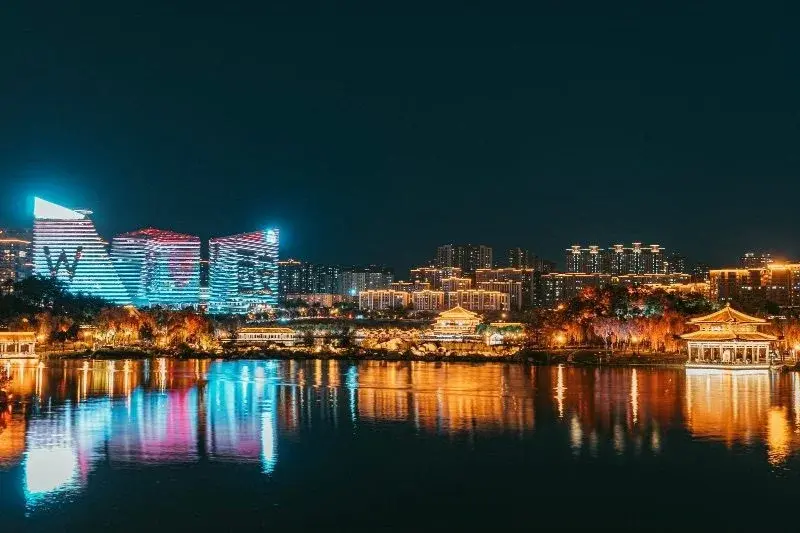
And now here it is, in that fourth or fifth act: 13 million people, semiconductor fabs, 44-cent buses, rent at 29% of a paycheck — a former center of the world that has settled into being something arguably harder to pull off: an affordable place to live in it.
Meanwhile, up on the Ming wall, between the lanterns, the shops are still selling the little beast that only swallows. A thousand years after the silver stopped coming, Xi'an still keeps the charm by the door. I can't decide whether that's stubbornness or patience. Then again — this is a city sitting on a tomb it's willing to leave shut for another century. Patience. Definitely patience.
08 — Questions people actually ask
Quick answers
How much does rent cost in Xi'an?
A one-bedroom in the city center runs about ¥2,240/month (≈$311) — the anchor figure for the whole page's cost breakdown.
Is Xi'an the most affordable city in this series?
By rent-to-income ratio, it's close, but no longer the outright lowest. Rent divided by average take-home pay comes to about 29%, second only to Kunming's 28%. Average take-home pay is around ¥7,840/month (≈$1,089).
What does a full month of living cost in Xi'an?
Total monthly cost for one person — rent, food, transit, and utilities combined — runs about ¥4,200–5,600 (≈$585–777).
Why does Xi'an's subway construction move so slowly in places?
The city sits on top of a 2,200-year-old unexcavated imperial site. Archaeologists are routinely brought in during tunneling because the metro keeps running into finds underground.
How much does a bus ticket cost in Xi'an?
About ¥3 (≈$0.44) for a single ride.
If you're thinking of going
Xi'an, for a first visit or a long stay
- Best season: spring and autumn. Summers run hot on the plateau; winters are cold and dry. The Terracotta Army is indoors and works year-round.
- Getting online: sort a China travel eSIM before you fly — data works the moment you land, no local SIM needed.
- Getting there: Xi'an Xianyang International Airport, plus high-speed rail from Beijing, Chengdu and beyond — the city is one of inland China's main rail hubs.
- Staying a while: a city-center one-bedroom runs about ¥2,200/month (≈$311). Short-stay options are easy to book online.
- Not sure Xi'an is the right fit? Browse cities by what you actually care about — opportunity, climate, food, history → Or take the seven-question quiz and get a personalized shortlist →