Living cost, at a glance
≈$720/mo
≈$389/mo
≈$556/mo
≈$1,276/mo
≈$944/mo
Same figures as the ledger in §02 — the outside-center all-in row is this widget's own addition, computed the same way (outside-center rent + the same "everything else" figure), not independently sourced. See §02 for full sourcing.
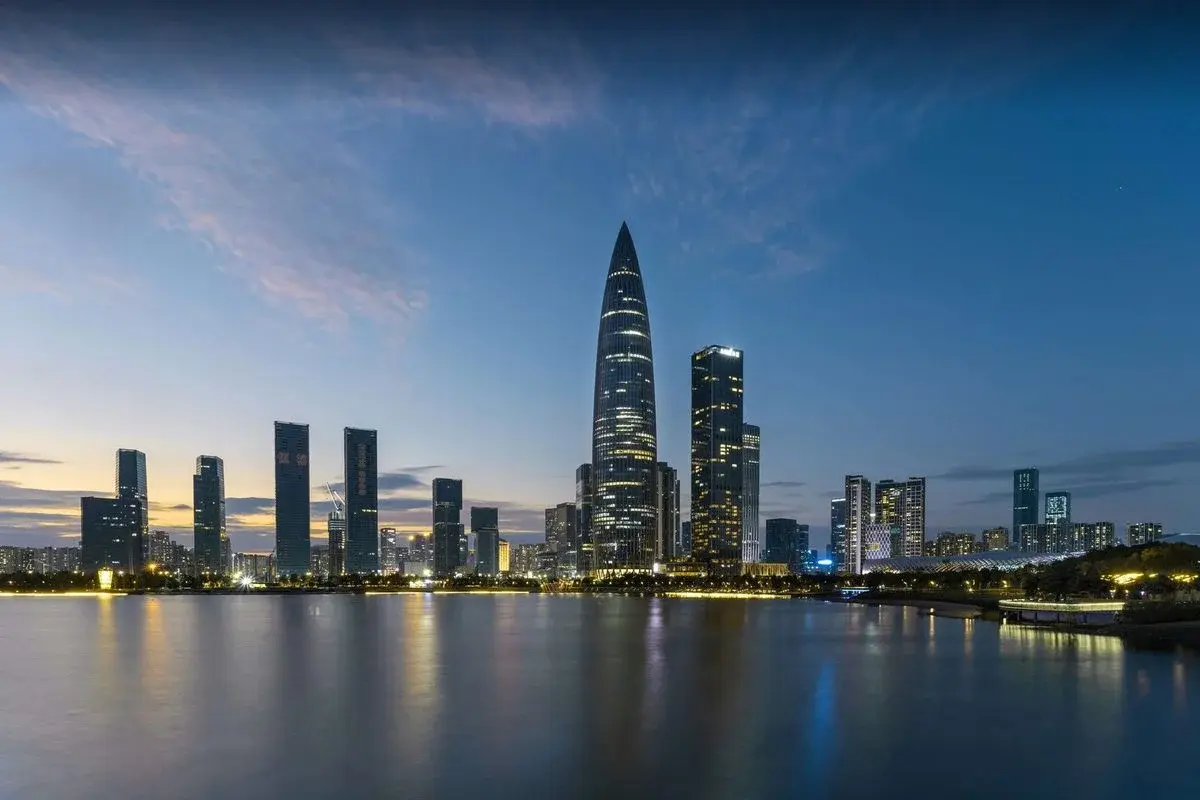
Shenzhen is the youngest big city in China, and it sits in Guangdong sounding nothing like it. Forty years ago it was fishing villages and paddy fields; today it's the country's third-largest economy — average age 32.5, almost no elderly, almost no natives, speaking Mandarin where the rest of the province speaks Cantonese. It's a place with almost no local tongue because it has almost no locals: everyone came from somewhere else. That's what makes it the most open city in China, and it's also why its cost of living acts different from anywhere else in this series. Shenzhen is not, in any sense, cheap.
This is not a travel piece. What follows is the math of living in a city built too fast — today's numbers, honestly sourced. I visited exactly once, for three days in December 2005, as a guest of classmates who paid for everything; the detail that stayed with me was crossing the line from Guangzhou and hearing the Cantonese greetings stop at the border, the whole city switched to Mandarin. I kept no receipts. So every price here is researched, not remembered — fitting for a place whose whole story is a number racing away from the people who earn it.
Twenty-five years in finance taught me the rule this whole site runs on: a number means nothing until you know whose income it sits next to. Let's start with why a city this new isn't cheap at all.
01 — Why is it this expensive?
Built too fast, and the land bill came due before wages could catch up
Designated China's first Special Economic Zone in 1980, Shenzhen didn't evolve into a metropolis — it was assembled into one, deliberately, at a speed no old city could match, on a patch of farmland the state chose to bet on. It now posts a GDP of about ¥3.68 trillion, third among all Chinese cities, with the country's highest industrial output; strategic emerging industries — the statistics bureau's phrase for the future — make up roughly 42% of the economy. This didn't grow. It was built, the way you'd build a machine.
You can stand inside the engine. In Nanshan district there's a subdistrict called Yuehai — about 20 square kilometers, roughly 320,000 people, a place you can drive across in ten minutes. As of a 2019 tally it held 112 listed companies with a combined market capitalization around ¥4.85 trillion; its firms' revenue at one point roughly matched the entire GDP of Singapore. Tencent grew up here. So did DJI, ZTE, Mindray, and, for a formative decade, Huawei.
There's a line that goes around: walk down Beijing's Chang'an Avenue and you'll pass a government ministry without trying; walk down Yuehai and you'll pass a listed company without trying.
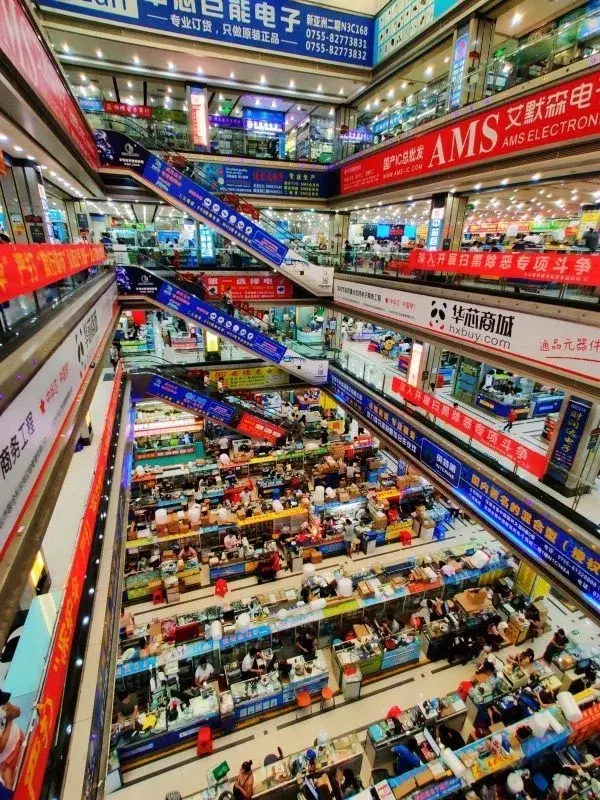
The same speed shows up in an older part of the city, too. Huaqiangbei, in Futian, was the electronics-trading district that built Shenzhen's reputation as the place you could source, assemble, or knock off almost anything — floor after floor of component stalls and phone-repair counters, a physical search engine for hardware. E-commerce has hollowed it out from the inside: the stalls are mostly still there, rent still gets paid on them, but the foot traffic that used to fill these floors has migrated onto phones. It's the same story as the 35-year-old engineer, only told about a building instead of a person — a piece of infrastructure the city threw up fast, and that the city's own progress is now quietly making optional.
Hold onto that. A city that manufactures its own future this quickly also manufactures its own land bill — and the bill comes due faster than the wages can grow. Housing in Shenzhen has for years ranked among the least affordable on earth by price-to-income: the salaries are high, the homes are higher, and the gap between them is the real subject of this piece.
A city that builds its future this fast also builds its own land bill. And the bill comes due before wages can catch up.
02 — Cheap compared to whom?
Say “Shenzhen salary” and you picture the top of the curve. The median refuses to be flattered.
Here's the trap. Say “Shenzhen tech worker” and a number pops into your head: a coder pulling ¥30,000 a month, stock options, a million-yuan year as standard issue. That number exists. It's just not the median.
The actual all-industry median wage in Shenzhen is about ¥8,000 a month before tax — roughly $1,111 — which means half the working city earns less than that. There are two Shenzhens sharing a skyline: one earns at the top of the tech ladder and rents, occasionally buys; the other is the median — the logistics worker, the shop clerk, the junior everything — and the math below doesn't add up for them.
Rents, single-person costs and the wage median: Numbeo, Wise and published Shenzhen wage-quantile data, mid-2026, converted at ¥7.2 = $1. The 2-bed figures are this site's own estimate — the midpoint between Numbeo's own 1-bed and 3-bed readings for Shenzhen, same source as the other rows above, not an independent reading in its own right.
This is the founding premise of the site, made literal. A number means nothing until you know whose income it sits next to — and in Shenzhen the same rent is a quarter of one person's pay and more than another person's whole paycheck. Shenzhen is one of the cities that breaks the "cheap" pattern entirely — see the full framework →
Where that ¥4,000 “everything else” goes
Electricity, water, and gas are all tiered. Shenzhen's electricity, like several southern cities in this series, is billed monthly, with a wider tier structure in summer (May–Oct) than the rest of the year — the rates themselves don't change between seasons, only the tier volumes do.
| Tier | Monthly usage | Rate |
|---|---|---|
| 1 | 0–200 kWhMay–Oct: 0–260 kWh | ≈¥0.663/kWh |
| 2 | 201–400 kWhMay–Oct: 261–600 kWh | ≈¥0.713/kWh |
| 3 | 400+ kWhMay–Oct: 600+ kWh | ≈¥0.963/kWh |
| — | Shared-meter (合表) | ≈¥0.700/kWh flat |
Households of 5+ can apply for an extra 100 kWh/month added to each tier's ceiling.
| Tier | Monthly usage | Rate |
|---|---|---|
| 1 | 0–22 m³ | ≈¥4.26/m³ |
| 2 | 23–30 m³ | ≈¥6.63/m³ |
| 3 | 31+ m³ | ≈¥12.94/m³ |
| — | Shared-meter (合表) | ≈¥5.34/m³ flat |
This is a genuinely three-part combined rate — water supply, sewage treatment, and garbage collection — each billed as its own component but summed into one figure here, unlike most cities on this site where the components aren't publicly broken out. Households of 4+ get an extra 5m³/month per additional person, at each tier.
| Tier | Monthly usage | Rate |
|---|---|---|
| 1 | 0–30 m³Nov–Apr: 0–40 m³ | ¥3.41/m³ |
| 2 | 31–35 m³Nov–Apr: 41–45 m³ | ¥3.91/m³ |
| 3 | 35+ m³Nov–Apr: 45+ m³ | ¥5.16/m³ |
Billed monthly, not carried over between months — a big month doesn't get averaged against a small one. Households of 4+ get an extra 6m³/month per additional person, at each tier. Low-income households registered with the city get a flat ¥20/month discount.
Electricity and water: Shenzhen municipal published residential schedules, current 2025–2026. Gas: Shenzhen Development and Reform Commission notice effective March 16, 2024, still current, including the seasonal tier-volume schedule. Converted at ¥7.2 = $1.
Standardized comparison figure, applied the same way across every city on this site: 220 kWh electricity + 15 m³ water + 25 m³ gas per month, a single-occupant baseline that excludes winter heating, run against the tiers above. At Shenzhen's rates that's ¥147 electricity + ¥64 water + ¥85 gas ≈ ¥296 (≈$41)/month — the highest utilities figure of the 15 cities on this site, and roughly 7% of the ¥4,000 "everything else" figure in the ledger above (which also covers food and transport, and isn't broken out further than that in the Numbeo/Wise source it's drawn from). The costs that never show up in the spreadsheet — seasonal tiers, climate-driven spending, visa renewals →
For the same cross-site comparison point used on every city page here: Numbeo puts an inexpensive restaurant meal in Shenzhen at ¥25 (≈$3.47) and a one-way transit ticket at ¥3 (≈$0.42), read early August 2026 — close to the "¥25 buys a solid meal" figure already mentioned above.
What the everyday basics cost, at the market
| Item | RMB | USD |
|---|---|---|
| PorkRetail average | ≈¥18.43/500g | ≈$2.56 |
| EggsRetail average | ≈¥5.72/500g | ≈$0.79 |
| VegetablesRetail average | ≈¥4.87/500g | ≈$0.68 |
| Beef | Not shown — see note | |
Pork, eggs, and vegetables: Shenzhen Municipal Development and Reform Commission's own monthly food-price report, May 2026 — genuinely city-specific, all three items the same month, already reported per 500g. We couldn't find a comparably sourced Shenzhen-specific retail beef figure, and didn't find one for imported salmon either — the salmon data we could find was national wholesale pricing, not Shenzhen retail, so we're leaving both out rather than substitute a number that isn't really answering the question. Converted at ¥7.2 = $1.
Groceries are the one line item in this city that behaves like anywhere else in China. Rent is the one that doesn't — and it's rent, not food, that decides who actually gets to stay. Your daily choices shape the bill more than the city itself →
03 — What does the speed cost?
A normal front door, your thirties, and a deal that's only good at the entrance
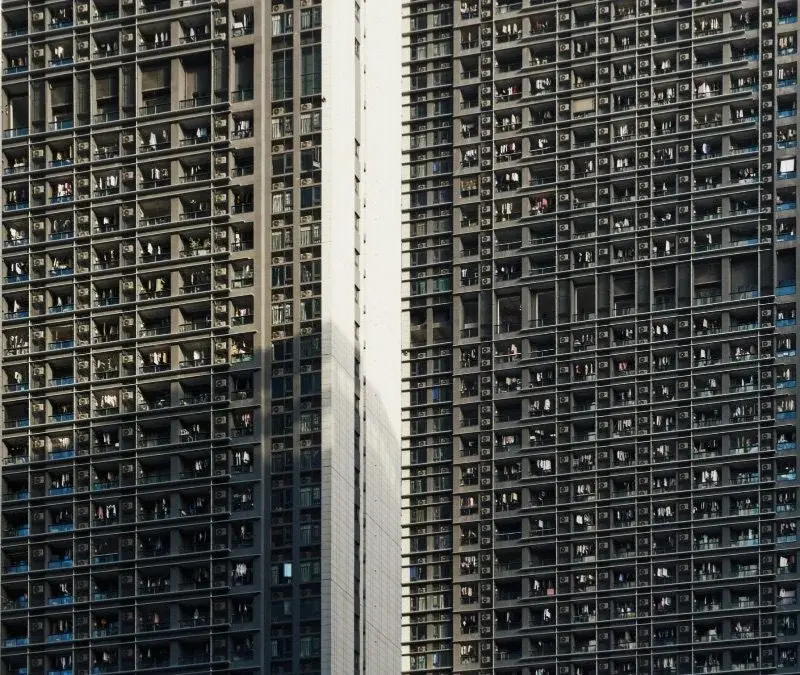
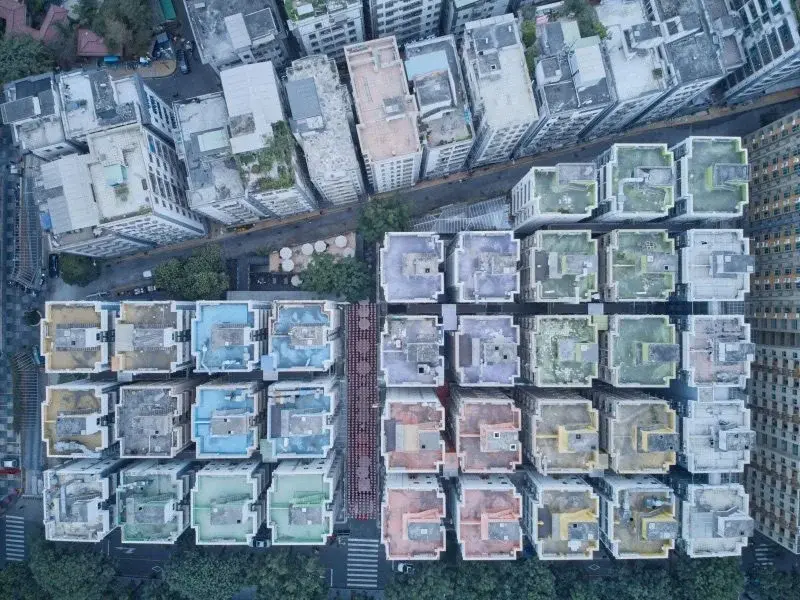
First, it costs you a normal front door. The pressure valve that keeps Shenzhen livable for anyone who isn't at the top of the curve is the chengzhongcun — the “village in the city.” These are the old village settlements the metropolis grew around and never absorbed: dense blocks of self-built towers so close their balconies almost touch — people call them “handshake buildings” — threaded by alleys the sun hits for about an hour a day. A room here runs ¥500 to ¥2,000 a month. In Nanshan, the same district that holds the engine, you can find seaside apartments over ¥200,000 per square meter and, up against the hills at Makan, rooms at around ¥500. Both are true. Both are within a subway ride of the same office towers. The real first-week bill includes deposits, fees, and setup costs most lists leave out →
The urban village is not a failure of the city. It is the quiet subsidy that lets the city keep running on people it doesn't pay enough to house properly.
Second, it costs you your thirties. Shenzhen's average age is 32.5; nearly 80% of residents are between 15 and 59. There are almost no old people here and almost no natives — the ID says everyone came from somewhere else. That youth is the fuel, and it's also the tell. A city this young is a city people leave: you arrive at 23 with a high salary and a low base, you burn hot for a decade, and then somewhere around 35 — the age China's tech industry has quietly turned into a cliff — you either cash out into a home you probably can't afford, or you leave for a cheaper city and let the next 23-year-old take the desk. The homes stay. The people rotate. It's the exact inverse of Jingdezhen, which keeps its costs low on purpose to make young people stay. Shenzhen's high wages pull them in and its high prices push them out, both on schedule.
Third — and here the outsider's read gets it backwards — Shenzhen's deal is genuinely good, at the entrance. When I visited in 2005 my classmates worked at Foxconn, then the anchor of the whole Longhua district: more than 200,000 people, an entire town leaning on one company. The phone counters in the local malls gave Foxconn staff a special discount — and it read as a badge, not a burden. In 2005 a Foxconn job was a job people wanted, and the discount was a small mark of belonging to the company that was building the future.
Hold onto that, because it's the pattern of the whole city. What Shenzhen offers a young arrival is a real bargain: a job, a bed, a discount, a place inside the boom. The catch is that none of the cost shows up at the door. It shows up at the exit — the rent you can never turn into a mortgage, the birthday when you turn thirty-five. The city is generous to the person walking in, and expensive to the person who wants to stay.
Shenzhen's deal is good at the entrance. The cost shows up at the exit.
The down-payment race
Take a coder near the top of the curve — say ¥15,000/month take-home, saving hard — and stack their savings up against the down payment on a modest Shenzhen apartment, in one of the world's least-affordable markets by price-to-income. The savings climb. The down payment climbs faster, and it started higher. The gap is the point. This is the chart nobody puts in the recruiting deck.
04 — And if you moved here?
What your Tuesday would actually look like
You'd wake in a room, not an apartment — most likely in an urban village, or a flat split three ways with people you found online. You'd take the metro, which is genuinely superb: 16-plus lines, 555 kilometers, some of the newest track in the world, a flat couple of yuan to start and about ¥140 for a monthly pass. You'd ride it every day and, like me, probably never once think about the fare — cheap enough to forget, which is its own kind of luxury. Those low fares rest on decades of capital investment and permanent subsidy — the real cost is upstream →
Outside the rail, the same national trio of shared-bike apps — Meituan, Hello, Didi's Qingju — covers the sidewalks, ride-hailing through Didi is as routine as hailing a cab used to be, and buses still carry more of the daily commute than the metro map alone would suggest, especially into the urban villages the newer lines haven't reached. You'd work long; “996” was coined for cities like this one. You'd eat well and cheaply — ¥25 buys a solid meal, and the food, pulled from every province because the workers are, is one of the real, un-priced-out pleasures of the place.
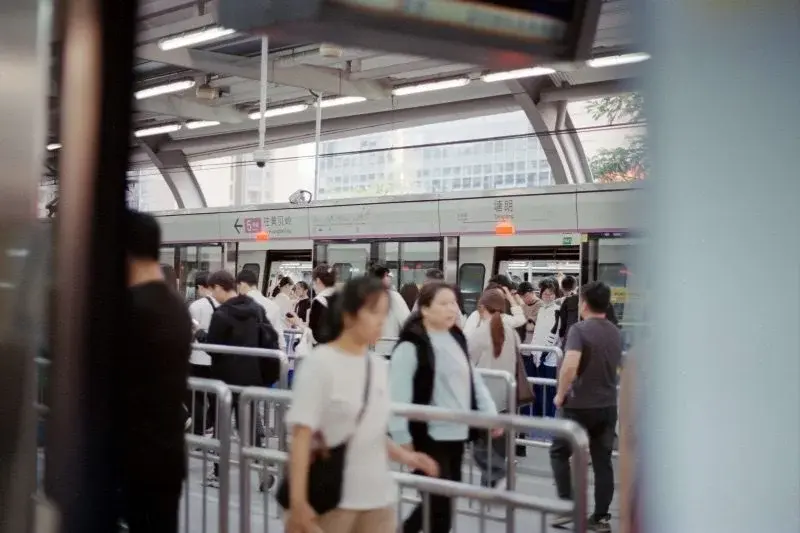
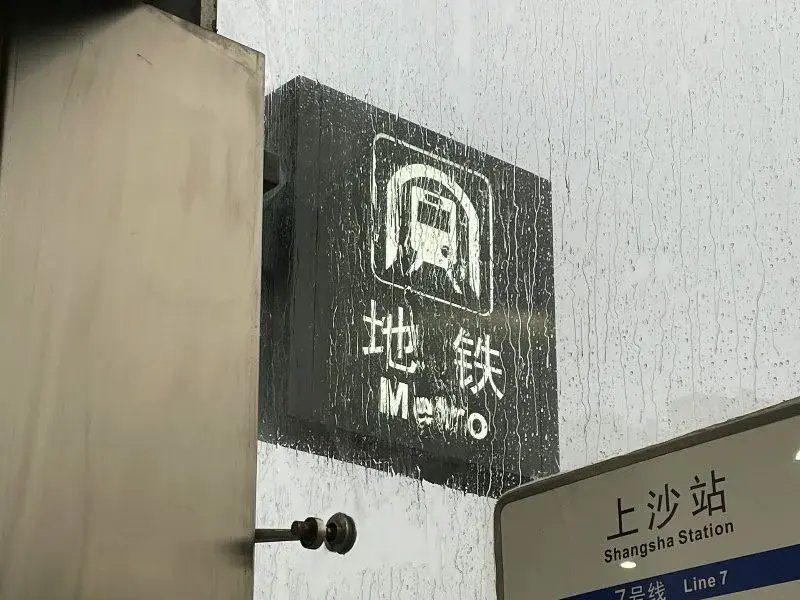
We haven't been able to source a metro map for Shenzhen that we're confident redistributing. For the current network layout, go straight to the operator: Shenzhen Metro — official map →
And you'd have almost no one nearby who knew you before you got here. That's the texture of a city with an average age of 32 and no grandparents in it: enormous freedom, enormous churn, and a clock running quietly toward the year you have to decide whether Shenzhen was a chapter or a home. You can make it here for a decade. Whether you can stay is the open question — and the city has arranged its prices so the question sharpens exactly when you're too old to keep answering it the easy way.
05 — A city with no cuisine of its own
What you eat here didn't get localized. It just got transplanted, intact.
That line a moment ago — food pulled from every province because the workers are — is worth more than a passing compliment. Shenzhen has never developed a signature cuisine the way Chengdu, Chaozhou, or Guangzhou has — a fact the city's own restaurant-industry association has said plainly: no deep culinary lineage, no dish the country associates with the name. That's not an accident of taste; it's a direct consequence of who the city is made of. A place where almost nobody is from here doesn't localize the food it imports, the way a settled city slowly bends outside cuisines toward its own palate over generations. It just imports it whole, because the people cooking it and the people eating it both grew up somewhere else and never stayed long enough to change it.
The practical result: a Hunanese restaurant in Shenzhen is typically run by people from Hunan, cooking for homesick people from Hunan, with no local majority around to ask for it milder. The same holds for the Sichuanese hotpot, the Northeastern dumpling houses, the Chaoshan beef-hotpot stalls that plenty of longtime residents rate as more faithful than what's served in some parts of Chaozhou itself. Unusually for a Chinese city this size, it's a place where "authentic" is closer to the default than the exception.
There's an older layer underneath all of this — Hakka cooking and a handful of local Guangfu-style dishes tied to the fishing villages the city grew from — but it's a minority tradition now, run by a small number of long-standing family shops well off the main strips, nearly invisible next to the imported majority.
On the absence of a native culinary lineage: Shenzhen Culinary Association, via 21st Century Business Herald, Dec 2024. On the local Hakka/Guangfu layer and its scale relative to transplanted cuisines: Chinese local reporting on Shenzhen's food scene.
06 — Who's actually here, if you're coming from North America
Shenzhen's transplant logic works on foreigners too — and one corner of it is older than almost everything else in this piece
§05 made the point with food: nobody localized what they imported because nobody stayed long enough to change it. The same logic runs on the international side of the city, with one twist — it isn't new. Shekou, a coastal district inside Nanshan (the same district holding the §01 tech engine, though a different corner of it), has been Shenzhen's foreign-family base since 1988 — older than most of the skyline, older than the Yuehai boom, nearly as old as the Special Economic Zone designation itself.
Shekou International School (SIS) opened that year as Shenzhen's first international school, founded by a joint venture of offshore oil companies that needed somewhere to educate their foreign staff's children — genuinely foreign-passport-only, run through International Schools Services out of Princeton, New Jersey. It now enrolls roughly 1,050 students from 43 countries, including the US and Canada, taught by about 230 faculty from 15 countries. A second school, QSI, has run three campuses in Shekou since 2001. Between them, they're most of the reason a North American family with school-age kids ends up in this specific corner of Nanshan rather than anywhere else in the city.
The rest follows the families: a cluster of international clinics and foreign-oriented healthcare providers, Western-style cafés and restaurants, and a noticeably older, more settled expat population than you'd find around the newer tech campuses — people who've been here fifteen or twenty years, not the hot-and-gone decade §03 describes for the median tech worker. It's a strange kind of continuity for a city whose entire identity is churn: Shenzhen's single oldest neighborhood, in foreign-community terms, predates almost everything that makes the rest of this page's story true.
This section describes where Shenzhen's foreign, largely North American, family and professional population is known to concentrate — compiled from school enrollment reporting and community history, not a formal nationality-specific census. Treat the figures as directionally right rather than a precise headcount.
07 — Questions people actually ask
Quick answers
How much does rent cost in Shenzhen?
A one-bedroom in the city center runs about ¥5,187/month (≈$720); outside the center it's roughly ¥2,800 (≈$389). A room in an urban village — Shenzhen's low-cost housing stock — can run as low as ¥500–2,000 (≈$70–280).
Why is Shenzhen so expensive compared to other Chinese cities?
It was built too fast — the land bill came due before local wages could catch up, unlike cities where cost and income rose together over a longer stretch.
Is the median income in Shenzhen as high as its “tech hub” reputation suggests?
No — the term “Shenzhen salary” tends to conjure the top of the income curve, but median take-home pay is closer to ¥6,500/month (≈$900) from an ¥8,000 pre-tax figure, well below what the city's reputation implies.
Does Shenzhen have its own local cuisine?
No — as one of China's youngest major cities, built from a fishing village in about forty years, Shenzhen never developed a cuisine of its own; what people eat there was transplanted intact from elsewhere, not localized.
What does a two-bedroom cost in Shenzhen?
A midpoint estimate puts it around ¥8,820/month (≈$1,225) in the city center, or ¥4,840 (≈$672) outside it.
If you're thinking of going
Shenzhen, for someone earning here
- The wage myth cuts both ways. The median is ¥8,000/month pre-tax; the tech-ladder numbers are real, but they're the top, not the middle. Know which one your offer is.
- Housing is the whole game. Renting a room in an urban village is normal, not shameful; renting a market one-bedroom on a median wage isn't realistic. Buying is a separate universe — budget for a decade, not a year.
- The metro is a genuine reason to live here — and it should shape where you rent more than a neighborhood's prestige does.
- Watch the 35 clock. It isn't a rule, but the industry treats it like one. Have an answer for your late thirties before your late thirties arrive.
- Not sure Shenzhen is the right fit? Browse cities by what you care about → or answer seven questions for a personalized recommendation →
The bottom line
Should you move to Shenzhen?
If you're young and want to see how fast a decade can move — yes. Shenzhen never sold cheapness; that was never the pitch. It sold speed, and speed is the one thing that always gets paid for by whoever's holding it when the bill arrives: the renter whose room never becomes an apartment, the coder whose savings never caught the down payment, the 34-year-old deciding whether to cash out or move on. Affordability, as this series keeps finding, is a phase, not a property — and Shenzhen's twist is that it never pretended otherwise. It offers a fast, brilliant, exhausting decade and prices the exit so most people take it. So go in knowing which of the two Shenzhens your salary puts you in — and what the city will charge you the year you turn thirty-five.