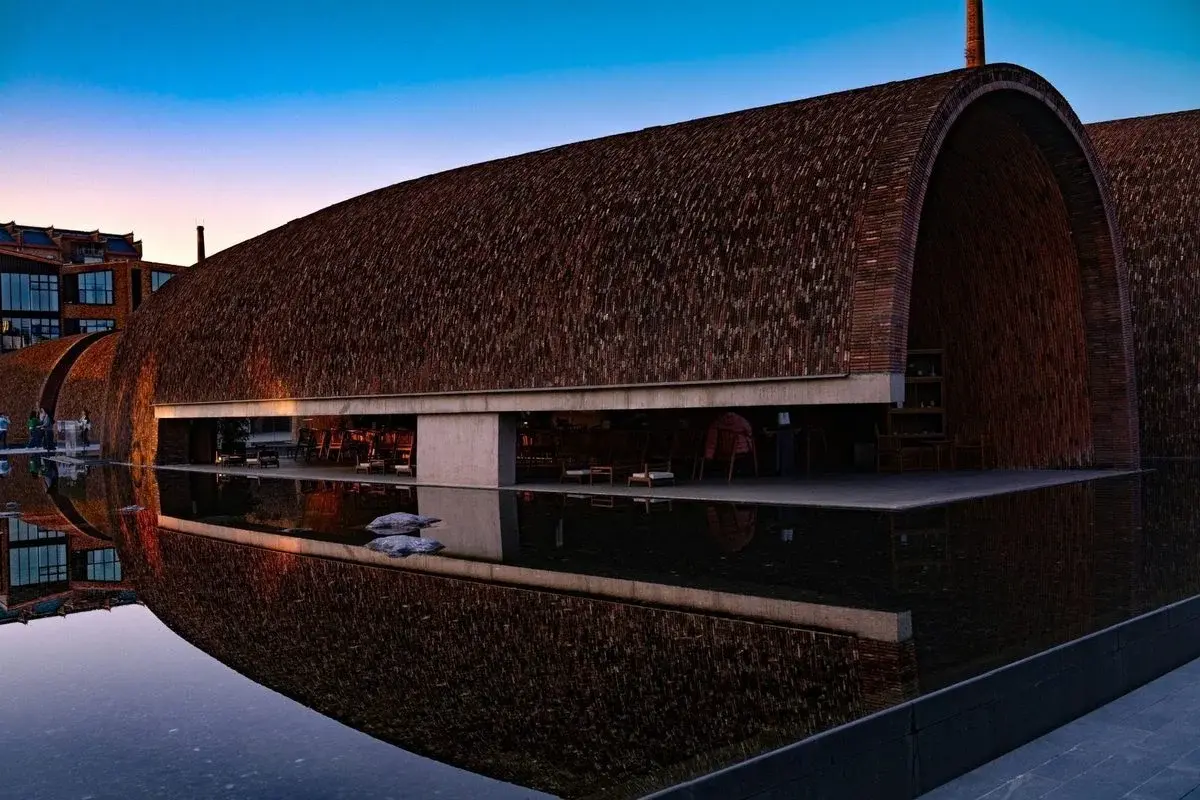
Living cost, at a glance
≈$42/mo
≈$70/mo
≈$110–125/mo
≈$32/mo
Jingdezhen doesn't fit the standard 1-bed city-center/outside-center frame used on most city pages in this series — see §01 for why. Rows above are drawn directly from the §01 ledger; the all-in figure is this page's own opening estimate (a city-center flat, food, and a studio to work in), not independently recomputed. Converted at ¥7.2 = $1.
Every other city in this series is cheap because something went wrong. Dalian is cheap because its economy stalled. Harbin is cheap because its people are leaving. The low prices are a residue, a symptom, the quiet after a factory closes. Jingdezhen breaks the pattern — and it's the most interesting city I've written about precisely because I've never been.
Here, cheapness isn't the wreckage left behind. It's the product. A small city in inland Jiangxi has spent the last decade doing what the rest of provincial China cannot: pulling young people in. Over the past ten years its population has grown, net, by more than 130,000 — and roughly eighty percent of them are young. They have a name now, these arrivals, coined to rhyme with the "Beijing drifters" and "Shanghai drifters" of the big cities: jǐng piāo, the kiln drifters. Around 60,000 of them, in a downtown of under 900,000 people.
They didn't come for jobs. There are no jobs, not in the salaried sense. They came to make things out of clay. And the reason they can afford to spend their twenties doing something that pays almost nothing is the subject of this page. Let's do the numbers first.
If you earn dollars, about $600 a month covers a city-center flat, food, and a studio to make things in — one of the cheapest creative bases anywhere on earth, if your money comes from somewhere else. If you're betting your twenties on it, it's a two-year gamble: the local saying is "whether you make it as a kiln drifter comes down to whether you can survive the first two years." Cheap rent buys you time. It doesn't buy you a living.
01 — The monthly numbers
What it costs to drift here.
The headline numbers first. Jingdezhen breaks every pattern in this series. A room by the lake in Xianghu runs about $42 a month. A move-in-ready elevator flat in the city center runs about $70. A frugal month of food and basics runs $110 to $125. About $600 a month covers a city-center flat, food, and a studio to make things in. This is not cheapness by decay — it is cheapness engineered on purpose. Jingdezhen keeps itself affordable as a recruiting tool for young makers, the way other cities spend money on marketing. The city has pulled in roughly 60,000 young "kiln drifters" over the past decade. The discount is real. It is also running out, as the rent section below makes clear. This page is researched entirely from a distance — the author has never been.
These are typical Jingdezhen figures for a young person living simply — drawn from public cost data and from the kiln drifters interviewed in Chinese reporting over the past two years. Amounts in yuan (RMB), dollars at roughly ¥7.2 to $1.
Sources: Xinhua, The Paper (Pengpai), and market reporting, 2024–2025, cross-checked against listing data. Meal and transit figures are Numbeo's "Meal, Inexpensive Restaurant" and "One-Way Ticket, Local Transport" for Jingdezhen, read early August 2026 — the same benchmark used across every city on this site, but weaker here than elsewhere: Numbeo's own Jingdezhen page runs on just 2 contributors and flags its data as partly estimated for that reason, the same limitation already noted above for the rent figures.
One deliberate choice: this ledger doesn't lead with the standard "1-bed, city center" figure most pages on this site use. Numbeo's own Jingdezhen page currently runs on two contributors and flags its own numbers as estimated. A fourth-tier city this size just doesn't have the crowd-sourced sample size that makes that figure trustworthy elsewhere. The drifter's-eye numbers above, cross-checked against actual 2024–2025 listing data and named in Chinese reporting, are the more honest version of the same question.
Your daily choices shape the bill more than the city itself →
What the rest of the bill looks like: electricity, water, and gas
All three are tiered, and — like most of the cities in this series — settled annually rather than month to month.
| Tier | Annual usage | Rate |
|---|---|---|
| 1 | 0–2,160 kWh/yr≈180 kWh/month equivalent | ¥0.60/kWh |
| 2 | 2,161–4,200 kWh/yr≈181–350 kWh/month equivalent | ¥0.65/kWh |
| 3 | 4,200+ kWh/yr≈350+ kWh/month equivalent | ¥0.90/kWh |
| — | Shared-meter (5+ person household) | ¥0.62/kWh flat |
| Tier | Monthly usage | Rate |
|---|---|---|
| 1 | 0–30 m³ | ≈¥1.5/m³ |
| 2 | 31–50 m³ | ≈¥2.25/m³ |
| 3 | 50+ m³ | ≈¥4.5/m³ |
Jingdezhen's household baseline for water is 5 people, not the 4 used in most other cities in this series. The tier-1 rate here is the last one we could confirm with confidence — the city phased in this pricing around 2015–2016, and we couldn't find a public notice of a more recent adjustment. So treat the absolute number as dated, even though the 1:1.5:3 tier ratio itself is still the current mechanism.
| Tier | Annual usage | Rate |
|---|---|---|
| 1 | 0–420 m³ | ¥3.09/m³ |
| 2 | 421–660 m³ | ¥3.40/m³ |
| 3 | 660+ m³ | ¥4.02/m³ |
Electricity: Jiangxi provincial tiered residential schedule, applied citywide, annually settled. Water: Jingdezhen Waterworks published tier structure; absolute tier-1 rate last confirmed circa 2016, flagged as dated. Gas: Jingdezhen Municipal Development and Reform Commission notice, effective April 1, 2026, tier-2/tier-3 rates derived from the notice's own stated 1.1x/1.3x multipliers on the current tier-1 price. Converted at ¥7.2 = $1.
Standardized comparison figure, applied the same way across every city on this site: 220 kWh electricity + 15 m³ water + 25 m³ gas per month, a single-occupant baseline that excludes winter heating, run against the tiers above. At Jingdezhen's rates that's ¥134 electricity + ¥22 water + ¥77 gas ≈ ¥233 (≈$32)/month.
Heating, AC, visa renewals, and the other monthly drains hidden from the spreadsheet →
These utility rates are low because the pipes, wires, and decades of capital behind them were subsidized long before you arrived. The real cost of cheap water, power, and transit →
What the everyday basics cost, at the market
| Item | RMB | USD |
|---|---|---|
| EggsRetail average | ≈¥6.1/500g | ≈$0.85 |
| Vegetables30-item basket, retail average | ≈¥3.3/500g | ≈$0.46 |
| Pork | Not shown — see note | |
| Beef | Not shown — see note | |
Eggs and vegetables: Jingdezhen Municipal Bureau of Commerce weekly necessities report, week of June 15–21, 2026 — genuinely city-specific. The same report's meat-category figures weren't cleanly separable into a confirmed pork price from the source we had, and we'd rather leave both pork and beef blank than publish a number we're not sure we decoded correctly. Converted at ¥7.2 = $1.
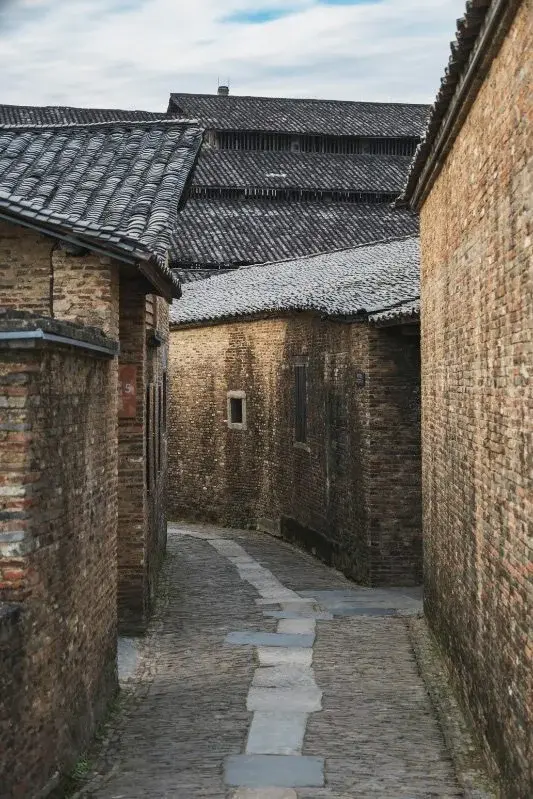
Rent that low is not the interesting part. Plenty of dying towns have ¥300 rooms. The interesting part is what the low rent is for. To see that, you have to follow a single object through the city — because in Jingdezhen, one bowl passes through more hands than you would believe.
02 — The part I watched on my phone
One bowl, seventy-two hands.
I have never been to Jingdezhen. What I have done — like millions of other Chinese people — is watch it on Douyin. There's a whole genre of short video there: a host takes ¥100 and tries to walk a single piece of porcelain through the city's workshops, paying each craftsman in turn, to see if a finished antique-style bowl can come out the other end under budget. It is oddly gripping. It is also the clearest possible X-ray of how this city actually works.
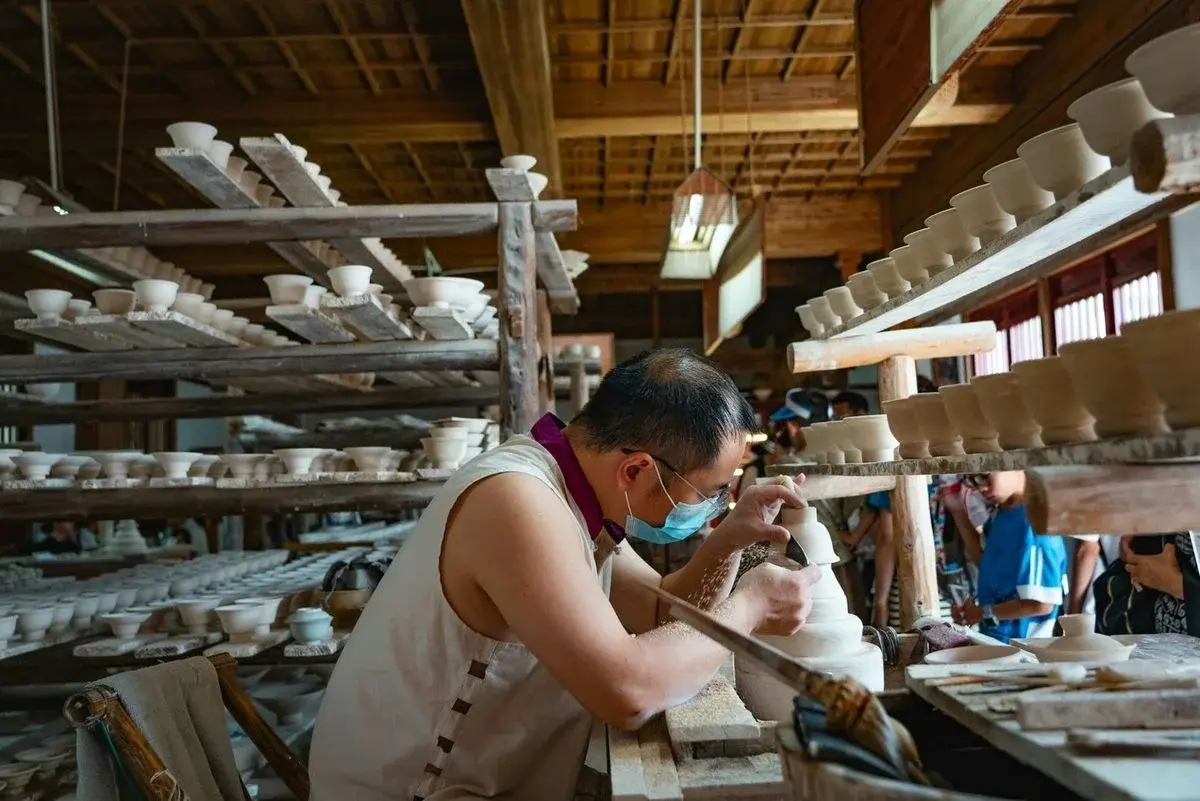
Because Jingdezhen never industrialized the old craft into a single factory line. It kept the craft split across specialists — the traditional count is seventy-two stages, and the city preserved close to all of them. You don't make a bowl here. You carry a bowl past the people who each do one thing to it. Here's what that ledger looks like:
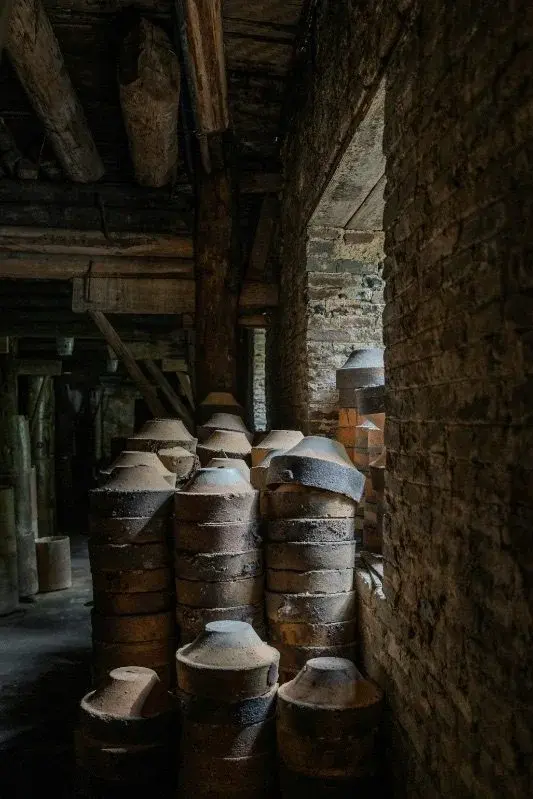
Individual prices vary by piece and workshop; treat the ledger as illustrative of the structure, not a fixed menu. But the structure is the point. Look at that list with a finance eye and you see something specific: this is the lowest-overhead way to make a physical product that has ever existed. You need no factory, no inventory, no line of your own. You rent the city's production system by the piece. The reporting puts it plainly — sixty-thousand-plus workshops across town, and you can ride an electric scooter down one street and buy every material and tool you need.
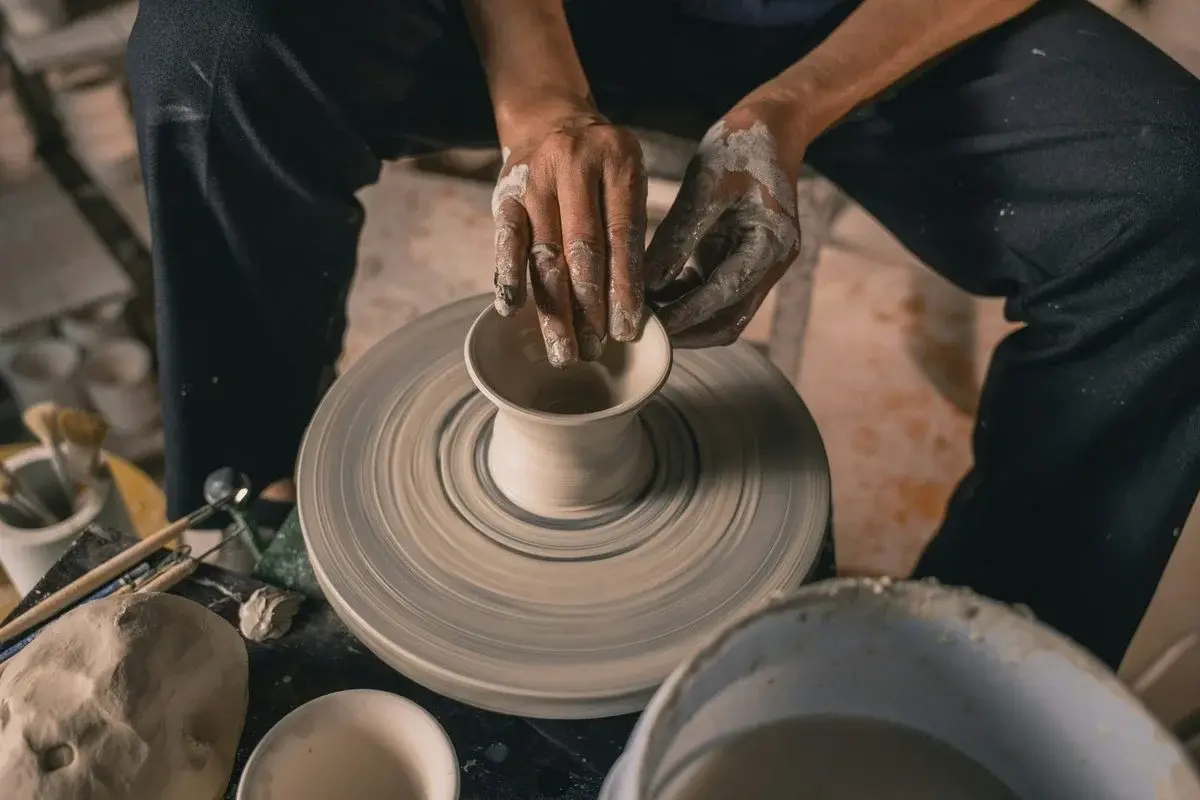
The two hands in the middle: line, then water
The two stages that cost the most on that ledger are the two that need an artist's eye. First huà xiàn — a painter inks the outline of the design onto the raw, unfired body. Then the one that gives blue-and-white porcelain its depth: fēn shuǐ, literally "dividing the water." Using a fat, water-heavy brush whose tip barely touches the clay, the painter floods cobalt pigment inside the drawn lines — thinning or thickening the water to pull one color into five graded tones. The Chinese phrase is "one pigment, five shades," a deliberate echo of the "five inks" of classical brush painting.
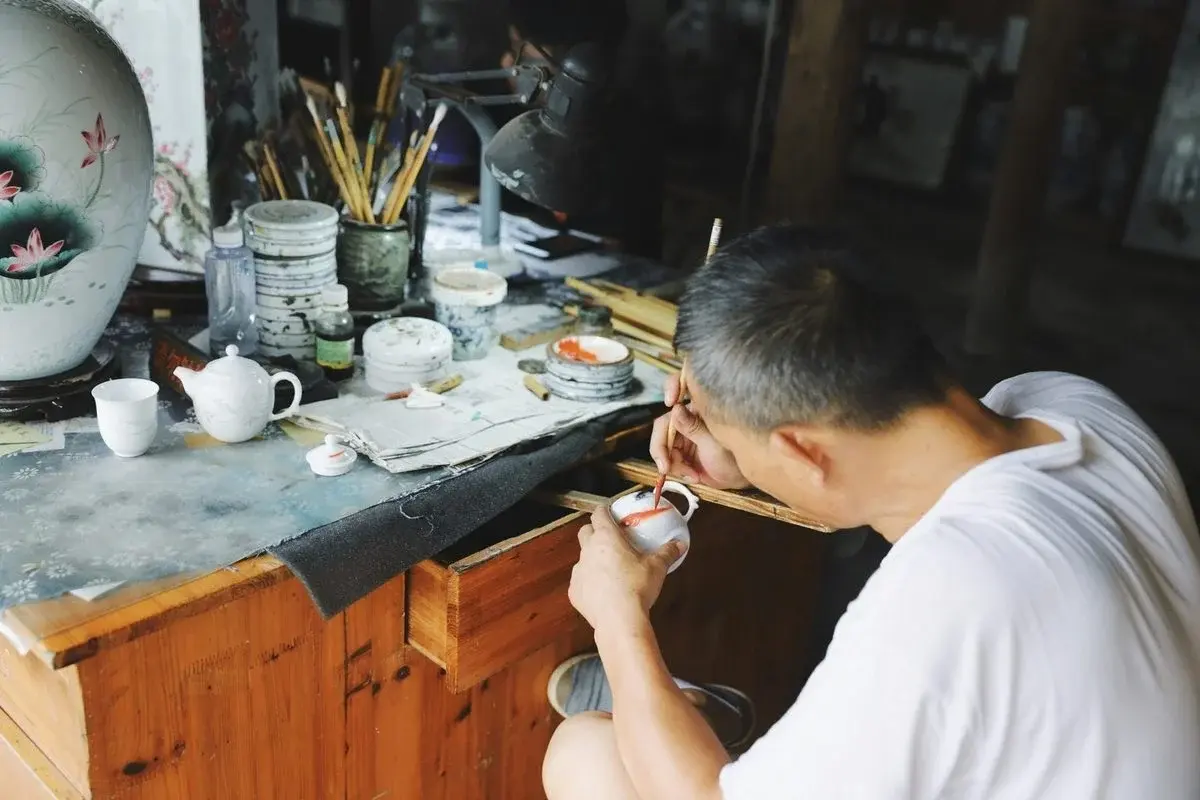
Here is the detail that stopped me, and that I think explains the whole city. When the painter floods that cobalt on, it isn't blue. It's a dull, dark grey. The great porcelain master Wang Bu described it exactly: painting cobalt on raw clay is nothing like ink on paper, where you see the result at once — the fresh porcelain painting is just "a black mass," and the true color only appears after the kiln. The painter works blind. She lays down the invisible, hands it to a fire she doesn't control, and finds out days later whether she got it right.
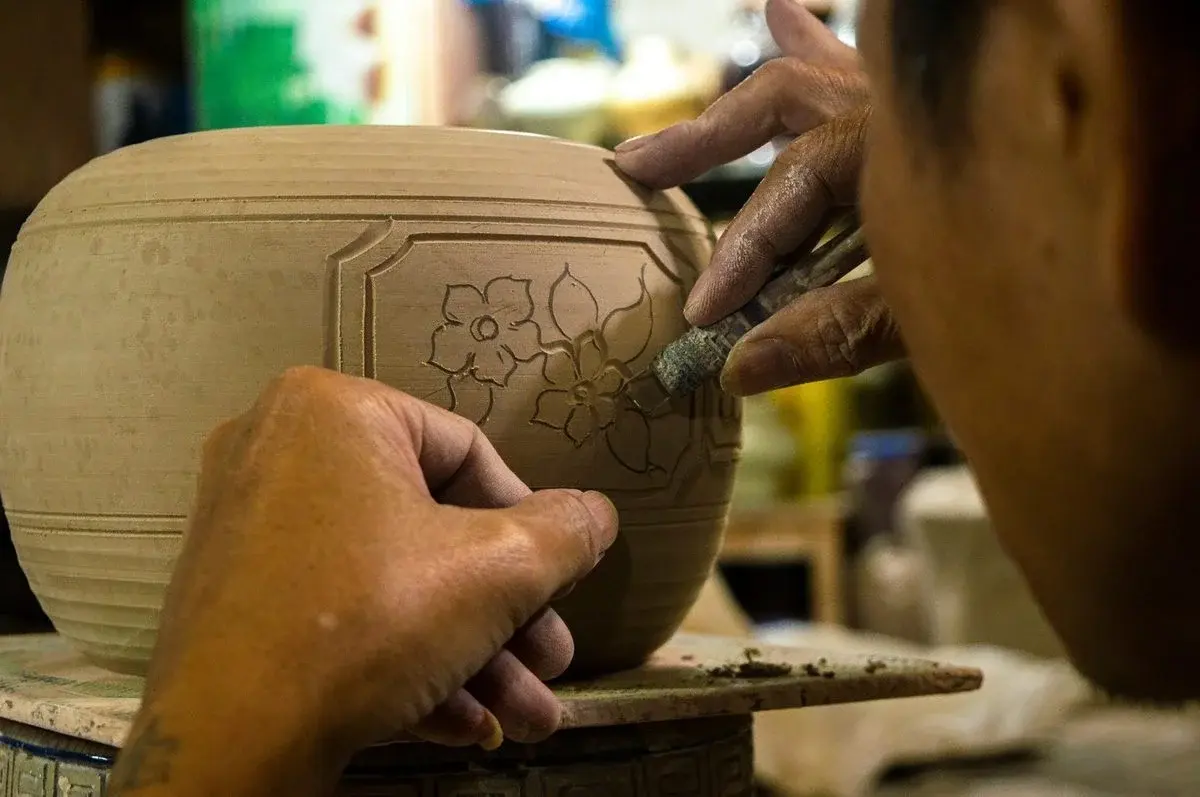
You paint in a color you cannot see, and wait for the fire to tell you if you were right. It is hard to think of a more honest picture of moving here in your twenties.
03 — The honest part
So why is Jingdezhen this cheap, and this full?
The low prices here are not an accident, and they are not decay. They were manufactured, twice — once by a collapse, and once by a decision.
First the collapse. Around the year 2000, Jingdezhen's ten great state-owned porcelain factories — which had once produced nearly half of all China's everyday ceramics — shut down, essentially all at once. This is the exact same event that hollowed out China's northeast, where I'm from: the state enterprises that were the economy simply stopped. When I first read the Jingdezhen version, it felt eerily familiar, and then it didn't, because the ending is different. In the northeast, the factories died and the skill died with them, because the skill lived inside the work unit. In Jingdezhen, the factories died and 100,000 porcelain workers scattered into the city — and kept making porcelain. The complete, 72-stage handmade system didn't collapse with the state sector. It was set loose into it.
A skill you can carry in your hands survives the thing that employed it. A production line does not. That is the whole difference between the northeast and here.
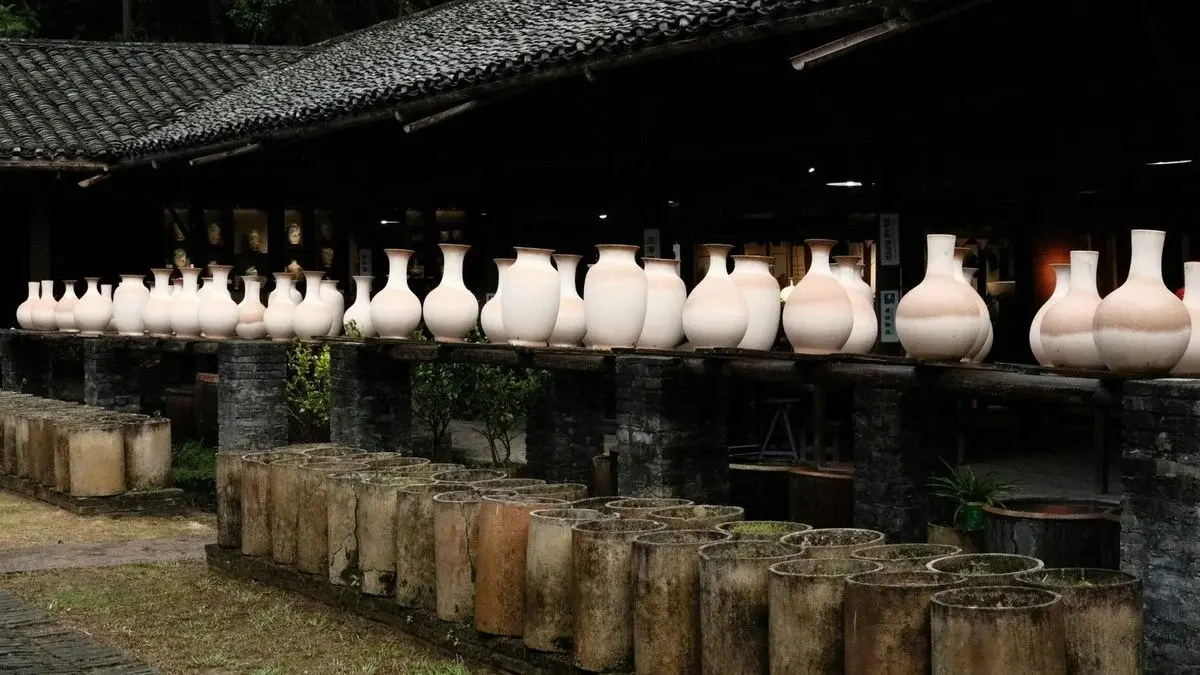
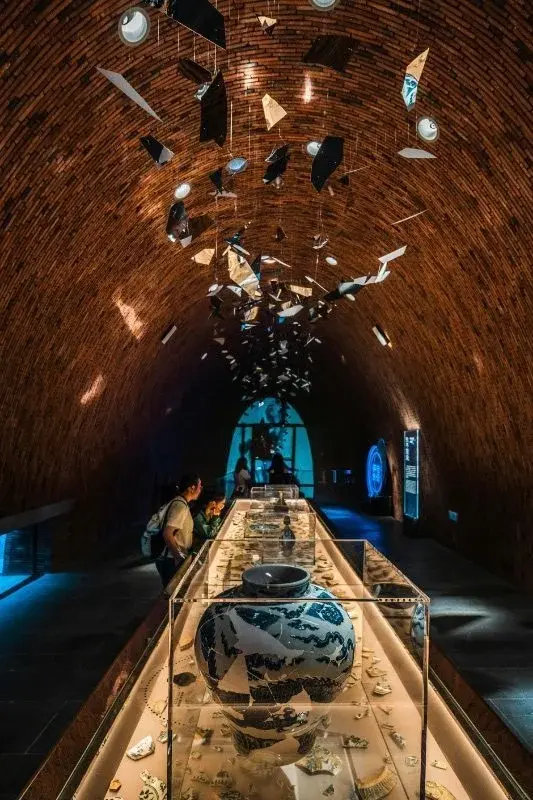
That accident of preservation is what made the second part possible: the decision. Faced with an emptied-out relic of a town, the city — and one state cultural-tourism company in particular — chose not to bulldoze the dead Yuzhou porcelain factory for real estate or a ticketed scenic park. They turned it into Taoxichuan: old kiln-brick workshops reopened as galleries, studios, and above all a market where the main street is closed to cars and handed to young people to sell from. The point was never nostalgia. The point was to make the barrier to entry as close to zero as a city can engineer.
And they engineered it hard. The reporting is full of the machinery: student long-lets for ¥300–400 a month right by the market; a bed in a youth apartment for a little over ten yuan a night; a ¥5,000 interest-free loan for graduates who want to start a workshop; government canteens and free parking opened to drifters on holidays. This is not a city that fell cheap. This is a city that spends money to stay cheap, because cheapness is its recruiting tool.
So here is the honest reading of the cheapness, and it's the mirror image of every other city in this series. In Dalian and Harbin, low prices are what an economy leaves behind when it recedes. In Jingdezhen, low prices are venture capital — the city underwriting the downside risk of a generation of young makers. Jingdezhen is the engineered kind of cheap — read how it fits the full framework → A kiln drifter earning ¥5,000 a month and spending ¥4,000 isn't failing to save. That ¥1,000 gap is tuition, after a discount the city is paying for. Cheap rent is the subsidy that lets you be bad at something long enough to get good.
Ask whether that bet is worth taking, and my own answer is yes — with a stranger's distance, but yes. If I were twenty-five, earning ¥5,000 and spending ¥4,000 to learn a real trade, I'd go. Not because it's guaranteed to work; it very much isn't. But because you're buying an apprenticeship in a craft, and the only way to find out if you have the talent and the luck is to be somewhere that lets you try cheaply. Making anything real takes more conditions than you can see going in. The young leave the northeast to go and find those conditions elsewhere; the young arrive in Jingdezhen for the same reason. There's an old line for it: a transplanted tree dies, a person who moves, lives.
04 — The foreign version of the same story
Yáng jǐng piāo: the same drift, in other languages too.
§03 explained why Jingdezhen pulls in jǐng piāo — the same subsidized, low-barrier-to-entry logic turns out to work on foreigners too, and it has a name of its own: yáng jǐng piāo (洋景漂), literally "foreign kiln drifters." Roughly 5,000 of them now live in the city, from dozens of countries, doing almost exactly the three things you'd guess: professional ceramic-making, design, and trade or teaching around the craft. Many have stayed long enough to call it a second home rather than a stop.
What the city did to make that possible
2022The year Jingdezhen made visas and residency easier specifically for this population — multi-entry visas and two-to-five-year residence permits, fast-tracked through a dedicated police-and-enterprise coordination channel, for foreign nationals working in ceramic trade, cultural exchange, or craft entrepreneurship. This is the same "spend money to stay cheap" instinct §03 already described, aimed at a foreign audience on purpose.
Two named examples, because the abstraction is easier to trust with faces attached to it: Australian artist David Reid first walked into a derelict Taoxichuan in 2006 — an abandoned factory, vines on brick walls — and came back for good in 2018, setting up a studio in a friend's old chemical plant to learn the region's cobalt-glazing technique. French artist Kaimi has stayed eleven years, working her way through the traditional seventy-two stages one at a time. Most of this population still concentrates around the same two places this page already names: Taoxichuan itself, and Sanbao Village — once, by its own former reputation, too scenic and too hard to reach, now an art colony where, in one report's phrasing, "people from all over the world have made a home."
What this doesn't give you is a North American-specific figure — the reporting counts "foreign," not by passport, and Jingdezhen has never published (or, as far as this research found, been asked for) a nationality breakdown the way a diplomatic-heavy city like Beijing or Guangzhou has to. A real slice of that 5,000 is probably North American, given how much of the "come learn a real craft cheaply" pitch in English-language ceramics circles points here specifically. But a guess is what it would be, so this page is naming the honest boundary of what's confirmed rather than rounding it into a number that sounds more precise than it is.
05 — Where the utopia gets expensive
The discount is running out.
If I only told you the ¥300 rooms, I'd be selling you the same fantasy the short videos sell — and I'd be breaking the one rule this site has. So here is the other half, and it is arriving fast.
The cheapness that built Jingdezhen is being priced up by its own success. Near the old sculpture factory, a small house-with-a-courtyard that rented for around ¥300 before 2022 is now a storefront starting at ¥5,000 — courtyard not included. Furnished three-room flats near the factory that once went for ¥1,500 are now two-to-three thousand, when they're finished at all. One drifter's landlord, after a road was built past the door, raised a studio's rent by ten thousand yuan overnight: pay it or leave. Fruit, several arrivals say, costs more here than in the first-tier cities they came from; local prices are creeping toward those of the provincial capital.
The number the videos don't show you
≈50%The share of one drifter's art-school friends who were still doing ceramics a year after starting — two out of four. The "learn for a month, earn ¥70,000" story that pulls people here is, in one veteran maker's words, survivorship bias. The failures don't post.
The local wisdom — you make it only if you survive the first two years — is getting harder to live out as rents climb, craft-fees climb, and training courses compress a 3-to-5-year apprenticeship into a six-month sprint. The utopia still exists. It's just no longer free, and the people it was built for are quietly starting to leave.
This is the tension that makes Jingdezhen worth watching rather than just admiring. A city that manufactured cheapness as infrastructure is now discovering the thing Austin discovered, the thing every "affordable, interesting" place discovers: the affordability and the interestingness are the same resource, and success spends it. Jingdezhen engineered its discount more deliberately than any city I know of. It is finding out that even an engineered discount is a phase, not a property.
For someone earning in a strong currency, none of that erosion has bitten yet — ¥5,000 for a courtyard storefront is still, to a dollar salary, almost nothing. That gap is exactly the one this whole site keeps pointing at. Jingdezhen is astonishingly cheap for you, if your money comes from elsewhere. For the young Chinese maker it was designed to attract, the window is starting to close.
06 — Two things I can only report, not describe
No metro, and a noodle that isn't Nanchang's.
This is a small city, and it moves like one. Jingdezhen has no metro — the reporting is explicit and unanimous on that point. So getting around means one of four ordinary things: about thirty-odd bus routes charging ¥1–2 a ride, taxis starting around ¥6 for the first two kilometers, ride-hailing, and shared bikes or e-bikes. Accounts of how many of the latter are actually on the street disagree — some visitors describe them as everywhere, others as surprisingly scarce, and I have no way to referee that from here. None of it is a system built to move millions; it's a system built to move a downtown of under 900,000 people between a few dozen kiln districts.
The food gets even thinner coverage in what I could find, but two dishes come up by name often enough to be worth reporting rather than inventing. The first is lěngfěn (冷粉), a cold rice-noodle dish similar in spirit to Nanchang's banfen but made with a thicker, chewier noodle, tossed with radish, garlic, scallion and chili oil. The second is jiǎnshuǐbā (碱水粑), a lye-water rice cake, chewy and faintly alkaline, eaten sliced on its own or stir-fried with egg and vegetables. On Fuzhou Alley (抚州弄), a short lane near Taoxichuan, two stalls come up in nearly every account: fried dough wrapped in glutinous rice cake, and a beef-bone noodle soup that locals queue for.
Local transit modes and fares, and the two named dishes with their Fuzhou Alley stalls, are drawn from Chinese travel and lifestyle reporting on Jingdezhen (Maigoo, Zhihu travel accounts, and local tourism guides), cross-checked across multiple independent sources where possible. Treat the shared-bike/e-bike availability note as an acknowledged disagreement between sources, not a settled fact.
07 — A personal footnote
The country that lent the world its name.
I love Chinese porcelain. I own none.
That sentence is the honest ground I'm writing this from, and it says more about the economics than another table could. Porcelain, jade, the whole inheritance of refined Chinese craft — these are what a Korean designer who stayed in Jingdezhen meant when she said, seeing a city where even the streetlamps and the jewelry are ceramic, "No wonder China is called 'China.'" The word for the country and the word for the cup are the same. And yet a fondness for the finer tradition is, for most people I know, a thing you get to afford later — after the necessities are handled, if they ever are. Economic base first; the superstructure of taste comes after. A city full of young people choosing to make beautiful useless things is a genuine wonder. It also rests, quietly, on each of them having somewhere to fall back to.
So I can't tell you what Jingdezhen smells like, or whether the tea at the market is any good. I've told you where every number comes from instead, and where I'm guessing, and where the fairy tale stops. That's the trade this whole site runs on: you don't need me to have been everywhere. You need me not to lie to you about the places I haven't.
08 — Questions people actually ask
Quick answers
How much does it cost to live in Jingdezhen?
About $600/month covers a city-center flat, food, and a studio to make things in — one of the cheapest creative bases documented on this site. A room by the lake in Xianghu runs as low as ¥300/month (≈$42); a move-in-ready elevator flat in the city center is about ¥500 (≈$70).
Who actually moves to Jingdezhen, and why?
Mostly young “kiln drifters” — people who relocate specifically to learn ceramics — drawn by rent this low turning a craft apprenticeship into something financially possible in a way it wouldn't be in a bigger city.
Is Jingdezhen's affordability guaranteed to last?
No — the page's own honest section flags that the discount is running out as the city's ceramics scene gains outside attention and prices start climbing in the areas drifters cluster in.
Has the author of this site actually lived in Jingdezhen?
No — this page is explicitly researched from a distance, not from firsthand residence, and is labeled that way rather than presented as lived experience.
What does a frugal month cost in Jingdezhen?
Around ¥800–900 (≈$110–125) for food and basics, based on figures reported by drifters living there early in their stay.
If you're thinking of going
Jingdezhen, sorted from the reporting, not from experience
- Where it is: Northeast Jiangxi, inland southern China — the Chang River town that shipped porcelain down to the Yangtze for a thousand years. Reachable by high-speed rail; a "fourth-tier" city by size.
- The heart of it: Taoxichuan, the old factory turned market district, is where the drifter economy is densest — markets on the side streets, big fairs each spring and autumn.
- Getting online: sort a China travel eSIM before you fly — data works the moment you land.
- If you want to make: short hands-on ceramics courses are everywhere, from a day to a few months — the low-commitment way to test the fantasy before betting two years on it.
- The first-week bill: Deposit, agent fees, visa medicals, and kitting out a studio stack up before you earn a yuan. See what move-in really costs →
- Still deciding? Answer seven questions to find a city that matches your priorities → or browse the city match tool →