
There's a particular kind of city that decides early on that it would rather be interesting than efficient. It keeps its odd bars and its street food. It resists whatever the capital is doing. Its residents say, with a certain pride, that outsiders don't really get it.
Chengdu is one of these — this site's own deep-dive calls its whole pace "the slow of a choice, not a stall." Austin is another. For years both were the same deal: the place you moved when the big expensive city quit being worth it — Beijing and Shanghai on one side of the Pacific, San Francisco and New York on the other. Cheaper rent, better food, a slower afternoon.
Austin's bargain is over. Chengdu's hasn't ended yet. That gap is the whole story. These two cities belong to completely different kinds of "cheap" →
 Chengdu
 Austin
Left: a panda cub at one of Chengdu's panda bases, photo by Ning Yu. Right: a paddle on Lady Bird Lake, downtown towers behind, Austin, photo by Karsten Winegeart. Same refusal to be boring, two completely different registers of leisure.
01 — Side by side
Chengdu vs Austin: $374 vs $1,894 rent, 36% vs 37% of wages.
Chengdu's city-center one-bedroom runs $374 a month, roughly 36% of the median after-tax wage of $1,050. Austin's center one-bedroom runs $1,894 a month, about 37% of its median after-tax wage of $5,082. On rent alone, the two cities are almost identical as a share of pay. But that is the first clue that rent was never the real question. Austin built its identity on being interesting and affordable. Then it got discovered, and the affordable part ended. Chengdu is next in line, and the numbers tell you exactly what that costs.
Typical 2026 costs for one person, in US dollars. Chengdu's yuan figures are converted at roughly ¥7.2 to $1.
 Chengdu
 Austin
Left: Chengdu's skyline, photo by Lingbo Huang. Right: Austin's, photo by Manuel Velasquez. Both cities are, right now, in the middle of building the same thing.
Austin runs about four to six times the cost of Chengdu across almost every line. Which sounds like an easy verdict, until you notice the last row.
Same city, different lifestyle — the bill gap can be even bigger →
02 — The honest part
Chengdu vs Austin: 36% vs 37% of wages — almost the same.
Costs in Austin are roughly 4–6× Chengdu's. Take-home pay in Austin is 4.8× Chengdu's. The only comparison that actually matters is rent as a share of what you take home — for anyone earning and spending in the same city:
One percentage point. For a barista in each city, the arithmetic of making rent is roughly the same — as it was for Dalian and Seattle. The eye-popping multiple isn't really about one country being cheap. It's about which currency your paycheck comes in — run your own offer through the move calculator instead of the average if you want the real answer for your situation. And in this site's Five Kinds of Cheap framework, Chengdu is the deliberate kind of cheap — a city that chose an easier pace, not one stuck with no better option.
But rent-to-wage math isn't the whole picture on either side. Before we get into what's specific to Austin, the steadier bills — the ones that show up every month no matter what the city is doing — are worth a careful look first.
02b — The everyday layer, priced side by side
Chengdu vs Austin: utilities, groceries, and transit costs.
Rent carries the multiple everyone quotes. The utility bill and the grocery bag tell a narrower story — narrower because both cities' utilities are billed by their own government or municipal utility, not a national average, and Chengdu's electricity turns out to be closer to Austin's than almost anything else on this page.
Electricity — official tiered rates, all-in
Water — official rates, water charge only
The surprise in this section
Chengdu's electricity, converted to dollars, isn't wildly cheaper than Austin's — the widest gap is only about 1.6×, against 5–9× for rent. Water tips the other way at the bottom tier: Austin's cheapest water is actually a hair cheaper per cubic meter than Chengdu's, before either city's fixed charges or Austin's separate sewer bill are added in. The multiple that makes Austin feel so much more expensive sits almost entirely in rent and salaries — not in the pipes and wires underneath the building.
Wet market vs. grocery store
Utilities and groceries are the steady bills — the ones that don't care what's happening to the city around them. What happened to Austin's own wage after it got discovered is anything but steady, and it's the part Chengdu needs to watch.
03 — What "weird" costs when a city gets discovered
Chengdu vs Austin: what getting discovered costs Austin.
The average Austin salary is around $72,000 a year. Analysts estimate you need roughly $113,852 to live comfortably there. The typical worker in Austin cannot comfortably afford Austin — and the shortfall is real.
The gap between the wage and the city
≈58%How far the average Austin salary falls short of what analysts say a comfortable single life now requires. Median household income (~$93,700) doesn't close it either.
And the relief that new construction was supposed to bring hasn't reached the people who needed it most. A wave of new apartments pushed listed rents down about 3% from their peak — while evictions in the city surged to historic highs. Cheaper rent on a listing page is not the same as a household staying housed.
This is what happens after the discovery. The music venues that made the city worth moving to now sit next to towers whose residents moved there because of the music venues. Dell, Apple, Tesla and Oracle arrived with salaries the barbecue joints can't match, and the city's average wage became a statistic that describes almost nobody.
"Keep Austin Weird" was never a celebration. It was a defensive slogan, invented by people who could feel what growth was about to do to the thing they loved.
 Chengdu
 Austin
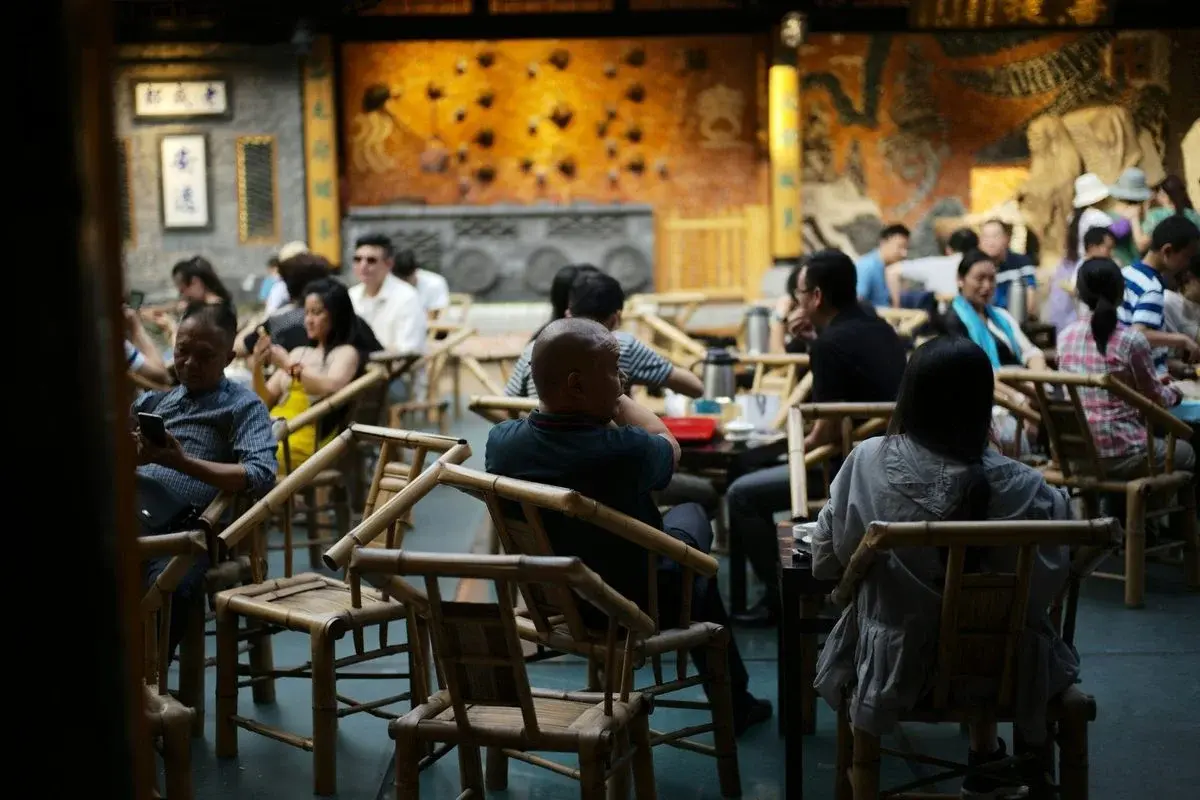
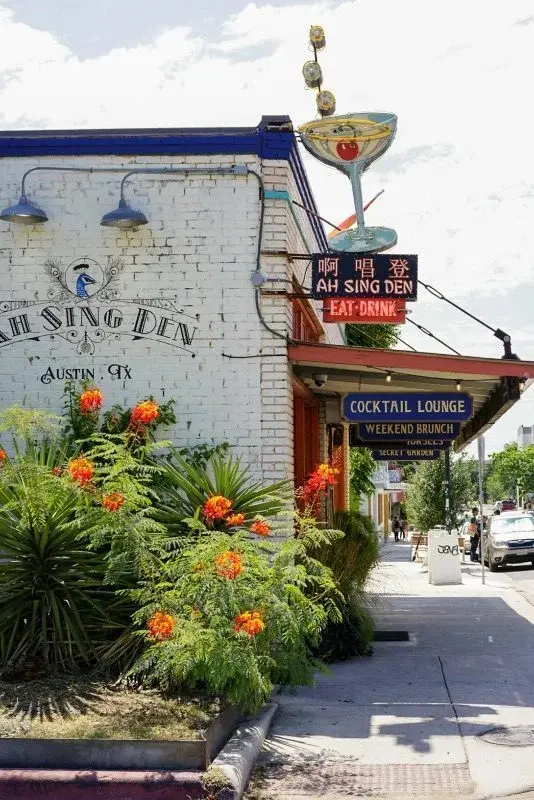
Left: a teahouse storefront in old Chengdu, photo by Andrea Sun. Right: Ah Sing Den, an Austin cocktail lounge borrowing Chinese lettering for its own kind of "weird," photo by Megan Bucknall. Neither city invented its identity to be marketable. Both are now selling it anyway.
Chengdu has never needed a slogan. Its teahouses didn't have to be kept — they simply stayed open, for three hundred years, because the sky was grey and the tea was cheap and your friends were already there. But Chengdu is now China's fourth-largest city, multinationals are moving supply chains inland, and the towers on Tianfu Third Street burn past midnight — fueled in part by a local pipeline of engineering graduates from schools like UESTC.
So: is Austin what Chengdu looks like in fifteen years?
 Chengdu
 Austin
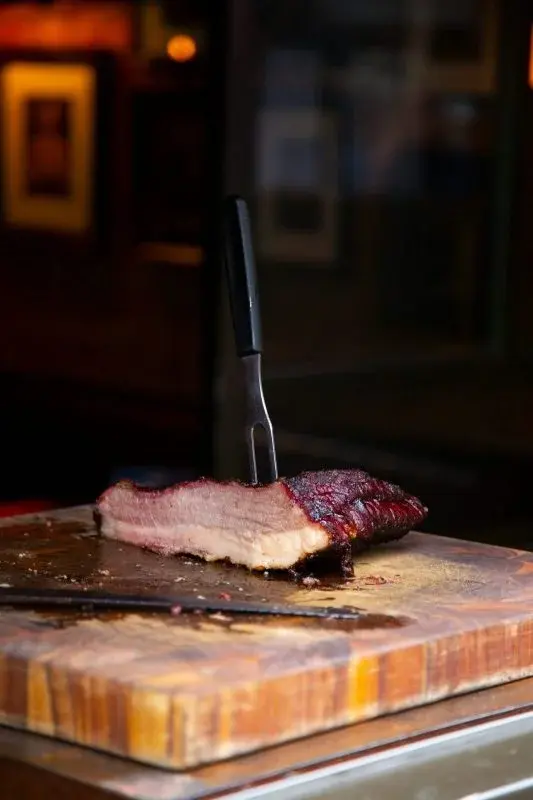
Left: dry-fried chili chicken, more chili than chicken, Chengdu. Right: smoked brisket, Austin, photo by Lex Guerra. The other thing these cities have in common: a food so central to local identity that people queue for it.
03b — What growth actually buys
Chengdu vs Austin: buying, schooling, and rail transit.
Three more numbers fill in what the rent ledger misses: what it costs to own instead of rent, what it costs to school a kid outside the local default, and what fifteen years of "growing fast" actually built underground.
Buying is the one line where the gap actually shrinks the further you get from the center — Austin's markup over Chengdu is 2× downtown but only 1.7× in the suburbs, because Austin can sprawl into real cheap land in a way a 21-million-person basin city can't. Education tells a blunter story: Austin's international-school tuition runs about 1.5× Chengdu's, and its private preschool almost 4× — not because either city's schools are bad, but because both prices are what a family with money pays to route around what the local default doesn't offer.
Underground, or not yet
Chengdu's own metro network has grown into the country's fourth-largest. Here's what fifteen years of "growing fast" built underground, on each side of the comparison:
448 stations1 line · 51 km
10 stations14×
(Line 1 alone, rush hour)≈1,900—
Chengdu: Chengdu Rail Transit reporting, as of December 2025 (already cited on this site's Chengdu city page). Austin: CapMetro's own MetroRail Red Line statistics — its only rail line, a commuter service running on shared freight track, not a metro — via Wikipedia's infrastructure entry, 2025 figures. Austin's Orange and Blue light-rail lines are budgeted and in planning under Project Connect, with an estimated opening as early as 2029; neither has broken ground as of this writing.
This is the starkest number on the page, and it isn't really about trains. Chengdu built fourteen times Austin's entire rail network — from a standing start — inside the same fifteen years Austin spent arguing about, then funding, then still not opening its first real light-rail line. A basin city of 21 million didn't out-build a metro of one million by being richer. It out-built it by being able to decide.
04 — Where the analogy breaks
Chengdu vs Austin: where the comparison breaks down.
The parallel is genuinely useful. It is also not a forecast, and I'd rather say why than let it stand as one.
Three places this comparison fails
- Scale. Chengdu has nearly 21 million people. Austin has around one million in the city, roughly 2.5 million in the metro. These are not the same kind of thing. A city of 21 million doesn't get gentrified by a tech campus; it absorbs one.
- Depth. Austin's identity is decades old, built by a university, a music scene and a slogan. Chengdu's is centuries old and built by weather — a basin, no sun, so people went indoors and drank tea together. One is a scene. The other is bedrock. Scenes can be priced out. Bedrock is harder to move.
- Systems. Different countries, currencies, land policy, housing markets, wage structures and household savings behavior. Chinese property does not work like Texas property. Anyone who tells you a single narrative arc spans both is selling something.
What holds up through all that is the modest, useful version of the claim: a city's low cost of living is a phase, not a property. It lasts as long as the thing that produced it. Austin's cheapness was produced by obscurity, and obscurity ended. Chengdu's is produced by a very large population, a very large supply of housing, and wages that haven't caught up to the country's coast. Those can change too.
05 — Who each city is really for
Chengdu vs Austin: who each city is for.
Chengdu makes sense if…
You earn in a strong currency and want an enormous, food-obsessed, unhurried city while it's still absurdly cheap for you. The teahouses are not a tourist attraction; they're where the afternoon happens.
Austin makes sense if…
Your industry lives there — tech salaries can outrun the rent, and no Texas income tax helps. You're buying access to a job market, and paying a premium the local average wage no longer covers.
Neither city wins. Both made the same bet — that being interesting is worth more than being cheap. Austin discovered that if you win that bet, you eventually stop being cheap. Chengdu is still collecting on it.
06 — Questions people actually ask
Quick answers
How does Chengdu rent compare to Austin rent?
A city-center one-bedroom runs $374/month in Chengdu vs $1,894 in Austin — about 5.1x apart. Outside the center it's $208 vs $1,302 (6.3x).
Is Austin still an affordable, quirky city?
Not the way it once was — Austin has already paid the price of being discovered, with costs that ran up sharply as its reputation grew. Chengdu hasn't reached that point yet.
How much do utilities cost in Chengdu vs Austin?
About $35/month in Chengdu vs $217 in Austin.
What do Chengdu and Austin have in common?
Both built their identity on refusing to be conventional — Chengdu's teahouse and mahjong culture, Austin's live music and food-truck scene — before Austin's version got priced accordingly.
How much does a restaurant meal cost in each city?
About $4.32 in Chengdu vs $20 in Austin — a 4.6x gap.