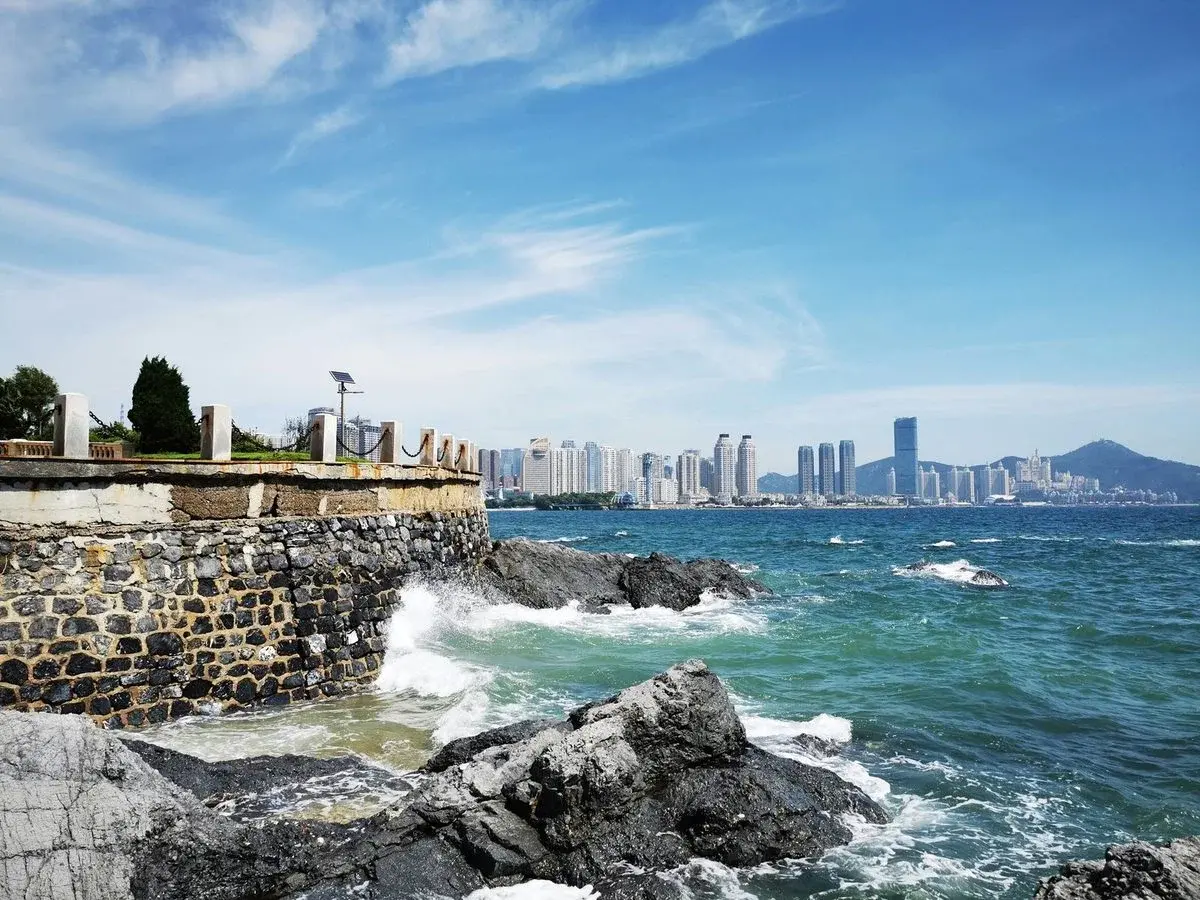

If you dropped a Seattleite onto Dalian's seafront, a lot would feel oddly familiar. The salt air. Mountains meeting the water. Ferries and container ships on the horizon. Fresh seafood as a way of life, not a treat. Even the coffee habit — Seattle invented the modern café, and Dalian's seaside cafés are packed every weekend.
The two cities rhyme. What doesn't rhyme is the price tag. A comfortable single life runs about $1,000 a month in Dalian and somewhere between $4,000 and $7,500 in Seattle. Let's put the numbers next to each other — and then ask the more interesting question: is that gap as lopsided as it looks?
 Dalian
 Seattle
Left: Dalian, blue sky and all — the climate this page keeps coming back to. Right: Seattle's towers, seen from ground level at Waterfront Park. Photos by HatTrick and Macarena Ollarzú.
01 — Side by side
Dalian vs Seattle: 37% vs 37% of wages on rent.
Dalian's city-center one-bedroom runs $409 a month, roughly 37% of the median after-tax wage of $1,093. Seattle's center one-bedroom runs $2,444 a month, about 37% of its median after-tax wage of $6,574. On rent alone, the two cities are almost identical as a share of pay. But that is the first clue that rent was never the real question. Dalian and Seattle look like twins across the Pacific: mountains, sea, seafood, coffee. The difference is which paycheck you bring to the table. Earn dollars and spend yuan, and Dalian is a steal. Earn yuan and spend yuan, and the math looks a lot more local.
Dalian ranged; Seattle derived, see note$415–695≈$3,606Derived—
Dalian ranged; Seattle derived, see note$280–485≈$2,726Derived—
Buying rather than renting is a different story — Seattle runs roughly $705 per square foot in the city center by Numbeo's own crowd-sourced figure. We don't have a comparably confident Dalian buy-price figure to set against it, so we're not building that comparison here; it's flagged as an open gap, not a number we're guessing at.
Look down the "gap" column and a pattern shows up: rent and take-home pay both cluster around six times more expensive in Seattle. Hold onto that number. It's about to matter. If you want to run this against your own salary instead of the average, the move calculator does that math directly.
Same city, different lifestyle — the bill gap can be even bigger →
02 — The everyday layer
Dalian vs Seattle: utilities, groceries, and transit costs.
Rent and take-home pay both land around 6× apart. What's less obvious is that the bills underneath — power, water, gas, heat, groceries, a phone plan, a train ride — don't all move at the same speed. Some of Dalian's edge comes from cheaper unit prices. Some comes from a completely different way of organizing the bill in the first place.
Utilities: tiered-and-annual vs seasonal-and-metered
Dalian prices electricity, water, and gas the way northern Chinese cities typically do: tiered per unit, settled annually. Seattle's three utilities are metered and billed monthly, each with its own seasonal rate structure. Seattle City Light's rate rises with usage and season. Seattle Public Utilities charges more for water in peak summer months. Puget Sound Energy's gas rate floats with wholesale cost. Neither city hides the bill. They just spread the risk differently across the year.
Annually settled≈15¢/kWh, seasonal tiers
Seattle City Light, monthly—
Plus separate ¥0.95/m³ sewage line≈$5.82–11.80/CCF
Off-peak/peak; sewer billed separately, ≈$86.77/mo typical—
Jinpu New Area rate, representative not universal≈$1.43/therm
Puget Sound Energy, typical bill $100–150/mo—
The bill Seattle doesn't have
Dalian's real heating advantage isn't in the rate table above — it's a separate, once-a-season flat charge (¥26/m², roughly $305 for an 85㎡ apartment, covering Nov 5 to Apr 5) that doesn't show up as a monthly utility line at all. Seattle has no equivalent: heat is typically electric or gas, metered like everything else, and a cold snap shows up on next month's bill the way it would anywhere in North America. This is a genuine structural difference, not just a cheaper price for the same thing — see this site's Dalian deep-dive for the full heating system.
Utilities are what you pay to the meter — or, in Dalian's case, don't. Groceries are the cost that shows up in your bag every week, meter or no meter.
Groceries: the everyday basket, not the seafood counter
Dalian's pork/beef/egg/vegetable prices, already published on this site's Dalian page, come from the city's own Development and Reform Research Center weekly monitor. Seattle's figures below are Numbeo's crowd-sourced city data.
Converted from ¥11.5/500g$8.28/lb*
*Not pork — no Seattle pork cut tracked; chicken fillet shown5.7×
Converted from ¥34.8/500g$10.48/lb2.4×
Converted from ¥5.9/500g at ≈60g/egg$5.394.6×
15-item basket average$1.61/lb
Potatoes specifically, not a basket match4.4×
Beef and eggs run noticeably narrower gaps (2.4× and 4.6×) than pork's proxy or the restaurant meal. "5–6× across the board" is a headline, not a law. Some items track closer, some further, and the honest version shows both.
None of that touches the bill that arrives whether you cook at home or eat out, or the ride that gets you to either.
Phone, internet, and getting around
Telecom and transit figures aren't on either city's own deep-dive page — both compiled fresh for this comparison.
This site's general China-carrier estimate, not Dalian-specific$71.79
Numbeo, 10GB+ data≈10–18×
This site's general China-provider estimate, not Dalian-specific$83.76
Numbeo, 60Mbps+≈4–6×
Metro only; trams are separate3 lines, 101 km, 50 stations
Sound Transit Link light rail—
Fares are pay-per-ride, ¥2–6$108—
Dalian's metro is more than twice the length of Seattle's Link light rail. But that's not an apples-to-apples "which system is bigger" comparison. King County Metro's bus network — not counted above — is what actually carries most Seattle transit trips, the same way Dalian's century-old tram lines run alongside its metro rather than instead of it. Seattle also has no equivalent to Dalian's century-plus-old, still-running tram system — Route 201's 1930s-built cars are a genuine rarity this comparison has no counterpart for. Getting out of Dalian by rail has its own quirk worth knowing before you book anything: the direct line toward Shanghai has to route around the whole curve of Bohai Bay, a real limitation of the peninsula's geography — see this site's High-Speed Rail in China guide for the full routing math.
 Dalian
 Seattle
Left: a Route 201 tram, over 90 years old in concept, running below a glass tower a century newer. Right: Seattle's own streetcar, a genuinely modern equivalent — the same idea, minus the century of continuous service. Photos by CJ and Jimmy Woo.
03 — The latte test
Dalian vs Seattle: the latte test — $2 vs $8.90.
All of that is table data. Here's the same gap in a single cup. Abstract dollar figures are hard to feel. So take the most Pacific-Northwest object imaginable — a café latte — and buy one in each city. Seattle is the birthplace of the global coffee chain; Dalian drinks its coffee looking at the same ocean.
Same drink, same kind of view, a 4.5× difference. Buy one every workday and that's the gap between spending about $40 a month and nearly $180. Now multiply that logic across rent, transit, groceries, a night out — and you have the shape of the whole comparison.
04 — The honest part
Dalian vs Seattle: is the 6× gap actually that big?
Here's where most "X is so cheap!" comparisons quietly cheat. They show you the prices and stop — as if a Seattle salary went into a Dalian wallet. It doesn't. The people who live in each city earn in that city.
And look back at the table: the average take-home pay in Seattle is about $6,574 a month, versus roughly $1,093 in Dalian — a gap of about 6.0×. That's almost exactly the same multiple as the cost of living.
The 6× that cancels out
Costs in Seattle run about 6× higher. Incomes run about 6× higher. For someone earning and spending within each city, the pressure is surprisingly similar — a local barista in each place is doing roughly the same math to make rent.
So the eye-popping gap isn't really "Dalian is cheap and Seattle is expensive." It's this: the discount only exists if your income comes from the expensive side and your spending happens on the cheap side.
Dalian isn't cheap. It's cheap for you — if you earn dollars and spend yuan.
 Dalian
 Seattle
Each city's most photographed shape — neither one built to be affordable, both built to be seen. Photos by Blank Weiss and Mark Thomas.
That's the whole trick, put simply. For a Dalian local on a local wage, none of this is a bargain — it's the stagnant kind of cheap, an economy that stalled rather than chose affordability. The rent-to-income math feels much like a Seattleite's. But for a remote worker, a long-stay traveler, or anyone whose paycheck is set in Seattle dollars, Dalian offers something real: a strikingly similar coastal lifestyle, minus about 80% of the bill.
05 — Who each city is really for
Dalian vs Seattle: who each city is for?
Dalian makes sense if…
You earn in a strong currency and want a clean, calm, seafood-rich coastal base where your money stretches 6×. Remote workers and long-stay travelers get Seattle's vibe at a fraction of Seattle's cost.
Seattle makes sense if…
Your career, network, or industry lives there — tech salaries and opportunity can outrun the high costs. You're paying a premium, but for access your paycheck is built around.
Neither city is "winning." They're two versions of the same Pacific-coast life, each priced for the wallets that live there. The gap only becomes a superpower when you can bridge the two — earning on the expensive shore, living on the affordable one.
06 — Questions people actually ask
Quick answers
How much cheaper is Dalian than Seattle?
A one-bedroom in the city center runs $409/month in Dalian vs $2,444 in Seattle, a 6.0x gap. Outside the center it's $236 vs $1,924, an 8.2x gap.
What do Dalian and Seattle have in common?
Both are Pacific-coast port cities with a strikingly similar feel: mountains, sea, seafood, and a strong coffee culture, despite the roughly 6x difference in cost of living.
How much do utilities cost in Dalian vs Seattle?
About $52/month for electricity, water, and gas combined in Dalian vs roughly $297 in Seattle, a 5.7x gap.
How does average take-home pay compare between Dalian and Seattle?
About $1,093/month in Dalian vs $6,574 in Seattle, a 6.0x gap, tracking closely with the overall rent multiple.
How does public transit compare between Dalian and Seattle?
Dalian runs a 6-line, roughly 237km metro plus trams, priced per ride at ¥2 to 6 with no monthly pass. Seattle's Sound Transit Link light rail covers 3 lines and 101km, with a $108 monthly pass.