Living cost, at a glance
≈$374/mo
≈$208/mo
≈$443/mo
≈$818/mo
≈$651/mo
Rent from the §06 ledger. The non-rent line is Numbeo's own compiled "estimated monthly costs, excluding rent" for Chengdu (single person, pulled Aug 2026) — it already folds in food, transport, utilities and everyday extras as one figure. This is a more granular breakdown than the single ¥4,800–6,500 all-in range already published in §06; both are legitimate estimates built by different methods — see that section for the site's original range and sourcing. Converted at ¥7.2 = $1.
China's "laziest" city is also one of its fastest-growing. I spent the better part of two years on business trips here, once a month, trying to work out how both could be true — and it turns out you can't explain the leisure without starting somewhere that has nothing to do with personality: the shape of the land.
01 — The honest explanation
Why Chengdu is like this: blame the geography.
The leisure isn't a personality trait. It's the last link in a chain that starts with the shape of the land.
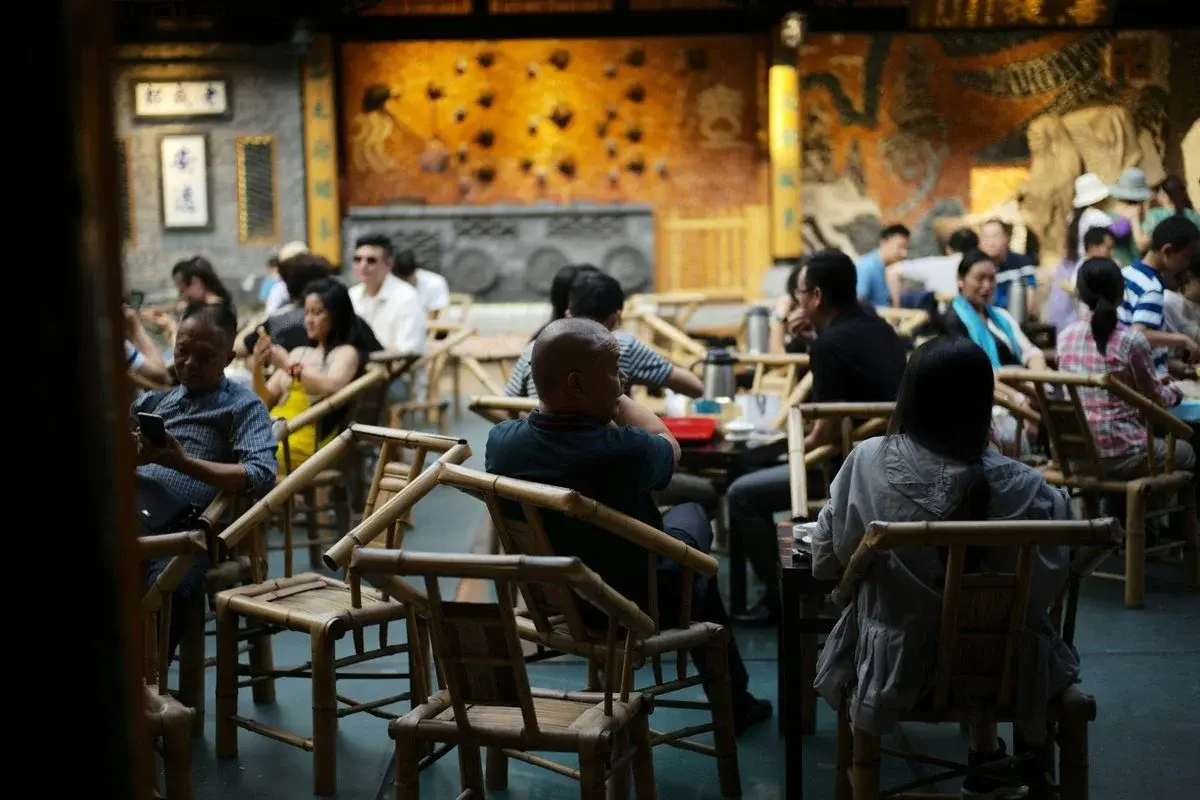
So the "laziness" a visitor sees is really just old public-life architecture, built by weather. The tea is cheap, the chair is comfortable, the friends are already there, and the sky was never going to be blue anyway.
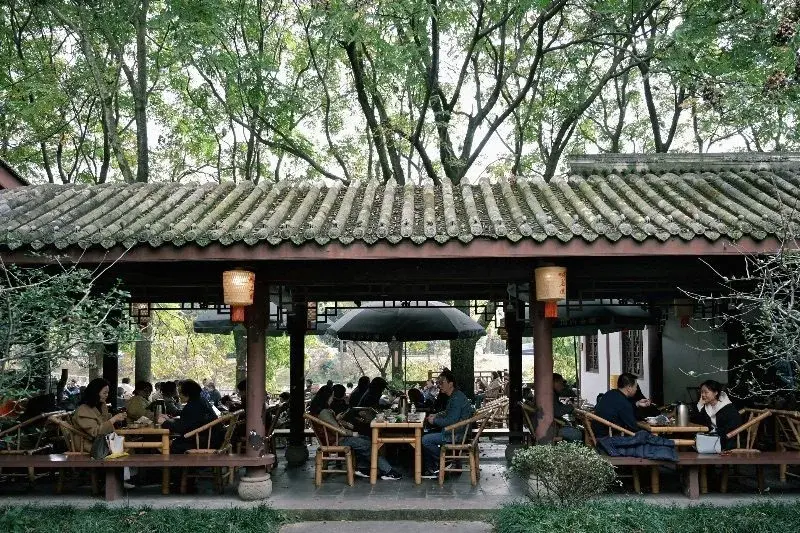
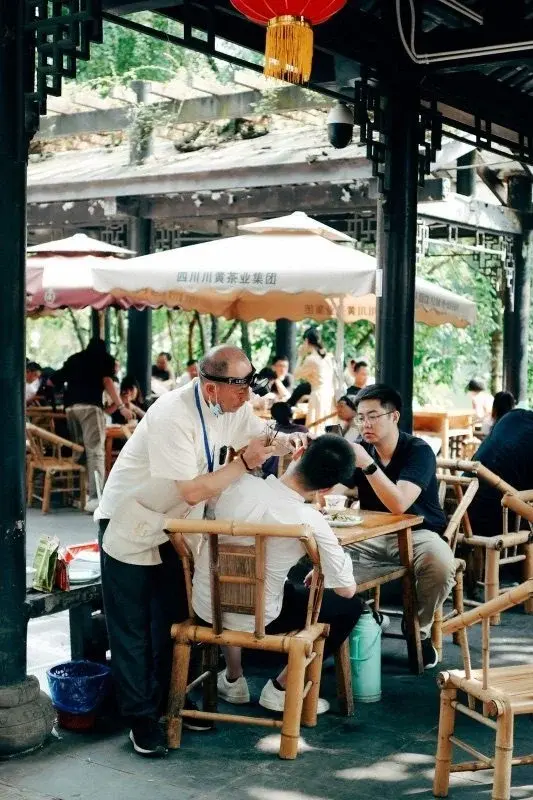
And the teahouse comes with an ecosystem. Vendors work the tables selling snacks and newspapers; someone will shine your shoes, massage your shoulders — or, if you tilt your head, clean your ears with a set of long thin picks and a headlamp. Ear-cleaning is a licensed street trade here, performed at your table while your tea goes cold. Nothing captures the difference between a Chengdu teahouse and a Western café quite like it.
02 — The part visitors miss
So, does anyone here work?
Yes. A lot. And Chengdu locals are visibly tired of being told they don't.
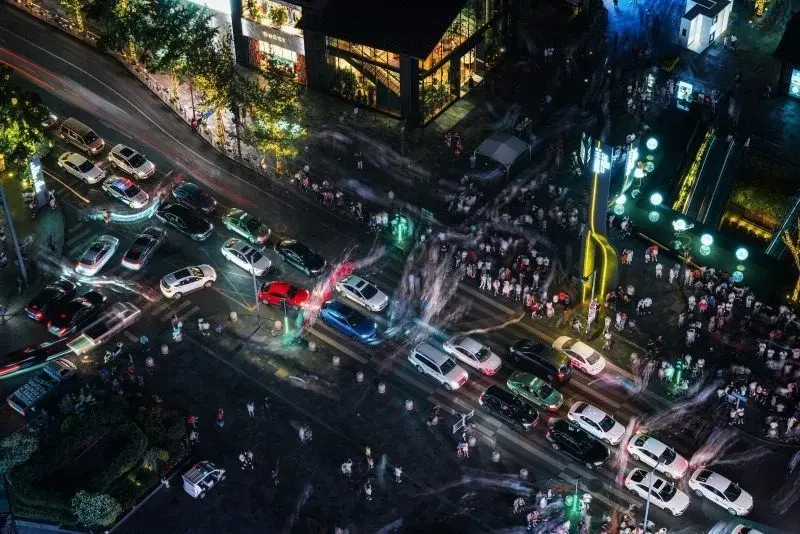
Ask a young person in Chengdu about the city's relaxed reputation and you'll hear some version of this: the people you see in the park with tea and cards are mostly retirees. Meanwhile Line 1 of the metro at rush hour is a crush; the office towers on Tianfu Third and Fifth Street keep their lights on deep into the night; the finance district has queues waiting for taxis after midnight. One resident put it flatly: my husband and I finishing at 11 or midnight is normal. A weekend without overtime is a pleasant surprise.
"Like a duck on water"
The best description I've found came from a Chengdu local, and it explains the queue I saw better than anything I could write:
"Chengdu people look like ducks on water — calm on the surface, feet paddling like mad underneath."
The leisure is real. The work is also real. What's different here isn't the amount of effort; it's that the city refuses to let work be the only thing. As another local said: people here know how to use eating, drinking and playing to discharge the pressure — so the same workload leaves you less exhausted.
And the economics back it up. Multinationals diversifying their supply chains have been pushing manufacturing investment inland — to Chengdu, Wuhan and Xi'an — and the professionals follow the money. Chengdu is China's fourth-largest city, home to nearly 21 million people, and consistently ranks among its most livable. It is not a city winding down. It's a city that grew fast while keeping its teahouses open.
03 — Who actually lives here, if you're arriving from North America
The other "duck on water": a foreign community that's been paddling here since the 1980s
§02 left off with the professionals who follow the manufacturing and investment money inland, to cities like Chengdu. Some of that money is North American, and the people it sends don't scatter across the city — they cluster in a handful of places, each for a specific reason you can actually trace:
| Area | Why here | Who you'll find |
|---|---|---|
| Tongzilin & Shenxian Shu | The U.S. Consulate General opened here in the 1980s; foreign firms and high-end housing followed, including a stretch known locally as the "European Street" | Long-settled expat households, consular staff, entrepreneurs |
| High-Tech Zone | Chengdu's corporate and tech campus district, home to newer international schools (Shengpo, Chengdu No.7's international department) | Corporate-relocation staff, tech and finance professionals, teachers |
| Sichuan University area | One of the city's main clusters of international-student and exchange programs | International students, visiting faculty |
Tongzilin specifically has been tracked for decades: as of the most recent community count, it's home to more than 4,300 foreign residents from 46 countries — roughly a fifth of the neighborhood's population, making it the most concentrated foreign-resident district in the city. Chengdu also hosts 15 foreign consulates, the third-most of any Chinese mainland city after Shanghai and Guangzhou, which is a large part of why Tongzilin and its consular anchor exist at all.
Worth noting: this is a genuinely older community than the "fastest-growing city" framing in §02 might suggest — Tongzilin's foreign presence predates most of the recent manufacturing and tech investment by a decade or more. It settled in for the same reason a lot of Chengdu residents do: once you're here, for reasons that have very little to do with ambition, people tend to stay — the same basin geography that built the teahouse habit works on a consulate family from Ohio about as well as it works on a native of Chengdu.
This section describes where a foreign, largely North American, professional and diplomatic population is known to cluster and roughly who they are — compiled from public reporting on Chengdu's consular and international-school geography and community-service counts, not a formal census. Treat the neighborhood names as directionally right rather than as a precise headcount.
04 — The weather explains more than the mood
Grey, warm, and 80% humidity, which is also why the food is this spicy.
Weather doesn't check anyone's passport, and it's the real reason both groups in §03 and every Chengdu native end up in the same teahouses. The basin that traps the clouds traps the damp along with them. Chengdu's annual average temperature is a mild 16.2°C (61°F) — summer highs peak around 25°C (77°F) in July and August, winter lows hover near 6°C (43°F) in January, and the city rarely sees anything close to freezing. It's a narrow, forgiving range. What isn't forgiving is the air itself: average relative humidity runs around 80% year-round, and the basin gets only about 1,020 hours of sunshine a year — among the lowest totals of any major Chinese city, the same fact that started the teahouse chain in §01.
That humidity is also the traditional explanation for the chili. The local reasoning — repeated by Sichuanese themselves, not just outsiders looking for a tidy story — is that eating ma la food and drinking baijiu are ways of "expelling dampness" from a body that's marinating in 80% humidity most of the year: sweat it out, warm the body from the inside, push the damp back out. It's a folk explanation, not a clinical one, and this site won't pretend otherwise — but it's the explanation Chengdu gives for its own cuisine, and it fits the same geography that built the teahouses.
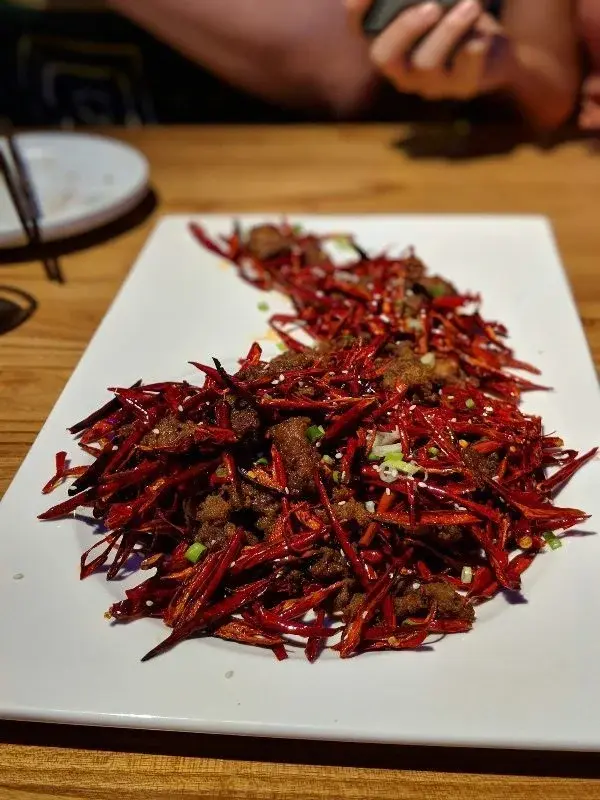
The other thing I noticed, month after month: it would pour at 2 a.m. and be clear by breakfast. I assumed I was getting lucky. I wasn't — I was experiencing something the Chinese have written poetry about for over a thousand years.
巴山夜雨 · "night rain over Ba mountain" — 60–80% of Sichuan's annual rainfall arrives between 8 p.m. and 8 a.m. At night, the mountain slopes ringing the basin cool fast; that cold air slides down and shoves the basin's warmer, wetter air upward, where it condenses. Meanwhile the cloud deck cools sharply on top while the ground below stays warm — an unstable stack that tips into rain. By day, the same cloud blocks the sun, flattening the temperature difference, so it stays dry.
The phrase comes from a Tang-dynasty poem by Li Shangyin, written to someone far away: you ask when I'll return, I can't say — the night rain over Ba mountain has swollen the autumn pool. Twelve hundred years later, the rain still keeps the same schedule.
Grey skies, cheap tea, night rain, small apartments. Put those together for a few hundred years and you get a city that treats leisure as infrastructure.
05 — The food, obviously
A culture with time on its hands learns to cook
You cannot separate Chengdu's leisure from its food. Sichuan cuisine is one of China's great regional traditions, and it didn't end up here by accident — in a place where people have historically had the hours to fuss over things. UNESCO made it official in 2010, naming Chengdu Asia's first City of Gastronomy.
Hotpot at a decent old local spot runs ¥40–80 a head (about $6–11) — roughly what a seafood dinner costs back home for me on the coast. But the attitude is different. Plenty of coastal cities cook well because the sea hands them good ingredients. Chengdu cooks well because people care, intensely and continuously, about eating. The range of dishes, the fuss over a broth, the willingness to queue an hour for the right noodle shop — that's what an unhurried culture does with its attention.
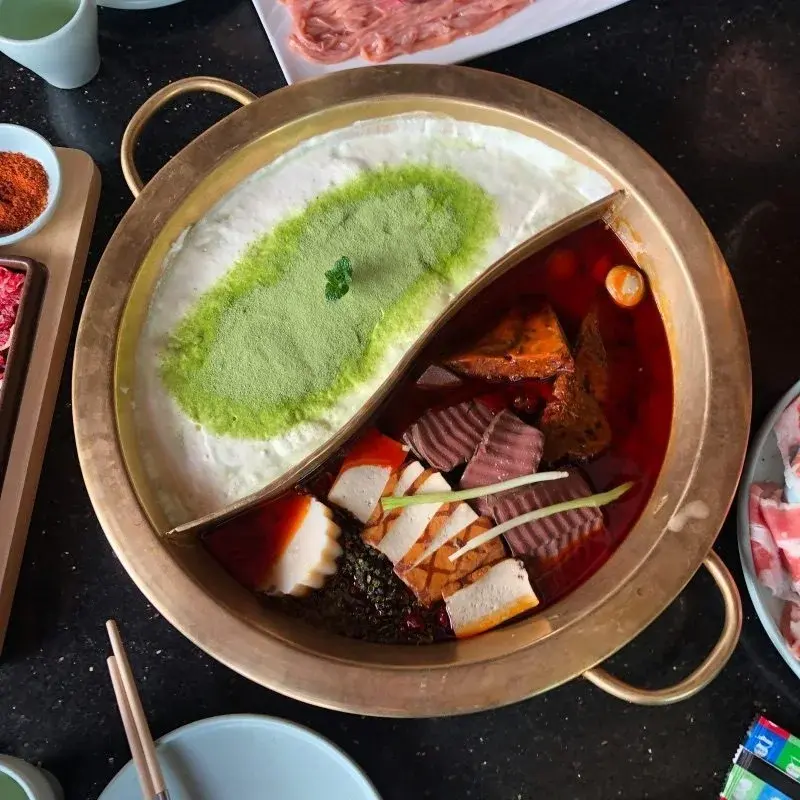
None of this means Chengdu residents eat out for every meal. The teahouse culture is about time spent in public, not a replacement for cooking — the wet market is still where most households shop, and the small neighborhood stall selling pre-made braises and stewed dishes by the portion remains a normal weeknight shortcut, not a sign nobody cooks at home.
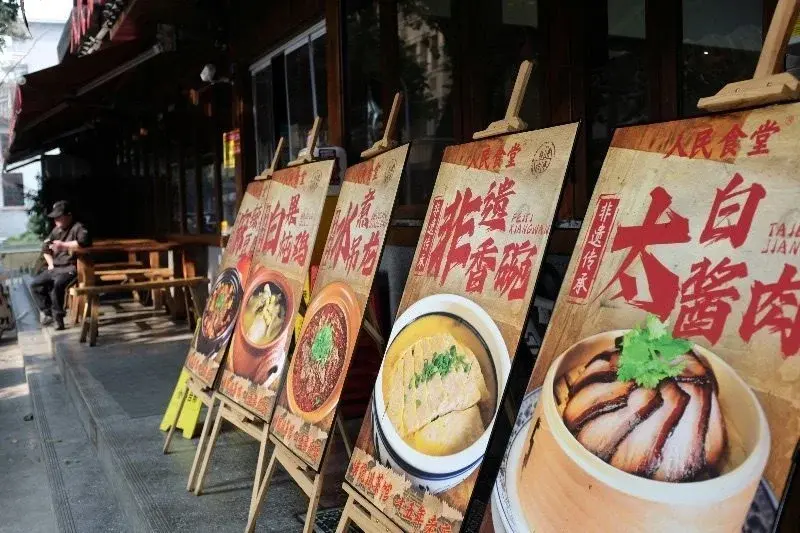
What has genuinely changed in the last two years is who's cooking for whom. The city has built out roughly 400–860 community and senior dining halls (depending on how you count) as part of a national "15-minute living circle" push — subsidized meals, originally aimed at elderly residents living alone who found daily cooking hard, now increasingly open to anyone. Some have struggled to break even and closed; others have expanded into breakfast, late-night service, even delivery. It's the same instinct behind the teahouse, aimed at a different problem: don't make people eat alone if the city can help it.
What the ingredients cost, at the market
| Item | RMB | USD |
|---|---|---|
| PorkRetail average | ≈¥11.4/500g | ≈$1.58 |
| BeefLeg cut, retail average | ≈¥38.4/500g | ≈$5.33 |
| EggsRetail average | ≈¥6.3/500g | ≈$0.87 |
| VegetablesRetail average, all types | ≈¥3.7/500g | ≈$0.51 |
| Norwegian salmonWholesale, center-cut — see note | ¥70–85/500g | ≈$9.72–11.81 |
Pork, eggs, and vegetables: Sichuan Provincial Department of Commerce weekly necessities monitoring report, week of June 1–7, 2026 — this is a provincial figure, not a Chengdu-specific one; we couldn't find a city-only weekly monitor bundling all these items the way some other cities on this site publish one, so we're saying so rather than passing it off as more precise than it is. Beef: same provincial monitoring series, a different week (mid-April 2026), included because Chengdu-specific beef data wasn't separately available. Salmon: reporting on Chengdu's own wholesale seafood market, dated April 9, 2026 — a wholesale, not retail, price, so treat it as directional rather than what you'd pay at a supermarket counter. Converted at ¥7.2 = $1.
The salmon line is the interesting one. Chengdu is landlocked — no coast, no river port for seafood — and yet Chengdu Shuangliu Airport has become China's second-largest entry point for imported salmon, with a cold-chain processing hub built specifically to receive it. A basin city with no seafood tradition of its own decided it wanted good salmon anyway, and built the logistics to get it. That's the same appetite that keeps a chuan chuan stall busy at midnight — just aimed somewhere the local cuisine never used to reach.
Hotpot gets the headlines, but the everyday cooking runs just as deep: mapo tofu and dandan noodles are Sichuan's two most internationally recognized exports, both built on the same doubled sensation the cuisine is known for — ma la, numbing and hot at once, from Sichuan peppercorn and chili working together rather than either one alone. At street level, chuan chuan — hotpot's cheaper, skewer-based cousin, priced per stick and eaten standing at a curbside stall — is where a lot of the queueing-for-an-hour energy actually goes on an ordinary Tuesday.
06 — The monthly numbers
A rental market still being built, for a population still arriving
The city-center rent number will hit you first. A one-bedroom in Chengdu runs about $374 a month, roughly 36% of the median after-tax wage of $1,050. That's the visible cost. But if you stop there, you've missed what Chengdu actually charges. The real gate isn't the rent bill; it's the city's exploding population and the infrastructure still catching up. Chengdu added 61,000 residents in 2025 alone, one of only two 20-million-plus Chinese cities still growing. The city is cheap now, but the growth is real and the price is unlikely to stay this low for long.
That's the backdrop. Supply keeps expanding into outlying districts to keep pace with people who keep arriving. That's a big part of why rent here hasn't caught up to the city's growing economic weight. It's a market still being built for people still showing up, not a market rationing space among people who already have it.
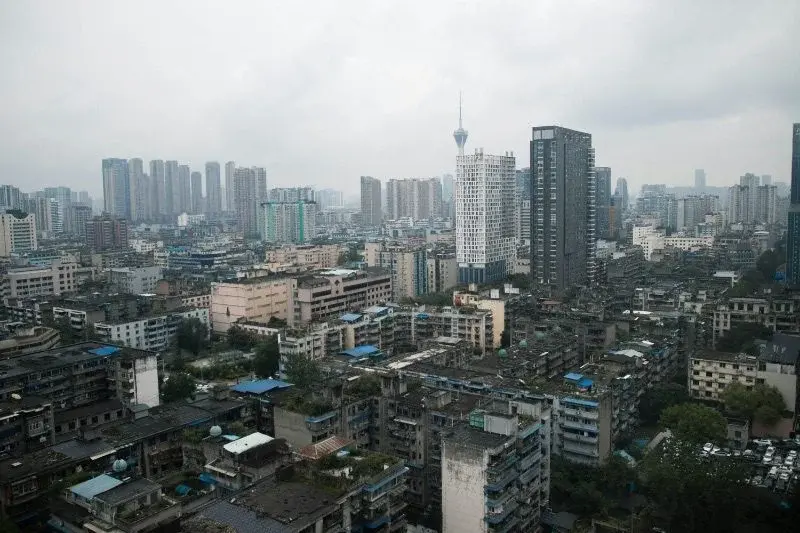
Typical 2026 costs for one person, pulled from public cost-of-living data. Yuan converted at roughly ¥7.2 to $1.
Sources: Wise, Numbeo, Livingcost.org, and Nomads.com (2026). Population change: Chengdu Municipal Bureau of Statistics, 2025 year-end communiqué. The 1-bed outside-center figure applies Wise's own center-to-suburb ratio for Chengdu (roughly 0.56) to the already-cited center figure, rather than an independently sourced number — flagged because it's a derived estimate, not a direct reading. The 2-bed city-center range is from informal local rental-listing chatter (Anjuke), not an aggregator average, and is weaker than the other figures on this page; we couldn't find a comparably sourced 2-bed outside-center number and left it blank rather than guess. Utilities uses this site's own standardized calculation, not a Wise/Numbeo figure — see below. Converted at ¥7.2 = $1.
The gap between rent (~$374) and take-home pay (~$1,050) leaves something most Chinese cities don't leave much of: disposable income and time. Which kind of cheap this is →
What that ¥250 a month for utilities actually buys
Electricity, water and gas are all tiered — use more, pay more per unit. Chengdu's electricity is billed monthly rather than settled against an annual allowance, so one hot month shows up on the very next bill.
| Tier | Monthly usage | Rate |
|---|---|---|
| 1 | 0–180 kWhJul–Sep: 0–260 kWh | ¥0.5224/kWh |
| 2 | 181–280 kWhJul–Sep: 261–460 kWh | ¥0.6224/kWh |
| 3 | 280+ kWhJul–Sep: 460+ kWh | ¥0.8224/kWh |
| Tier | Annual usage | Rate |
|---|---|---|
| 1 | 0–216 m³ | ¥3.03/m³ |
| 2 | 217–300 m³ | ¥3.90/m³ |
| 3 | 301+ m³ | ¥6.51/m³ |
| — | Shared-meter buildings | ¥3.03/m³ flat |
Shared-meter buildings pay the flat first-tier rate regardless of volume — not tiered at all. It's a proxy for older housing stock that hasn't been converted to individual metering.
| Tier | Annual usage | Rate |
|---|---|---|
| 1 | 0–500 m³ | ¥2.34/m³ |
| 2 | 501–660 m³ | ¥2.75/m³ |
| 3 | 661+ m³ | ¥3.36/m³ |
| — | Shared-meter buildings | ¥2.54/m³ flat |
Electricity: Sichuan Provincial Development and Reform Commission notice〔2026〕#255, effective July 1, 2026 (rates unchanged from prior schedule; only the summer tier bands were widened). Water: Chengdu Waterworks Co. published residential rates, central "5+1" districts (Chengdu High-Tech Zone, Jinjiang, Qingyang, Jinniu, Wuhou, Chenghua); tier volumes per the 2015 rate-setting notice, still current. Districts outside this area set their own rates and can differ. The published water figure is a single combined rate — we couldn't find a public breakdown into supply versus drainage/sewage components, so we're not guessing at one. Gas: Chengdu Development and Reform Commission notice, central "5+1" districts, current as of the 2024 price adjustment. Converted at ¥7.2 = $1.
Standardized comparison figure, applied the same way across every city on this site: 220 kWh electricity + 15 m³ water + 25 m³ gas per month, a single-occupant baseline that excludes winter heating, run against each city's own published tiered rates above. At Chengdu's rates that's ¥119 electricity + ¥45 water + ¥58 gas ≈ ¥222 (≈$31)/month — close to the previous ¥250 figure, which was already this site's own tier-schedule estimate rather than an aggregator number.
Your daily choices shape the bill more than the city does →
There's no separate, higher gas schedule here for winter heating — Chengdu's basin winters are mild enough (see §04) that piped heating isn't standard, so one gas tier covers cooking and water-heating year-round.
07 — The crush on Line 1, in numbers
A metro network that's grown almost as fast as the queue outside that office tower
The Line 1 crush mentioned above isn't a fluke of one bad morning — it's what happens when ridership outgrows the network faster than the network can be built. By the end of 2025, Chengdu's rail system had reached 17 lines, roughly 719 kilometers, and 448 stations. That's the fourth-largest network on the Chinese mainland, after Shanghai, Beijing, and Guangzhou. A 2024 national commuting survey ranked Chengdu second nationwide for the share of commuters within 800 meters of a station.
| Distance | Fare |
|---|---|
| 0–4 km | ¥2 |
| 4–12 km | +¥1 / 4 km |
| 12–24 km | +¥1 / 6 km |
| 24–40 km | +¥1 / 8 km |
| 40 km+ | +¥1 / 10–20 km |
We haven't been able to source a metro map for Chengdu that we're confident redistributing. For the current network layout, go straight to the operator: Chengdu Rail Transit Group — official line map →
Fare schedule: Chengdu Metro distance-based pricing (max single fare ¥12). Network size and station count: Chengdu Rail Transit reporting, as of December 2025. Commuting-coverage ranking: 2024 China Major Cities Commuting Monitoring Report. Converted at ¥7.2 = $1.
The real cost behind these low prices →
Outside the rail, the national trio of shared-bike apps — Meituan, Hello, Didi's Qingju — covers the flat, wide boulevards easily (this is basin terrain, not Chongqing's stairs), ride-hailing is as unremarkable here as anywhere else in urban China, and buses fill in the routes the newer outlying lines haven't reached. None of it competes with the teahouse for a Chengdu resident's actual attention, but it's how they get there.
08 — Questions people actually ask
Quick answers
How much does rent cost in Chengdu?
A one-bedroom in the city center runs about ¥2,700/month (≈$374); outside the center it drops to about ¥1,500 (≈$208). A three-bedroom in the center runs about ¥4,600 (≈$641).
Why is Chengdu called China's laziest city?
Blame the geography — the Sichuan basin traps humidity and grey skies, around 80% humidity most of the year, producing a slower pace of life that's historically pointed to as a virtue rather than a stall.
Why is Chengdu's food so spicy?
The same humid, grey climate that produces the city's relaxed pace also shapes its food — sweating out the damp is part of the local logic behind why Sichuan cuisine leans this hot.
Does landlocked Chengdu actually have good seafood?
Surprisingly, yes — Chengdu Shuangliu Airport has become China's second-largest entry point for imported salmon, despite the city having no coast or river port of its own.
How much does a meal cost in Chengdu?
An inexpensive restaurant meal runs about ¥31 (≈$4.32); hotpot at an old local spot runs ¥40–80 per person (≈$6–11) depending on the place.
If you're thinking of going
Chengdu, for a first visit or a long stay
- Expect grey: Chengdu is one of the least sunny places in China. Mild winters, hot humid summers, and a lot of soft overcast light. Pack accordingly.
- The rain: it mostly falls overnight. Days are usually dry, if cloudy — which is why the outdoor teahouses stay full.
- Getting online: sort a China travel eSIM before you fly.
- Staying a while: a furnished 1-bed in the center runs ¥2,700–3,500/month.
- Still deciding? Not sure this is the right fit? Try the city match tool → ; Answer 7 questions to find a better match →