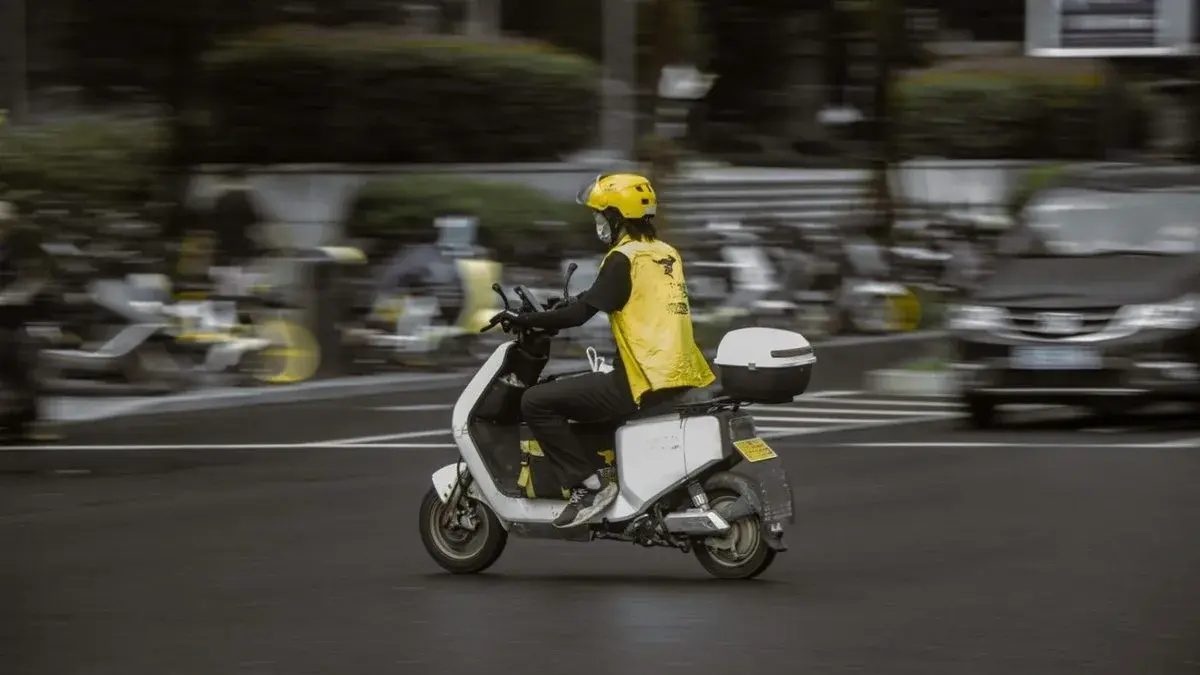
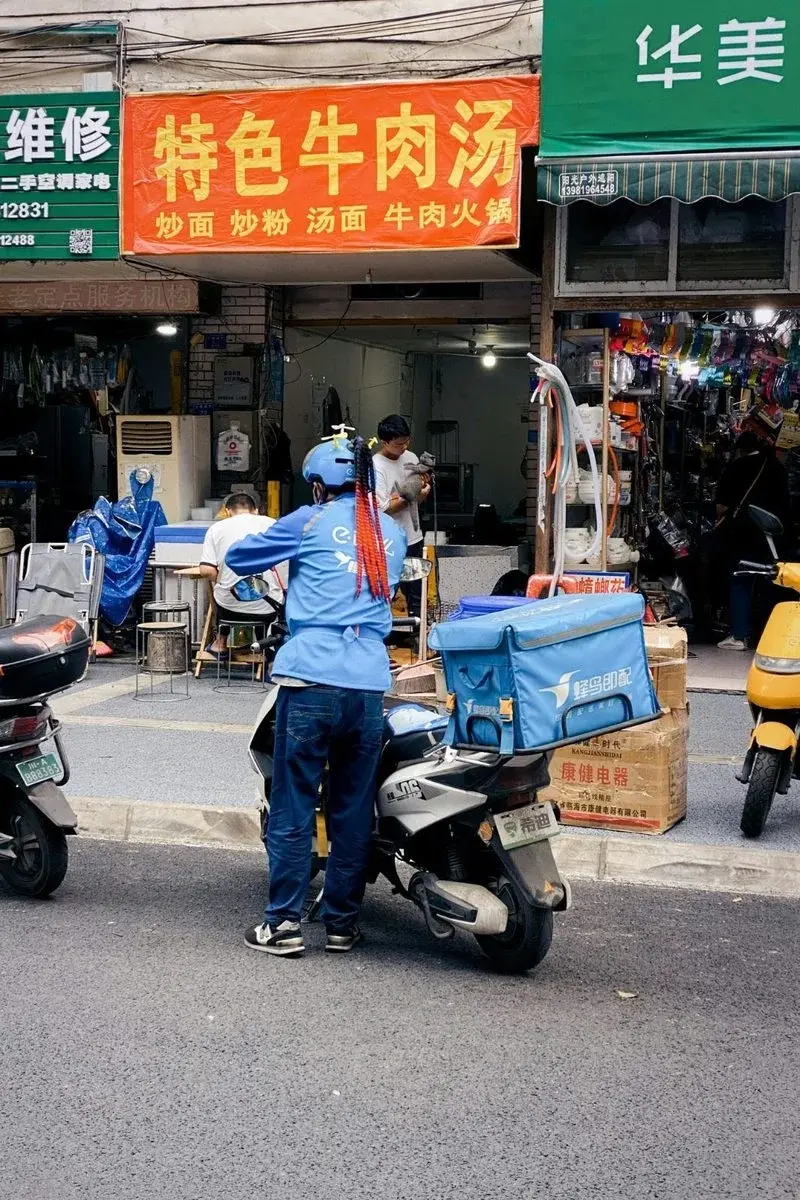
From ¥9.9 group meals to 28‑minute delivery: how China redefined instant?
In pretty much any corner of a Chinese city, at pretty much any hour, food is a few taps away. How fast did delivery actually take over? Fast enough that instant noodles — China's original answer to "I don't want to cook, I don't want to go out" — have been sliding more or less continuously since 2013. That's probably not the only reason, but it's a big one: delivery is now instant enough that a lot of people just order instead of boiling water for noodles.
There's a second shift happening alongside it, harder to quantify but worth naming. Remote work, livestreaming, one-person businesses — all the ways you can now earn a living without showing up to an office — have quietly multiplied the number of people who spend most of their day at home. Delivery is what makes that lifestyle workable: it hands back the time you'd have spent cooking or going out, and most people seem to pour that time into more work, not less. This page is about what it took to make "just order something" the new definition of instant.
01 — Five things that all had to happen at once
Five systems, one moment: apps, payment, riders, algorithms, density.
Delivery this fast isn't one breakthrough. It's five separate systems that had to mature at roughly the same time — and if any one of them were missing, the other four wouldn't matter much.
Every restaurant is online. Somewhere along the way, having a storefront on a delivery platform stopped being optional for any restaurant that wants customers it can't otherwise reach. The listing is table stakes now, not a bonus channel.
Payment friction basically doesn't exist. Scan, tap, done — no cash, no card reader, no "sorry, we're cash only." Mobile payment removed the last manual step between wanting food and paying for it.
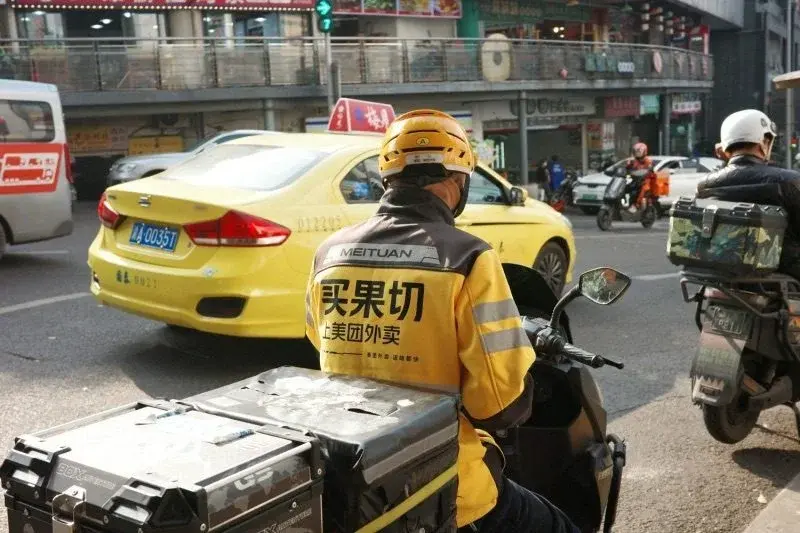
A workforce large enough to carry the volume. By the end of 2025, riders across the major platforms — Meituan (700,000+ active), Ele.me (400,000+), plus JD Dada, SF Intra-city, and others — added up to more than 13 million nationwide, up from just over 5 million in 2018. Someone has to physically get on a scooter, in the rain if it's raining, and be there within the promised window — order after order, all day. That's not a small labor pool, and the job is genuinely hard: tight windows, weather, traffic, buildings with no elevator. What's easy to miss from the outside is that a lot of riders carry that grind with a surprisingly upbeat attitude — not something I'd generalize into a claim about the whole workforce, just something worth noting rather than ignoring.
Dispatch algorithms doing the actual matching. Riders and orders don't pair themselves. Platforms run systems — Meituan's is nicknamed "the super brain," Ele.me's is called "Fangzhou" — recalculating routes billions of times an hour, deciding who takes what order, in what sequence, along which streets. This is also where point three gets sharper: the better the algorithm gets at optimizing the whole network, the tighter the squeeze on any one rider inside it.
Restaurants packed close together. This is the one that's easy to miss entirely. Delivery in China is mostly cooked to order, not pulled off a warehouse shelf — bottled drinks and convenience-store fast food are the exceptions. What makes 20-minute delivery possible isn't a warehouse near you. It's a restaurant near you — often several on the same block. Dense cities with dense food scenes let a rider cover a short real distance instead of a long one.
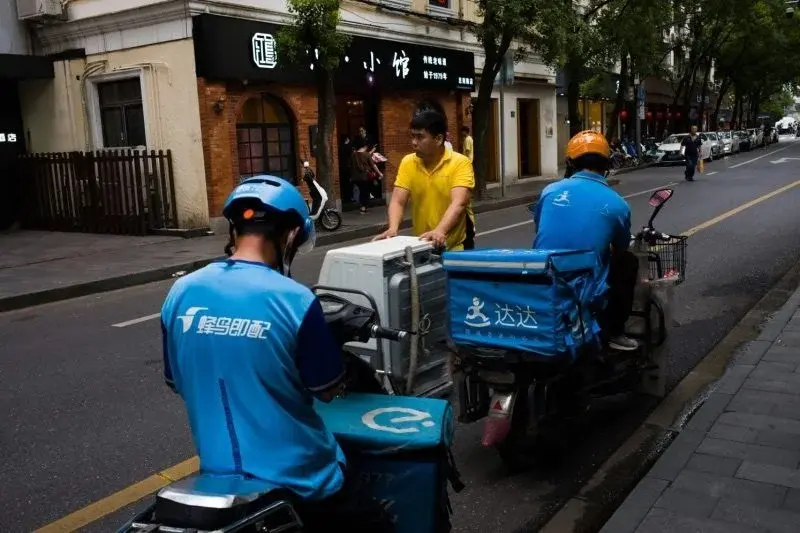
A number worth sitting with
Between 2018 and 2025, the rider workforce grew nearly threefold. National daily order volume, over roughly the same stretch, grew by about 40%. More people showed up to carry the food than the food itself grew — which is part of why, starting in 2025, some delivery stations in Beijing, Shanghai, and Shenzhen began posting "not hiring" notices.
Remove any one of these five and the system doesn't gracefully degrade — it stops working the way people have come to expect.
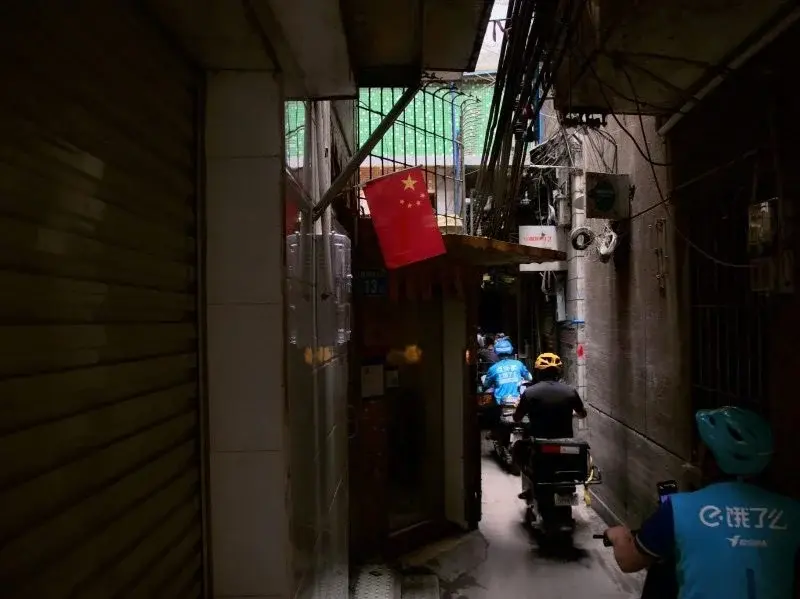
02 — How fast, exactly
28 minutes, 110M daily orders, 94% on‑time: delivery as infrastructure.
China's delivery platforms now average 28‑32 minutes per order, with 110+ million orders placed daily across the country.
| Metric | 2025 figure |
|---|---|
| Average delivery time, major platforms | 28–32 minutes |
| On-time delivery rate | 94–96% |
| Fastest reported delivery times | as low as 19 minutes |
| National daily order volume, pre-price-war baseline | ~80 million |
| National daily order volume, post-price-war | 110+ million |
Platform performance figures and national order-volume estimates are aggregated from multiple 2025 industry reports; see sources below.
The 2025 price war between the major platforms didn't just create a temporary spike — it permanently moved the baseline. Whatever this looked like as a novelty a decade ago, it's infrastructure now. Speed is only half the picture, though — the other half is what an order actually costs.
An everyday lunch order runs ¥20‑35 with delivery often free; group‑meal deals can go as low as ¥9.9.
| Order tier | Typical spend | Delivery fee |
|---|---|---|
| Group-meal deals | ¥9.9–15 | Usually free |
| Everyday order | ¥20–35 | ¥0–5 |
| Chain fast food (KFC-tier) | ¥38–40 | ¥2–6 |
| Casual sit-down chain | ¥55–76 | ¥3–8 |
Delivery fees scale mainly with distance and time of day — short, off-peak orders often waive the fee entirely under an ongoing subsidy, while a longer or late-night order can run closer to ¥8–9.
Put plainly: a filling weekday lunch with free delivery, for less than the price of a bus fare and a coffee combined in most Western cities, isn't a special deal here — it's the ¥9.9–15 tier competing for ordinary daily orders, not a promotional stunt. The subsidy war that produced those prices runs on thin margins throughout the chain. Platforms take a 5–8% commission on the order total, and on a typical ¥30 order the rider's own delivery fee — commonly split between the restaurant and the customer — can run close to ¥8 of that. Which is part of why restaurants, not just riders, have been vocal about commissions and delivery fees creeping back up as the 2025 subsidies wind down.
Those everyday delivery numbers are one piece of a larger daily spending pattern — how lifestyle choices stack across three budget tiers →
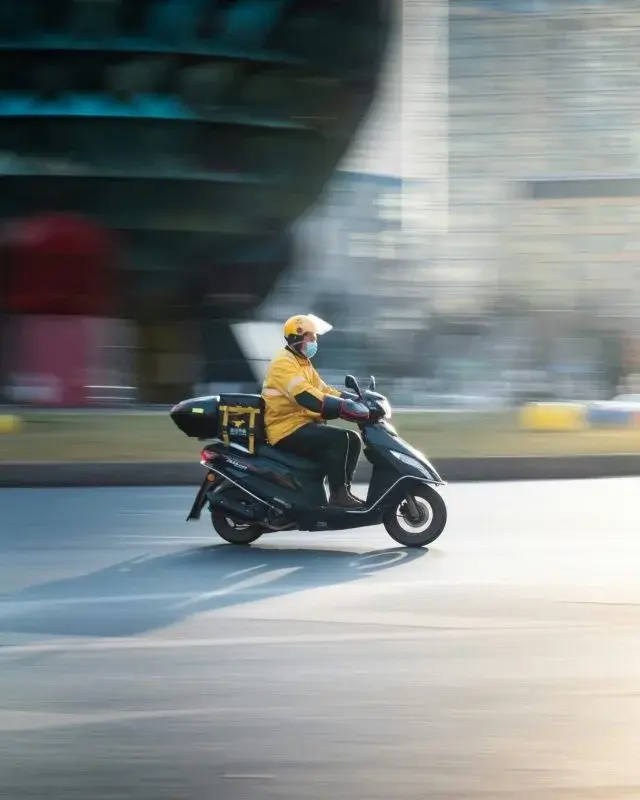
03 — Red, yellow, blue: even the marketing turned into theater
Red, yellow, blue: the marketing war that became theater.
Those thin margins are exactly why the 2025 price war got so loud — three platforms weren't just cutting prices, they were throwing everything they had at the same shrinking slice, marketing included. In May 2025, Meituan (yellow) dropped a Shanghainese-dialect ad starring singer Huang Ling — a pun on her surname ("yellow") and the platform's color, with the tagline "yellow works better." Ele.me (blue) answered ten days later with actress Lan Yingying, whose English name genuinely is "Blue Win Win," under "blue is sure to win." The pairing was crowdsourced — internet users half-jokingly suggested her, and Ele.me actually followed through, publicly thanking and paying out red envelopes to the users who made the suggestion. JD (red) closed the loop with actress Hui Yinghong and "red will win."
Meituan
"外卖,黄的更灵" — a Shanghainese pun linking Huang Ling's surname to the platform's color and to the local word for "reliable."
Ele.me
"蓝的一定赢" — built around Lan Yingying's real English name, "Blue Win Win," a coincidence the internet noticed before the brand did.
JD
"红的会赢" — the third and final entry, closing out a color war none of the three companies started on purpose.
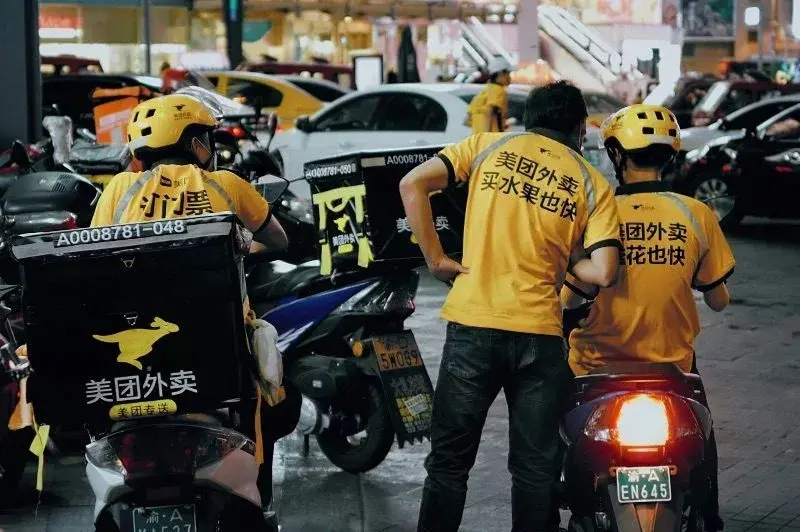
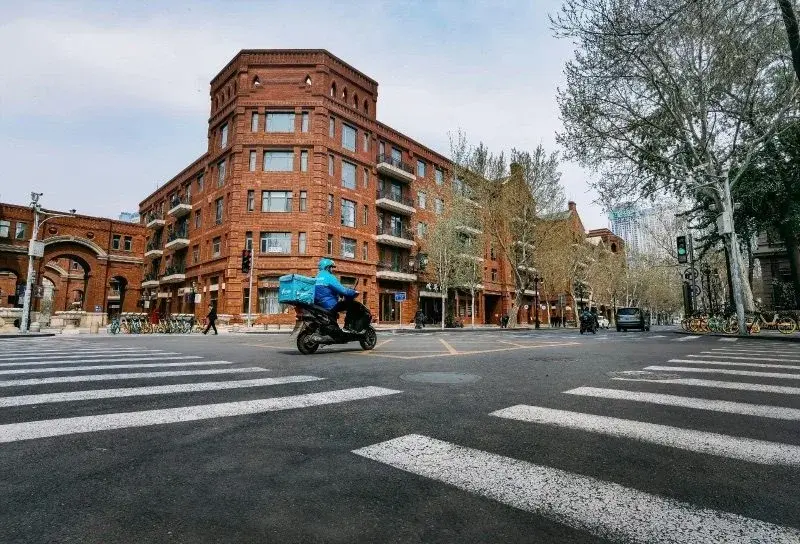
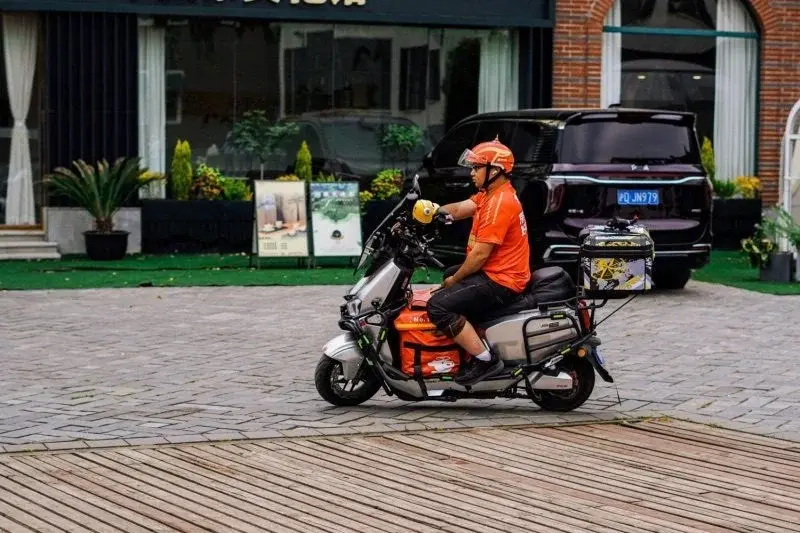
Left to right: yellow (Meituan), Photo: Billow926. Blue (Ele.me), Photo: Wu Yi. Orange-red (JD), Photo: Vong Vathanak.
Somewhere in the comments under all this, someone joked the platforms were running out of colors to fight over — an echo of the same joke people made a few years earlier about shared bikes. Just a line people were passing around online, not a documented shortage of anything.
04 — Delivery now means more than food
From dinner to everything: instant retail passes ¥1 trillion in 2026.
Instant retail — same-platform delivery of groceries, medicine, cosmetics, phone chargers, sliced fruit — is projected to cross a trillion yuan by 2026. Meituan's non-food instant retail alone runs upward of 18 million orders a day. This runs on a slightly different backbone than restaurant delivery — dedicated micro-warehouses stocked with high-turnover goods, positioned so a rider never has to go far — but it's built on the same five ingredients from §01, just pointed at a wider set of things.
05 — Even the high-speed rail has an ordering menu
Ordering food to your seat on a 300 km/h train.
The expansion doesn't stop at instant retail, either — it's reached somewhere a lot less obvious: a moving train. I haven't ordered food to a train seat — a colleague has, on a work trip, and reported ordinary McDonald's showing up at her seat. Worth being clear that this is secondhand, not something I've tested myself. It's a real service, though: since 2017, China Railway's 12306 platform has let passengers pre-order food through the app, now covering 80-plus stations, with chain brands like KFC and McDonald's among the first vendors.
It has real limits. Orders have to go in ahead of time — originally two hours before departure, now closer to one — and it only works at stations that participate, not the whole route. 12306 itself has publicly noted that open flames aren't allowed on the train, so nothing is cooked to order the way it might be on the ground. It's less "call for anything, anytime" and more the same convenience, with a schedule attached.
The bottom line
What "instant" actually took to earn
Noodles were instant because they were fast and required nothing. Delivery is instant because it's fast and requires nothing — it just does more, and does it better. The word didn't change. What it takes to earn it did.
Curious what that actually feels like? Maybe it's time to see it for yourself.
06 — Questions people actually ask
Quick answers
Why did food delivery in China get so fast?
Not one invention — five separate systems had to show up at once (dense restaurant supply, near-frictionless payment, a large delivery workforce, dispatch algorithms, and tightly packed urban density) before "instant" delivery became possible.
What's the “color war” in Chinese food delivery?
Three platforms adopted red, yellow, and blue branding, each fronted by a celebrity whose name happened to rhyme with the platform's pitch — marketing that turned into genuine theater.
Does food delivery in China only cover food?
No — the same apps that started as “order dinner” have quietly expanded into ordering almost anything, from groceries to convenience-store goods.
Can you order food delivery on a moving high-speed train in China?
Yes, through an in-train ordering menu — though the page's own author hasn't used it personally, relying on a colleague's account instead.
What happened to instant noodles once delivery got fast enough?
Delivery effectively took over the word “instant” that noodles used to own — when a hot meal can arrive faster than boiling water, instant noodles lose their core convenience argument.
How much does food delivery actually cost in China?
An everyday order runs about ¥20–35 with a ¥0–5 delivery fee, and the budget group-meal tier (拼好饭) can go as low as ¥9.9 with delivery usually free — a filling lunch for less than a bus fare and a coffee combined in most Western cities.