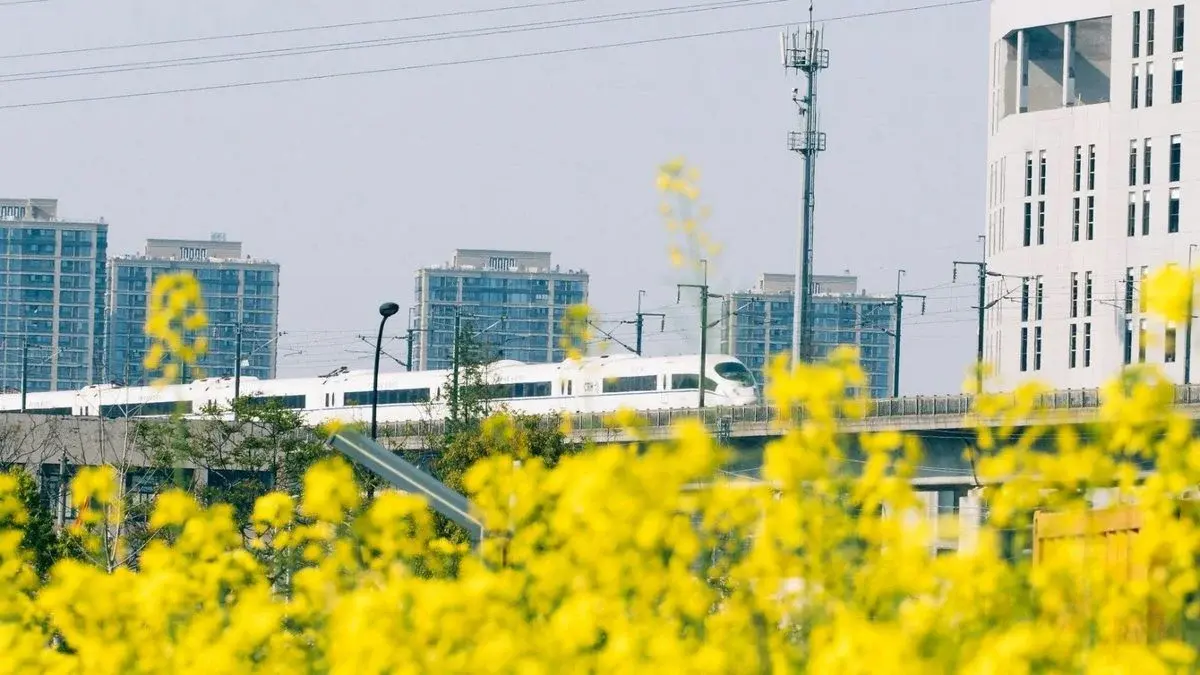
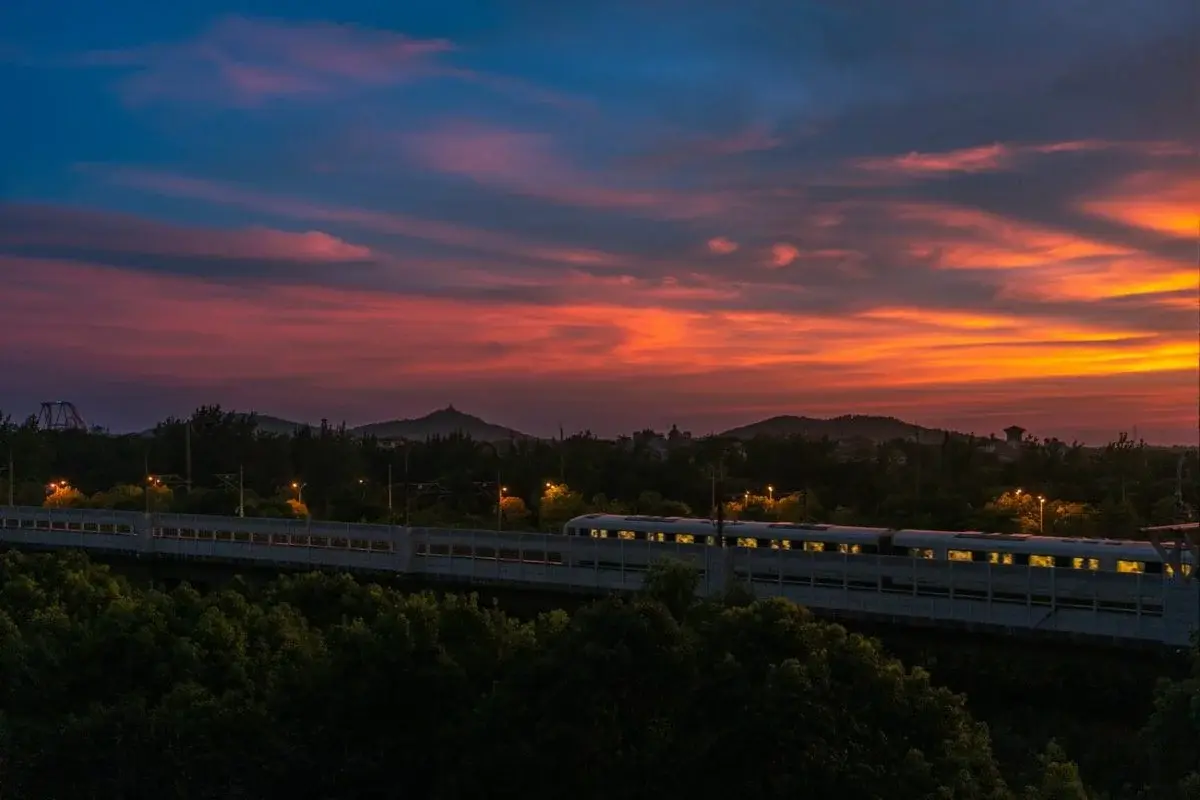
Three numbers, and one exception
China's high-speed rail costs about $0.06 per kilometer, covers 50,000 km, and lets you live cheaply in one city while working in another. For most of the country, it's the fastest, cheapest way to move. But if you live where I do — Dalian, staring at a bay — sometimes you still need a plane.
$0.06 per kilometer: why China's rail network is cheaper than it looks
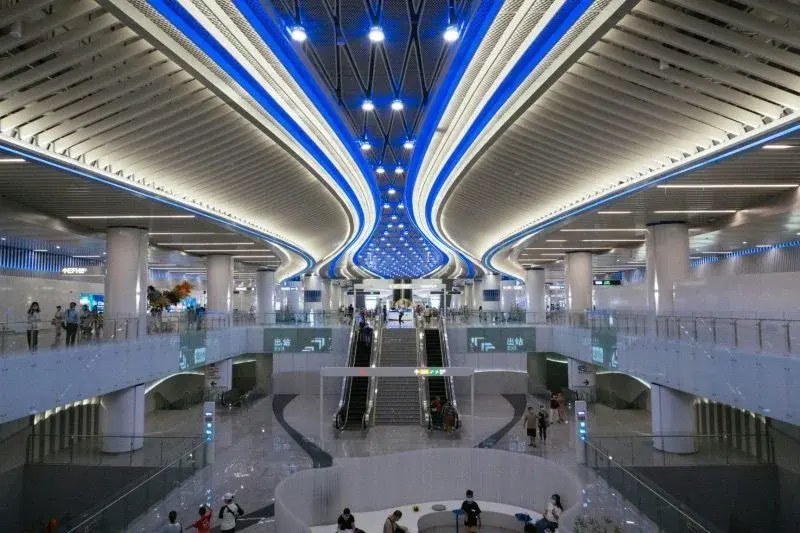
I first saw the video of Chongqing East Station on a rainy Tuesday in Dalian. 13 million square feet of glass and steel, and Elon Musk reposting it with no caption, just the footage. My first thought was that something that large had to cost a fortune to ride. I checked the fares that afternoon: a ticket from Chongqing to Chengdu starts at ¥150, about twenty dollars for a 350-kilometer trip.
01 — Why it's this cheap
$0.06/km vs Amtrak's $0.36: how the math works
| Route | Distance | Fastest time | 2nd class | Frequency |
|---|---|---|---|---|
| Beijing ↔ Shanghai | ~1,318 km | ~4.5 hrs | ≈¥550 / ≈$77 | dozens daily |
| Beijing ↔ Tianjin | ~120 km | ~30 min | ≈¥55 / ≈$8 | every ~10 min, peak |
| Guangzhou ↔ Shenzhen | ~140 km | ~30 min | ≈¥75 / ≈$10 | near-commuter |
Figures are rounded on purpose: fares, exact timings and schedules shift over time, so treat this as a sense of scale rather than a quote. Check 12306 for current numbers before booking.
How this compares to the West
I ran the math three times because I didn't believe it the first two. Beijing–Shanghai is 1,318 kilometers, roughly the distance from New York to Chicago, and costs about $0.06 per kilometer in second class. The closest thing America has, Amtrak's Northeast Corridor, averages $0.36. Six times isn't a price gap. It's a different system. I've paid more for a sandwich at Penn Station than I pay for a hundred kilometers of Chinese high-speed rail.
Even Europe's better-run systems can't touch this. Germany's ICE runs about $0.17/km and France's TGV about $0.15/km, both two-and-a-half to three times pricier. Put another way: a New York–Washington Acela ticket (roughly 360 km) commonly runs $100–$500 one-way. A Beijing–Shanghai ticket, nearly four times the distance, runs about $77 in second class.
China's high-speed rail costs $0.06 per kilometer. Amtrak's Northeast Corridor averages $0.36. That's a sixfold difference.
Western fare-per-km figures from Pedestrian Observations' 2024 analysis of Amtrak's 2023 Northeast Corridor revenue report, benchmarked against French and German operator data; Acela one-way fares from Amtrak's public pricing, 2025–2026.
China figures based on Hangzhou–Shanghai and Beijing–Shanghai corridor pricing, mid-2026. Western equivalents from Amtrak monthly pass pricing and Deutsche Bahn / SNCF public fares, 2025–2026.
In 2025 alone, a record year, China poured ¥901.5 billion (≈$125 billion) into rail construction, with high-speed lines getting the largest share. That scale of sustained build-out, year after year since 2008, is a big part of why the per-kilometer cost stayed this low. The low fares aren't a sign of loose operations, either: automated train control keeps speed pinned to the safe limit, and in my experience, across maybe thirty trips, only one was late, by eleven minutes. The flagship Fuxing-class trains typically hit the higher end of the 95–99% punctuality range.
02 — What that cheapness actually buys you
50,000 km of track, 97% coverage: what the network connects
China's high-speed rail network now reaches 50,000 km and covers 97% of cities with over 500,000 people.
As of the end of 2025, China's high-speed rail network passed ~50,000 km, up from ~38,000 km in 2020, reaching roughly 97% of Chinese cities with 500,000+ urban population. That's the real payoff of the low fares: living somewhere cheap doesn't mean being cut off from the cities where the money and opportunity are. A resident of a cheap third-tier city can plausibly commute into a first-tier one, or visit family across the country, for less than a Western reader spends on a single Uber ride.
Chinese planners call the tightest version of this an "hour circle" (一小时圈), but it isn't one single, nationally-numbered entity. It's regional shorthand that different metro clusters wear under their own official names:
1 — Beijing-Tianjin-Hebei
一小时通勤圈
"One-hour commuting circle": this exact phrase appears directly in national coordination planning for the capital region.
2 — Yangtze River Delta
上海"一小时经济圈"
The loosest of the four: local governments and media reach for "Shanghai's one-hour economic circle" often, but it isn't a single fixed, nationally-designated entity the way the other three are.
3 — Chengdu-Chongqing
成渝地区双城经济圈
A formal national-level strategy: the official name doesn't literally say "one hour," even though a one-hour travel time between the two core cities is the stated goal.
The car you never have to buy: Among people I know in Chinese cities under 35, almost nobody owns a car. In the US, car ownership is basically mandatory: the AAA estimates average annual ownership at $10,000+. In China, a Hangzhou–Shanghai commuter spends roughly ¥600 a month (≈$83) on rail.
In practice: a colleague of mine used to live in Suzhou while working in Shanghai's Bibo Road area, and the daily commute was a metro ride from Bibo Road to Hongqiao Railway Station, then a high-speed train from Hongqiao to Suzhou, and the intercity leg was consistently shorter than the in-city metro ride that got him there. That was back in 2016; the company's office has since moved to Hongqiao itself, cutting the in-city half of the commute out almost entirely and making Suzhou, and nearby Kunshan, an even easier place to live while working in central Shanghai. He pays less rent, keeps the Shanghai salary, and spends about ¥2,000 a month on transport total. Try doing that between Brooklyn and Manhattan.
The gaps that remain are specific rather than random: Tibet has no high-speed line yet, and large, sparsely populated stretches of Xinjiang, Inner Mongolia and Heilongjiang's rural north are still years away, because the economics of 350 km/h track don't pencil out against the traffic those areas would generate. Everywhere else, a mid-size Chinese city almost certainly has a station.
What "connected" doesn't always mean: I live in Dalian, a coastal city that's technically on the network but geographically shortchanged: Bohai Bay sits directly in the way of the straight line south. Dalian–Beijing is reasonable: ~5.5 hours for about ¥420. But Shanghai? The track has to crawl around the entire bay: 10.3–10.8 hours and about ¥907.5, 65% more expensive than Beijing–Shanghai and more than double the time for a broadly comparable distance as the crow flies. I actually tried to book it once, last spring, thinking I'd get work done on the ride. Then I checked flights: ¥380, two hours. I closed the 12306 app and bought the plane ticket. Being "on the map" and being the sensible way to travel aren't always the same thing. I live with that gap every time I plan a trip.
Time is the other half of the comparison. For Beijing–Shanghai, the train is 4.5 hours center-to-center. A flight is 2.5 hours in the air, but add airport transit, security, boarding buffer, and downtown egress on the other end, and you're looking at 5–6 hours total. I've done both. For distances under 1,300 km, the train often wins on total elapsed time, and you can show up fifteen minutes before departure instead of ninety. That matters if you're trying to squeeze a weekend trip into a life that already has five working days.
03 — Using it
Booking, boarding, and Chunyun: how to use the trains
You'll book through an app. Everyone does. The official one is 12306, the state platform and the only place where seats actually exist. Everything else, from Trip.com to Fliggy, is just a prettier window into the same inventory. When I first registered with my passport, the app rejected my name twice because I included a middle name. Chinese citizens just tap their national ID; foreigners like me need about five extra minutes and a bit of patience. Once you're in, though, it's seamless: buy the ticket, show up, tap your passport at the gate, board. No paper, no printing, no drama.
The standard presale window is 15 days before departure, for every route in the country, and no third-party site can get you around it. Third-party sites that advertise booking "30 or 90 days ahead" are marketing gimmicks; every platform pulls from the same 12306 inventory and the same 15-day rule. The one real exception: since July 2026, a pilot "reservation" service lets travelers on Beijing–Shanghai corridor trains submit a request up to 60 days out, which the system then fulfills 16–20 days before departure, which is worth knowing if you're planning that specific corridor far in advance, but it doesn't apply nationwide yet.
| Class | Layout | Fare vs 2nd class | What's different |
|---|---|---|---|
| Second class | 2+3 across | baseline | Standard, most of the fleet |
| First class | 2+2 across | ~1.5–1.8× | Wider seat, more recline, quieter car |
| Business | 1+2 across | ~3× | Near-flat recline, meal service, lounge access |
For comparison, a domestic flight's economy-to-business jump often runs 5–10×; the gap between classes here is much gentler.
Security itself runs like an airport's minus most of the wait: X-ray scanner, no liquids restriction, usually under ten minutes even at a busy hour. A realistic arrival buffer is 30–45 minutes at a normal station, closer to an hour at a mega-hub like Beijing South. Boarding gates close five minutes before departure: miss it and the ticket is void, not just late.
Plans change, and the fee structure is forgiving in one direction only: switching to a train on the same date or earlier is always free. Pushing the date later, or cancelling outright, follows a sliding scale based on how close to departure you are:
| Action | Fee |
|---|---|
| Change to same date, or earlier — any time | Free |
| Change to a later date, 24–48 hrs before original | ~5% |
| Change to a later date, under 24 hrs before | ~15% |
| Change after the original train has left | ~40% |
| Cancel, 8+ days before departure | Free |
| Cancel, 48 hrs – 8 days before | ~5% |
| Cancel, 24 – 48 hrs before | ~10% |
| Cancel, under 24 hrs before | ~20% |
Change and refund rules from China Railway's official 12306 policy, current as of early 2026; rules occasionally shift, so check the app for the exact fee before cancelling.
Two things worth knowing before a longer trip. For genuine long hauls (Harbin to Shanghai runs close to 13 hours), a small fleet of sleeper high-speed trains exists: private compartments with real beds, running overnight at up to 250 km/h. And the one stretch of the year the whole system gets hard to book is Chunyun, the Lunar New Year travel period, roughly 40 days with well over 500 million rail trips nationwide. Tickets release exactly 15 days before departure and popular routes can sell out within minutes; 12306's waitlist feature will automatically claim a seat if one opens up. I've watched friends refresh the app like it's a concert drop. If there's one stretch of the year to build slack into a China trip, this is it.
What it costs a regular rider: there's no monthly pass or subscription for high-speed rail: every trip is booked and paid for individually, unlike a metro card. But the math still favors frequent riders: someone commuting between two cities in the same cluster (say, Hangzhou–Shanghai, about ¥75 one-way) who makes that trip weekly spends roughly ¥600/month (≈$83), less than a single monthly transit pass in many Western metro areas, for round-trip intercity travel most of those systems don't even offer. My colleague in Suzhou doesn't think of this as "cheap transport." He thinks of it as "I don't need a car, a second apartment, or a different job." That's what the numbers actually buy you.
The verdict
Train vs plane: when to ride, when to fly
For most of the country the train wins, and it isn't close. It's fast, smooth, clean, priced at a fraction of Western equivalents, and still reaching further into smaller cities every year. Cheap rent means less if getting around is expensive, and here it usually isn't. The exceptions are specific rather than random: coastline detours like mine, and travel deep into the far west or north. For most of the country, the train is no longer the interesting choice. It's the default. I'd take it every time, unless I'm trying to get from Dalian to Shanghai. Then I'm flying.
04 — Questions people actually ask
Quick answers
How extensive is China's high-speed rail network?
Roughly 50,000 km of track, reaching 97% of Chinese cities with a population over 500,000. I've watched this map grow in real time since I moved here; coverage keeps pushing into smaller cities every year.
Is China's high-speed rail actually cheap?
Yes. Guangzhou–Shenzhen is half an hour and costs less than a Western short-haul taxi, at roughly $0.06 per kilometer.
What's the difference between second class, first class, and business?
Second class runs 2+3 seating as the baseline; first class is 2+2 with a wider, more reclining seat at roughly 1.5–1.8x the price; business is 1+2 with near-flat recline, meal service, and lounge access at roughly 3x.
How do you actually book a ticket as a foreigner?
Almost entirely through an app. I use 12306, the official state platform, though third-party apps like Trip.com offer a friendlier English interface for a small fee. You'll need your passport number, and I'd recommend registering a day or two before your first trip: verification can take a few hours, and you don't want to discover this at 8 AM on departure day.
Do you actually ride these trains, or just read about them?
I wish I could say I commute by HSR daily, but I live in Dalian, a city the network technically reaches but practically forgets. So my authority here is part firsthand, part obsessive research, and part asking friends who do commute this way.
Is it hard to book during Chunyun, the Lunar New Year rush?
Yes. Tickets release exactly 15 days before departure and popular routes can sell out within minutes. 12306's waitlist feature (候补购票) will automatically claim a seat if one opens up, so submit a request as soon as the window opens. If you can travel outside the 40-day window, do.