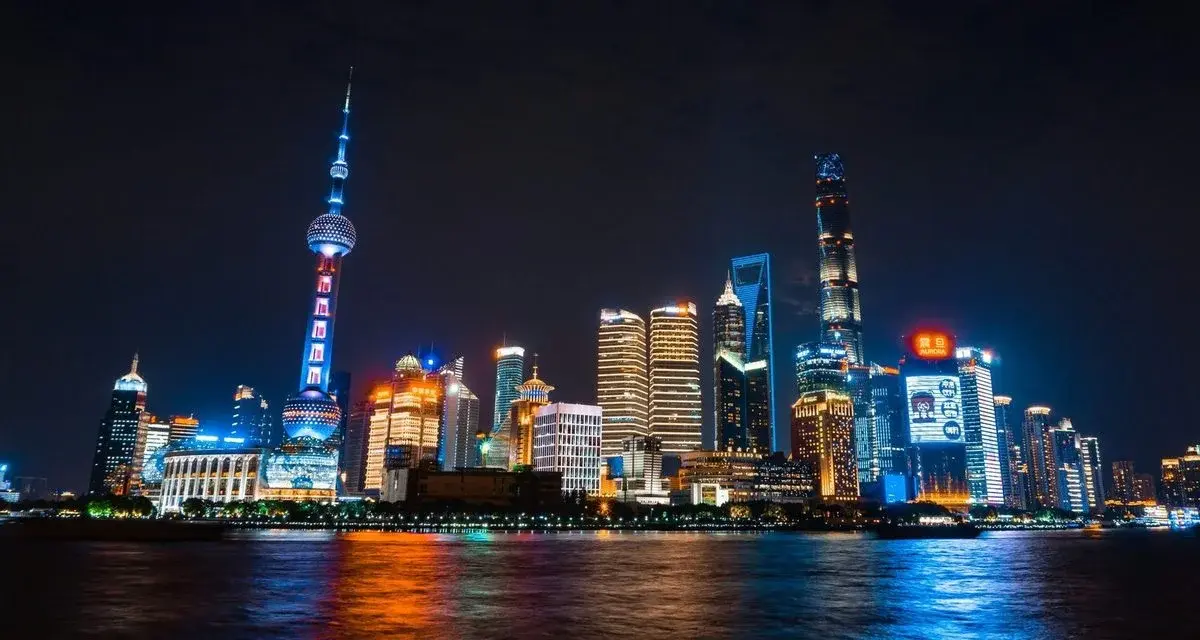

Put the two skylines side by side and you have to look twice. A river, a wall of glass towers lit gold at dusk, a single needle-topped landmark to anchor the eye. Both cities are their nation's money capital and aspirational magnet — the place the ambitious go to make it. Both stack a thin top tier of finance-and-tech salaries over a vast floor of service and labor. Both were built, and are still run, by people born somewhere else.
So it's tempting to treat them as the same city in two currencies. On the money, that's nearly true. On the thing that actually decides a life there, it isn't — and the gap is the whole point of this page. Shanghai is more than three times New York's population packed into eight times the land, and neither city keeps municipal winter heat running the way a northern Chinese city does — a fact that turns out to matter later, in what each city's electric bill is actually paying for.
 Shanghai
 New York
Left: Waibaidu Bridge and Broadway Mansions, Shanghai, photo by Will. Right: the Queensboro Bridge and the Roosevelt Island Tramway, New York, photo by Zoshua Colah. Both cities built their money on a river crossing — one by bridge and rail, the other by bridge and tram.
01 — The money nearly cancels
Shanghai vs New York: 70% vs 78% of wages on rent.
Shanghai's city-center one-bedroom runs $972 a month, roughly 70% of the median after-tax wage of $1,391. New York's center one-bedroom runs $4,295 a month, about 78% of its median after-tax wage of $5,486. The multiples nearly cancel. Both are brutal on paper, survivable on a local wage — but the door that decides who gets to belong is what really separates them.
*Paper figure — see why it lies in section 02. 1-bed and 3-bed rent, and the average after-tax salary, for both cities are Numbeo contributor data; each city's 2-bed row is a simple midpoint between its own 1-bed and 3-bed figures, not an independently sourced number — same estimation method used on both sides. Shanghai's 1-bed city-centre figure was captured earlier in 2026; New York's full rent and salary set and Shanghai's other rows were pulled in July 2026, so treat the set as roughly, not perfectly, contemporaneous. Converted at ¥7.2 = $1. Full sources below.
 Shanghai
 New York
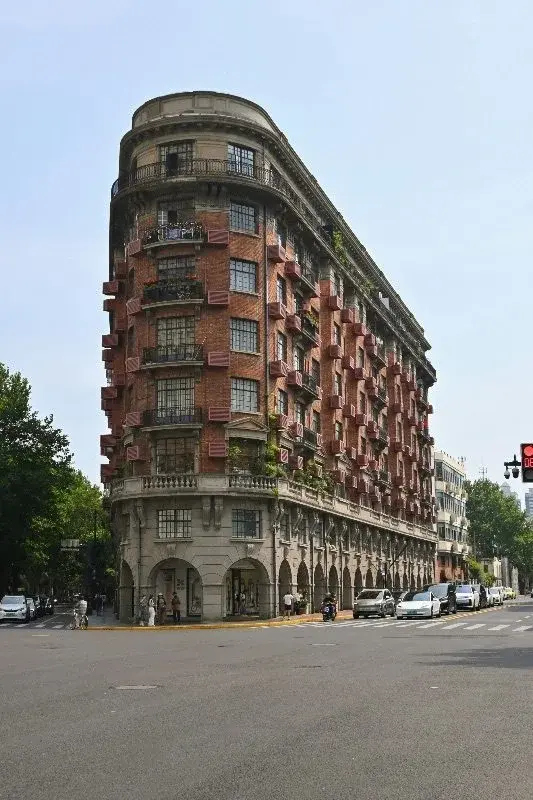
Left: a lane-corner apartment building in Shanghai, photo by Bryan Sun. Right: the Flatiron Building, New York, photo by Sam Butler. This is the kind of building both rent ledgers above are actually pricing — pre-war stock over a century old, still standing in the middle of both cities' most expensive ground.
New York's city-center rent runs a little over four times Shanghai's; its wages run about four times as much. The multiples very nearly cancel — closer, in fact, once the real July 2026 numbers replace the older estimate this page used to carry. Which means the lived experience rhymes: on paper the center looks impossible in both, and for someone actually earning the local wage, both turn out survivable. Neither city is cheap. Both are cheap enough for you, if you earn its salary and spend its prices — and if you want to check that against your own offer rather than the average, the move calculator runs the same math on your actual numbers.
Same city, different lifestyle — the monthly bill gap can be larger than the gap between cities →
01b — The everyday layer, priced side by side
Shanghai vs New York: utilities, groceries, and daily costs.
Rent carries the drama, but a household's other fixed costs — power, water, the weekly shop — say something different about each city, and they come from each government's own published rates, not a crowdsourced guess.
tiered · $0.086–0.127≈33.8¢/kWh
flat, all-in
Electricity: Shanghai's tiered rate is the Shanghai Municipal Development and Reform Commission's published guide (2025–26 edition); New York's is Con Edison's own published all-in Residential Service (SC-1) rate for 2025, the most recent it has posted, covering delivery, commodity and riders. Water: Shanghai's combined supply-plus-drainage tiers are the same Commission guide, cross-checked against Shanghai Chengtou Water Group; New York's $5.05 per 100 cubic feet (748 gallons) metered rate plus its 159%-of-water sewer surcharge is the NYC Water Board's official rate schedule effective May 11, 2026, converted here to a per-cubic-meter figure for comparison. Beef and pork: Shanghai from the Jing'an District government price bulletin, July 2026; New York beef is Numbeo's crowdsourced "beef round" figure, July 2026 — a comparable everyday cut, not identical. *Pork has no New York-specific figure available; the number shown is the U.S. national average pork-chop price (Bureau of Labor Statistics, May 2026), not a New York number — flagged here rather than presented as local. Eggs: Shanghai's wet-market price is sold by weight and converted here to a dozen-equivalent at roughly 60g per egg; New York's is Numbeo's directly-tracked dozen price, July 2026 — different measurement bases, so treat the multiple as directional, not exact.
Some of the widest gaps on this page aren't rent at all. Eggs run roughly five times as much in New York; at the cheapest tier, water runs closer to nine times as much once converted to the same unit. Electricity is a smaller gap by comparison — two-and-a-half to four times, depending which of Shanghai's tiers you compare it to. Rent is the cost people notice first. On a pure multiple, some of the smaller line items on the monthly bill are actually further apart.
Eating out, and staying connected
Neither city really expects you to cook. Shanghai's default is someone else's stove — a noodle shop, a steamed-bun stall, a food-delivery app, or one of the 1,600-plus subsidized community canteens that serve a full meal for about ¥15. New York's default is the same instinct dressed differently: takeout, a diner, a $25 plate at the corner place, because a kitchen in a 500-square-foot apartment is often barely a kitchen at all. Both cities eat out because home doesn't leave much room to cook — but one of those defaults costs a few dollars and the other costs several times more, tip included.
Dining and telecom figures for both cities are Numbeo crowdsourced averages — Shanghai's dataset last updated 1 December 2025, New York's 21 July 2026, so treat the comparison as roughly, not perfectly, contemporaneous. Converted at ¥7.2 = $1. The community-canteen figure is from the same municipal civil affairs reporting cited on the Shanghai city page, not from Numbeo.
New York's restaurant dinner for two runs about five times Shanghai's. Mobile and broadband together run about $149 a month in New York against roughly $20 in Shanghai — call it seven times over. Neither multiple is really about the food or the signal. Chinese telecom is state-directed and priced to stay near-universal; American telecom and restaurant labor are priced the way American labor and American commercial rent are priced. Every one of these gaps eventually traces back to the same place rent does.
02 — Both numbers lie, the same way
Shanghai vs New York: the phantom median in both cities.
That 70%/78% rent burden is a fiction in both cities, for an identical reason. Match the center rent to the salary of the person who actually signs that lease — a Lujiazui analyst, a Wall Street associate on ¥28k–45k or its dollar equivalent — and it drops toward a quarter of income. Match it instead to the wage of the rider or the line cook who keeps the city running, and it's simply impossible; they live four to a flat, or an hour and a half out. Both cities are bimodal. Both medians describe almost no one. It's the same trap, run twice.
Look back at the headline numbers and the same trap shows up a second way. Shanghai's average take-home pay — $1,391 — doesn't even reach the low end of the compiled "all-in, one person" range ($1,600–2,500). New York's average pay sits comfortably inside its own range, well above the $5,000 floor. Neither city's "average salary" is the salary of the person actually paying that city's average bill — and in Shanghai's case, the average salary doesn't cover it at all, on paper. That's not evidence the money is coming from savings, family capital, or investment income specifically; this page doesn't have data on where the gap actually gets filled, and it won't guess. What it is evidence of is the same underlying fact this section keeps circling back to. An average built from a bimodal population describes a household that doesn't really exist, on either side of the ledger. Average pay and average spend are each averaging over a different mix of people, and there's no reason to expect the two averages to reconcile.
This site's founding rule is that a number means nothing until you know whose income it sits next to. Shanghai and New York are the two cities where there is no single "whose" — just an average floating between two populations who never meet in the middle. It's also why Shanghai is the one city in the Five Kinds of Cheap framework that isn't cheap by any of the five mechanisms. The phantom median is the reason no discount survives contact with it.
03 — The commuter mirror
Shanghai vs New York: the commuter mirror.
Each city is organized around people who don't quite live in its core. Every morning New York pulls hundreds of thousands of commuters in — from New Jersey, Connecticut, the far edges of Long Island — people who earn in Manhattan and sleep outside it. I ran the mirror image of that: I earned in Shanghai and slept in Dalian, flying out every Friday night and back every Monday. Not the train — Dalian sits on the wrong side of Bohai Bay for that; the high-speed rail route has to detour so far around the water that it runs over ten hours and costs 64% more than the equivalent Beijing–Shanghai trip, so flying wins on both time and price. In versus out; daily versus weekly. Either way, the city is where the money is made, and home is wherever the rent lets you breathe.
Even the turnstiles tell the split. New York charges one flat fare — $2.90 to ride one stop or the length of the island. Shanghai charges by distance, which is part of why its metro ranks among the most expensive in China to actually commute on, tier by tier, even though the base fare looks cheap. Here's the system each fare buys, side by side:
19 lines399 km
36 lines / 28 services
¥3 (≤6 km) → ¥15 capFlat
$2.90 any distance
30-day unlimited pass
*Not a like-for-like product: Shanghai has no official unlimited monthly pass, so this is Expatistan's crowdsourced average monthly transit spend for a Shanghai resident (March 2026), converted at ¥7.2 = $1. New York's figure is the actual price of the MTA's 30-day unlimited MetroCard/OMNY pass, via Numbeo, July 2026. Route length, station count, and annual ridership for both systems are from Wikipedia's Shanghai Metro and New York City Subway infrastructure entries, current as of this writing; Shanghai's ridership figure is the most recent full-year total available (2023), New York's is 2025 — not perfectly contemporaneous, flagged here rather than smoothed over.
Shanghai's network is roughly twice New York's by route length and carries more than half again the annual riders — on a distance-based fare that, tier by tier, actually prices out cheaper for most real commutes than it looks from the ¥3 headline. New York's flat fare is simpler and, for a regular rider on the unlimited pass, ends up costing about five times what an average Shanghai commuter spends in a month — even though a single ride costs about the same at the turnstile. The single-fare number is nearly identical. The monthly bill isn't close.
And in Shanghai the real rush hour isn't underground at all — it runs on electric bikes, the same way a Shanghai winter runs differently from a New York one. Shanghai gets snow most years, but almost always as a night event: it falls after dark, dusts the parked bikes and the lane rooftops, and is gone by the time the street wakes up — Suzhou Creek's bridges bare again by nine. New York's snow does the opposite. It falls in daylight as often as not, and once it lands it stays: plowed into gray berms at the curb, tracked through the subway stairs, still there a week later. Same word, two different relationships with the ground.
 Shanghai
 New York
Left: a street near the Bund, Shanghai, bare pavement on an ordinary day. Right: a DUMBO street under snow that's staying put, Manhattan Bridge behind it, New York, photo by Andre Benz.
04 — The door
Shanghai vs New York: 42% vs 37.5% outsiders, opposite doors.
Here is where the twin cities stop being twins. Look at how much of each is made of people from somewhere else — and then at what that status lets them become.
Shanghai
42%
of residents hold no Shanghai hukou
≈10.5M of 24.9M · 2020 census
They build the city, staff it, feed it. But a decade in, many still can't enroll a child in a local school on equal terms, buy on equal terms, or convert their status — the city grants only tens of thousands of local hukou a year. Residence and belonging are two different things you qualify for separately.
The door mostly stays shut.
New York
37.5%
of residents are foreign-born
≈3.1M · ACS 2023
Nearly the same share, arriving for nearly the same reason. But the overwhelming majority are lawful immigrants on a path that ends, if they choose it, in citizenship — a passport, a vote, an equal claim on the place. The outsider who stays long enough can become an insider.
The door, for most, opens.
The skyline is the same. The membership isn't.
04b — What putting down roots costs
Shanghai vs New York: buying in and raising a child.
"Belonging" isn't only a legal status. It shows up as two very concrete bills: the price of owning instead of renting, and the price of educating a child well enough that the next generation doesn't start over from zero. Neither of these appears on the site's own Shanghai deep-dive, because they're not what a typical renter or a typical local family pays — they're what an outsider trying to plant something permanent pays.
Center to center, New York costs about a third more per square foot to buy. But look at the second row — Shanghai's outer ring is actually pricier than New York's, by roughly ten percent. The two cities' suburbs run on opposite logic. New York's outer boroughs are, on average, simply cheaper land, further from the core, with no ceiling on how far the city can sprawl. Shanghai's outer districts are still Shanghai — the same school-district rules, the same limited pool of land a non-resident is even legally permitted to buy in, the same 24.8 million people competing for a fixed footprint that can't sprawl the way New York's can. Scarcity outside the center is a New York discount. In Shanghai it barely is one.
New York's international-school tuition runs a little over twice Shanghai's — a real gap, but a smaller multiple than rent, eggs, or dining out produced. The reason isn't that either system is cheap. It's that both prices are, in their own way, an exit fee — a family paying to route a child around whichever local system they don't fully trust or don't fully qualify for. In Shanghai that's a non-hukou family buying its way past a public-school assignment tied to residency status. In New York it's often a family paying to skip a public system it can legally use for free, for reasons that have nothing to do with belonging and everything to do with school quality and class. Same price tag, two entirely different things being purchased.
The two dimensions in this section are the ones the rest of this page doesn't quite reach. Rent measures what it costs to live somewhere. These measure what it costs to stay — to own instead of lease, to hand a child something better than the local default. Shanghai's door mostly stays shut on the legal question; on the financial one, staying is expensive in both cities, just for different reasons.
05 — The honest brake
Shanghai vs New York: three honest caveats.
First, the ledger doesn't run one way. On street-level safety the advantage is Shanghai's, and plainly: violent-crime rates are far lower, and I could walk home at any hour without a second thought — a daily ease New York's numbers don't match. So each city holds something the other withholds. New York offers a path to belonging; Shanghai offers a nightly walk home without fear. Neither is the whole of a life, and which one weighs more is yours to decide, not mine.
Second, and this is a limit on me, not on the cities: I lived Shanghai for five years, and I have never set foot in New York. Everything on the New York side of this page is read from data — the Census, the city's own planners, Con Edison's and the Water Board's own rate filings, the rent trackers — not from a sidewalk. I've told you which city I know and which I only researched, because that's the deal on this site. Weigh the New York column accordingly.
Both cities were built by outsiders. Only one of them was built into a place an outsider could belong.
If you're choosing between them
Deciding on more than the number
- The money won't decide it. The multiples nearly cancel — you'll feel similarly squeezed on paper and similarly fine on a real local salary. Don't pick on cost of living alone; it's close to a wash.
- Price the things the spreadsheet can't. A path to belonging, or a nightly walk home without a thought. Those two are the real difference, and neither shows up in a rent figure.
- Ask which crowd you'd actually land in. The median in both cities is a phantom. Your real monthly math depends entirely on whether you arrive already earning the wage that rents the center — or spend years working toward it.
- Don't let rent be the only line item you check. Eggs run roughly five times as much in New York as in Shanghai on this page's numbers; water runs six to nine times as much. A rent-only comparison misses where the real gap sits.
06 — Questions people actually ask
Quick answers
Is Shanghai cheaper than New York?
The money nearly cancels — both are brutal on paper but survivable on a local wage, following a similar affordability pattern despite being in different countries.
What's the real difference between Shanghai and New York, if not cost?
The door — about 42% of Shanghai's population holds no local hukou, and about 37.5% of New York is foreign-born, but only one of those groups has a realistic path to full local insider status.
Do both cities' “average” cost figures actually describe real residents?
No — in both cities, the person renting the center isn't the same person earning the median wage; the headline average obscures who's actually paying what.
Are Shanghai and New York both commuter cities in some sense?
In a sense — both function as places people go specifically to earn, with home and family life often located somewhere cheaper nearby.
What does putting down roots cost in Shanghai vs New York?
Both cities carry a real cost tied to buying property and raising the next generation locally, addressed directly in the comparison rather than assumed to be identical in both places.