
The same seat can cost four times as much, three weeks apart
China doesn't just have a busy travel season — it has several, moving in different directions at different times of year, each one pushing fares up on a different set of routes. Winter sends northerners toward Hainan; the same weeks send visitors north to Harbin for the ice and snow. Summer flips it again, driving up fares to northern coastal cities as an escape from inland heat. Layer on discount tiers, a fuel surcharge that quadrupled this year, and a checkout page full of pre-selected extras, and the price on screen stops being a fixed number and starts being a small negotiation with the calendar.
01 — How big this actually is
7.7 billion passenger trips in 2025 — and 2,613 planes over China as I write this
China’s domestic aviation market is the world’s second‑largest, handling 7.7 billion passenger trips in 2025 alone — and it actually turned a profit.
In 2025, China's civil aviation sector carried 7.7 billion passenger trips, up 5.5% from the year before, with flight volume up 4.7% and an on-time rate above 90% — and the sector actually turned a profit, not some subsidized operation running at a loss. At peak travel times it gets even denser: during the 2025 Spring Festival travel period, airlines carried 90.2 million passengers on 739,000 flights — averaging 18,500 flights a day, with a single-day record of 2.48 million passengers.
My own routine
470,241 km, 655 hours, 20 airlines — mostly the same Dalian–Shanghai corridor. One person's habit, not evidence about the industry; the number is almost certainly an undercount.
This exact moment
A live flight-radar screenshot grabbed while writing this — not a yearly total, just whatever happened to be in the sky over mainland China right then.
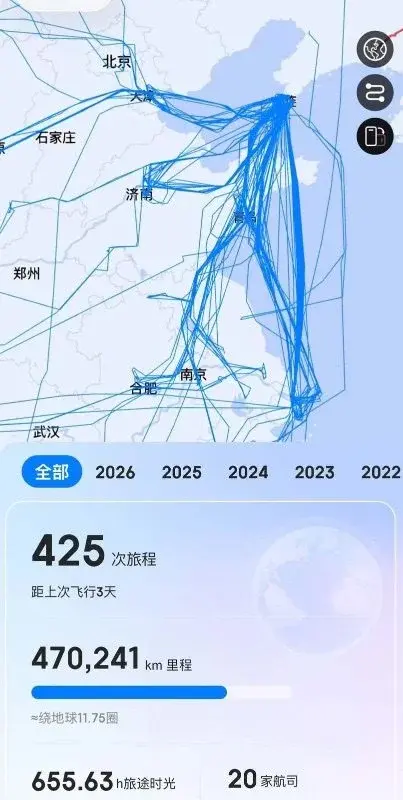
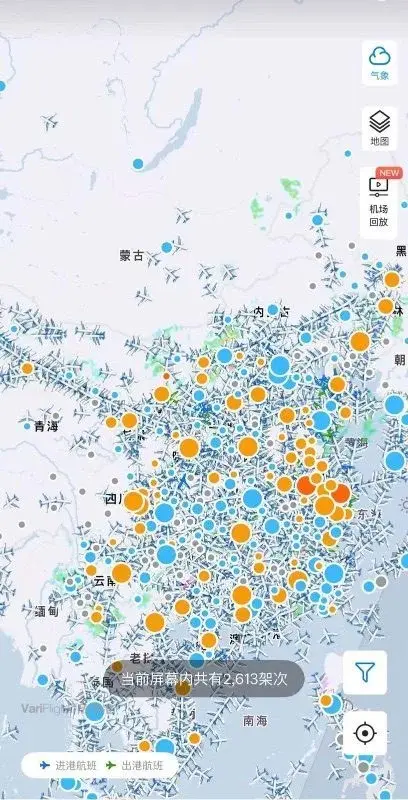
Left: the author's own logged flight history, 2012–2026. Right: a live radar snapshot, July 2026.
None of this means flying is automatic — where a coastline forces a long rail detour, like Dalian heading south, flying becomes the practical default. That story's in the rail piece; not repeating it here.

02 — What that fare actually includes
Hidden fees, fuel surcharges, and baggage costs – what a domestic China flight really adds up to.
All that traffic runs through a pricing system with more moving parts than the headline fare lets on. Every domestic ticket carries fixed government fees, a fuel surcharge that shifts with oil prices, and — unless you catch it at checkout — a stack of pre-selected extras.
| Add-on | Typical cost | Note |
|---|---|---|
| Airport construction fee | ¥50 / person | Fixed, government-set |
| Fuel surcharge | ¥10–220 / person | 2026 range — quadrupled, then partly eased |
| Delay / accident insurance | Varies, often pre-checked | Optional — easy to buy without noticing |
| Transfer / hotel vouchers | Varies, often pre-checked | Same as above |
Fuel surcharge swung sharply in 2026 — new rules effective April 2026 now require platforms to display bundled add-ons clearly and make them easy to remove.
My own approach: I don't buy any of the extras, insurance included, reimbursed or not. That's a preference, not a recommendation — the insurance isn't fake, it's just easy to end up with by not paying attention.
Checked baggage is the other add-on worth watching before you fly. Standard economy allowance is 20 kg (30 kg in business, 40 kg in first), and going over it costs 1.5% of the full one-way economy fare per excess kilogram — not 1.5% of whatever discounted price you actually paid. Two extra kilograms on a ¥1,000 full fare works out to about ¥30, but the rate is pegged to the sticker fare, not the bargain one — easy to miss if you booked one of the deep-discount fares covered in §03 below.
The sharpest edge of this: tickets under 30% of full fare usually can't be voluntarily changed, and cancelling one can cost way more than expected. One widely reported case involved a ¥900 ticket that cost roughly ¥3,000 to cancel — extreme, but real.
That fixed ¥50 airport fee sits on top of a system built on enormous upfront capital — the real cost of that infrastructure is settled elsewhere →
03 — The migrations behind the price
Spring Festival is the one true nationwide peak. Everything else is regional.
Those fare-class penalties are just one symptom of a system where the sticker price is barely the starting point — the bigger swings come from when you fly, not what you click at checkout.
| Season | Fare tier |
|---|---|
| Off-season | 20–30% of full fare |
| Shoulder season | 40–50% |
| Peak season | 60–70% |
| Highest-demand dates | 80%–full fare |
Seasonal demand shifts — not random airline pricing — can make the same seat cost four times more just weeks apart.
Spring Festival and National Day are the two calendar-driven peaks. The more interesting swings are regional and seasonal: winter break sends northerners toward Hainan (the "migratory birds,") while Harbin fills with visitors chasing ice and snow (the "little potatoes,"). Summer break drives up fares to northern coastal cities like Dalian, Qingdao, and Yantai. It's less a single busy season than several overlapping migrations, each pricing a different set of routes at a different time of year.
How fast it flips
Days after the 2026 Spring Festival period ended, Beijing–Sanya fares dropped to as low as 11% of full price, and Beijing–Harbin tickets went for ¥277. Same routes, same planes — a completely different market inside a week.
04 — When to actually buy
When to book a domestic China flight – the 30‑to‑45‑day sweet spot.
Airlines usually haven't released discount fare classes three months out, so early bookers often see only the priciest seats. The sweet spot for most domestic routes is 30–45 days before departure. International routes follow a wider U-curve, best around two to four months out.
Airlines will sometimes slash prices in the final days if a flight isn't filling — but it's unreliable, mostly limited to quiet routes and the off-season, and a bad bet if your dates are fixed. The 30–45 day window is a compromise, not a guarantee.
05 — The discount-ticket ecosystem I've never used
An entire industry of "secret cheap flight" accounts exists, and I don't know if it's worth trusting
The 30–45 day rule is the mainstream answer to "how do I pay less." But there's a parallel, much less official answer running alongside it. Douyin, Kuaishou, and Xiaohongshu are full of ads for absurdly cheap flights — framed as insider tricks or code-word deals only savvy travelers know. It's a genuinely large corner of Chinese social media.
I've never used one of these channels, and I don't have a strong basis for recommending or debunking them — a deliberately honest gap, not modesty. What I notice as an outsider: the ads lean hard on urgency and secrecy, framing that works whether the deal is real or not. Some channels are almost certainly legitimate resellers; others blur into the territory the §02 regulations were written to address. I can't sort which is which from the outside.
06 — Where people actually book
Three channels cover almost everyone
Airline apps book direct with the carrier — most reliable for fare rules and support, rarely the cheapest-looking number. OTA platforms (Trip.com/Ctrip, Fliggy, Qunar) aggregate multiple airlines with easier comparison, for a small service fee. Flight-tracking apps like Feichangzhun (飞常准) and Umetrip (航旅纵横) aren't booking tools, but their delay tracking comes in handy once you're holding a ticket.
The bottom line
What this page is really for
This isn't a claim that flying in China is cheaper or better run than anywhere else — I don't know how it compares, and I'm not going to guess. What I can say is that it's dense, convenient, and priced by a system with real logic behind its swings. If this gets you to check the fuel surcharge, question a pre-checked insurance box, or wonder if there's a cheaper way to book the same seat — it's done its job.
07 — Questions people actually ask
Quick answers
How much can domestic flight prices in China vary?
The same seat can cost up to four times as much just three weeks apart — driven by demand swings tied to migration patterns, not some fixed fare.
How big is China's domestic flight network?
7.7 billion passenger trips in 2025, with over 2,613 planes in Chinese airspace at once during peak periods.
What hidden fees show up on a domestic China flight?
A fuel surcharge (¥10–220/person, which quadrupled in 2026 before easing back) and often-pre-checked delay/accident insurance that's easy to buy without noticing — both sit outside the base fare on the results page.
How much is the checked baggage fee on a domestic China flight?
Standard economy allowance is 20 kg; going over costs 1.5% of the full one-way economy fare per excess kilogram — a rate tied to the sticker fare, not whatever discounted price you actually paid.
Is Spring Festival really the only major travel peak in China?
Yes — it's the one true nationwide peak. Every other travel surge is regional, not national.
When's the best time to book a domestic China flight?
Not as early as you'd think — booking too early is its own mistake, since fares often move closer to departure rather than only rising. That's the opposite of the usual Western flight-booking wisdom.