Living cost, at a glance
≈$347/mo
≈$833/mo
≈$528/mo
≈$875/mo
≈$1,361/mo
Rent varies dramatically by season — see §01. The non-rent line folds in food, transport, utilities and everyday extras as one figure. Converted at ¥7.2 = $1.
Sanya's first impression is usually beach and sunshine. But once you settle, the city's real rhythm shows up in the hallways—buildings empty in November, Northeastern accents fill corridors in December, and by April the crowds disperse. This is a city reshaped by "snowbirds": a permanent population of 1.136 million, but the actual number of winter residents likely far exceeds that. For a deeper look at China snowbird migration: real costs and trade-offs for expats.
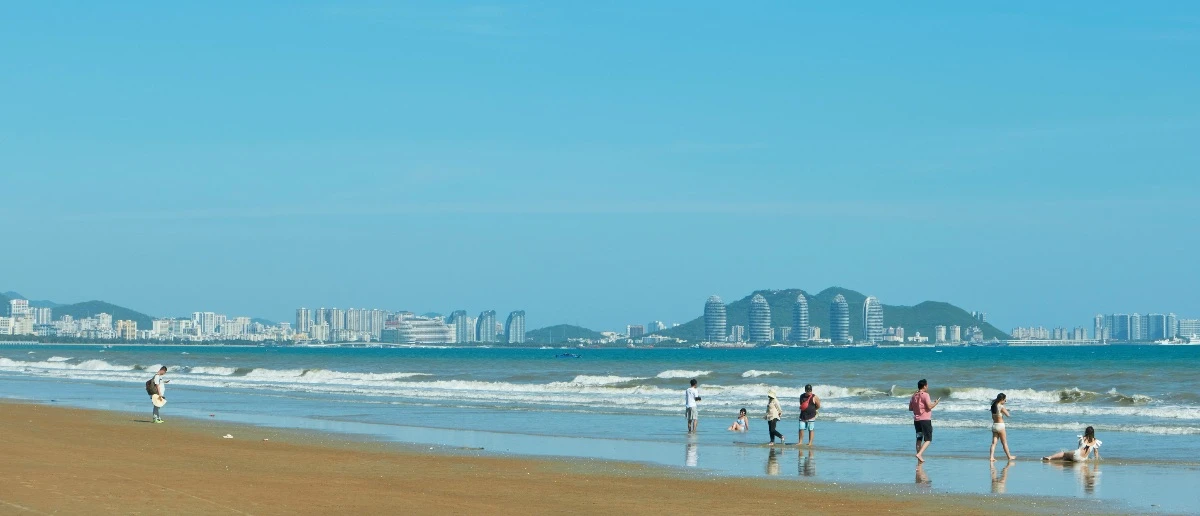
Geographically, Sanya sits at the southern tip of Hainan Island, near 18°N, China's only tropical coastal tourist city. It covers 1,921 km², has a 209.1 km coastline, and administers four districts: Haitang, Jiyang, Tianya, and Yazhou. The average annual temperature is 25.4°C; even the coldest month, January, averages around 21°C. For northern Chinese, it's essentially perpetual summer.
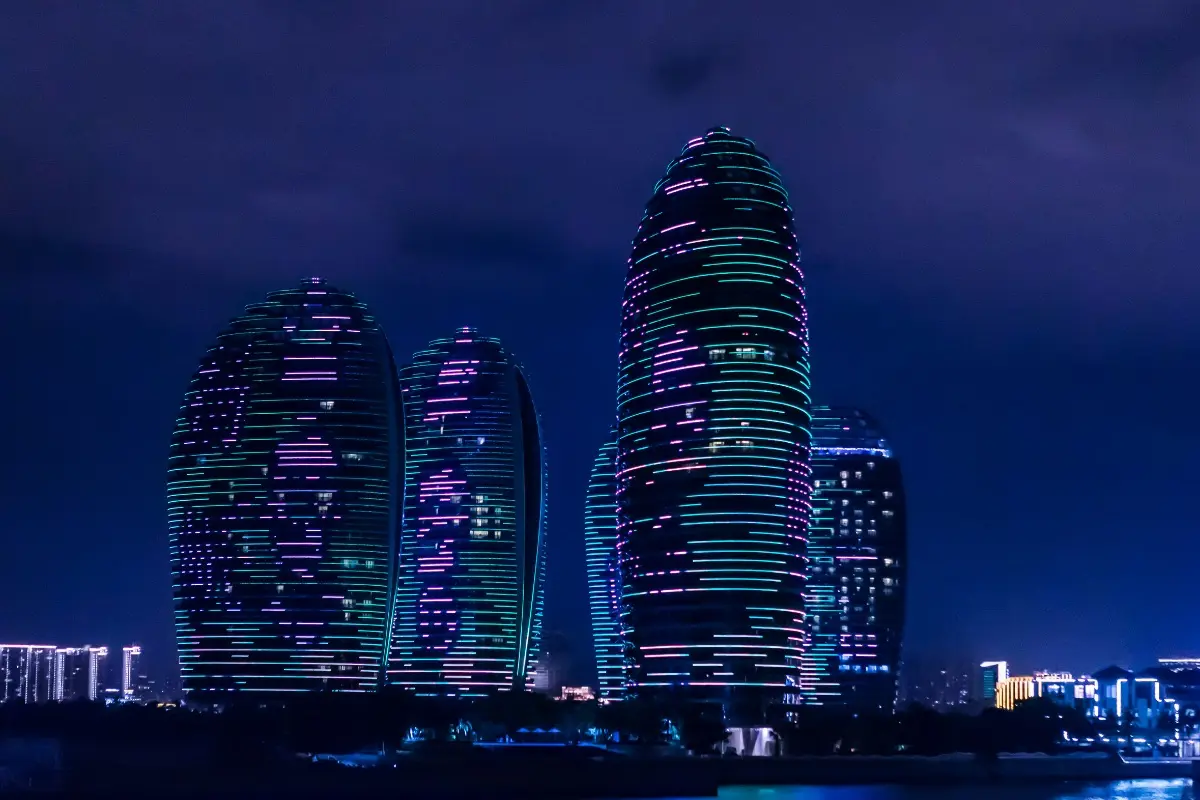
In 2025, Sanya received 27.08 million overnight tourists, with total tourism spending reaching 98.426 billion yuan, and an average hotel occupancy rate of 69.0%. Duty-free shopping is another key driver, retail sales of consumer goods totaled 57.306 billion yuan, with automobile sales (including duty-free) up 125.3%, and gold, silver, and jewelry up 25.0%. Behind the numbers, however, are two parallel ways of life: the tourist's Sanya and the snowbird's Sanya.
If you earn dollars, about $875/month covers a city-center one-bedroom, food, transport, and utilities in the low season; in high season, that number can double. If you earn a local salary, the urban per capita disposable income in 2025 was 49,225 yuan/year, roughly $570/month, Sanya is not cheap. There's a tourism premium here, and that premium seeps into everyday costs year-round.
01 — The monthly numbers
Sanya rent: ¥2,500/mo in low season, ¥6,000+ in high season.
The headline numbers for Sanya are clear, but they come with a catch that no other city in this series has. A city-center one-bedroom runs about ¥2,500 (≈$347) per month in low season, but jumps to ¥6,000–8,000 (≈$833–1,111) in high season. That is a 2–3× swing, driven entirely by the snowbird calendar. The blended after-tax median wage is about ¥4,100 (≈$570) per month. Against that wage, low-season rent is manageable, but high-season rent is not. This page is built from public data and the author's family visits since 2016. The numbers are sourced; the personal texture comes from an aunt's rental building in Gangmen Village, and is clearly marked as such.
Sanya's cost of living has a feature you won't find elsewhere: extreme seasonal price swings. The figures below use the low season (May–October) as a baseline; rents in the high season (December–February) can jump 2–3 times. Amounts are in RMB, with USD roughly at ¥7.2 = $1.
Sources: 58.com Sanya rental data (2026), Sanya Municipal Development and Reform Commission water/electricity/gas price notices, Sanya Transport Bureau bus/tram fare approvals, Hainan Provincial Development and Reform Commission fuel prices (2025). Currency converted at ¥7.2 = $1.
How renting actually works in China — deposits, contracts, and what to watch for →
What that ¥204 a month for electricity, water, and gas actually buys
Sanya has no winter heating, but air conditioning runs heavily over a long summer. All utilities use tiered pricing, settled annually or monthly.
| Tier | Usage | Rate |
|---|---|---|
| 1 | Summer: 0–220 kWh/mo Winter: 0–160 kWh/mo | ¥0.6083/kWh |
| 2 | Summer: 221–360 kWh/mo Winter: 161–290 kWh/mo | ¥0.6583/kWh |
| 3 | Above tier 2 | ¥0.9083/kWh |
Summer standard: Apr–Oct. Winter standard: Nov–Mar. In Sanya, "winter" is mild, but the lower tier threshold still applies. Most households run air conditioning 6–8 months a year; a single-occupant apartment with efficient AC typically stays within tier 1.
| Tier | Monthly usage | Rate |
|---|---|---|
| 1 | 0–24 m³ | ¥2.10/m³ |
| 2 | 24–30 m³ | ¥3.20/m³ |
| 3 | 30+ m³ | ¥6.50/m³ |
Plus a separate "water-resource tax-related cost" of ¥0.10/m³, and a sewage charge (typically ¥0.95–1.25/m³ depending on district) billed as a distinct line item. The table above shows the pure water price only.
| Tier | Annual usage | Rate |
|---|---|---|
| 1 | 0–260 m³/yr | ¥2.94/m³ |
| 2 | 261–390 m³/yr | ¥3.53/m³ |
| 3 | 391+ m³/yr | ¥4.41/m³ |
Rates adjusted Aug 2020. Annual cycle. Most tropical-city households use gas mainly for cooking and occasional water heating; monthly consumption is typically modest, keeping most users comfortably inside tier 1.
Electricity: Hainan provincial residential tiered schedule (Southern Power Grid), summer/winter dual standards. Water: Sanya Development and Reform Commission notice on water price structure adjustment, effective Apr 18, 2025. Gas: Sanya DRC pipeline gas price notice, Aug 2020, tier thresholds from the 2015 Hainan Provincial Price Bureau approval. Sewage charge: estimated based on common Hainan municipal practice — Sanya does not publish a unified citywide sewage fee in the same public document as the water price.
Standardized comparison figure, applied the same way across every city on this site: 200 kWh electricity (Sanya summer tier 1: 200 × 0.6083 = ¥122) + 12 m³ water (tier 1: 12 × 2.10 = ¥25, plus resource tax ¥1 and estimated sewage ¥12 = ¥38) + 15 m³ gas (tier 1: 15 × 2.94 = ¥44) ≈ ¥204 (≈$28)/month. This is lower than northern cities primarily because there is no heating component.
02 — The bay map
Sanya's four bays: Haitang, Yalong, Dadonghai, and Sanya Bay, four different jobs.
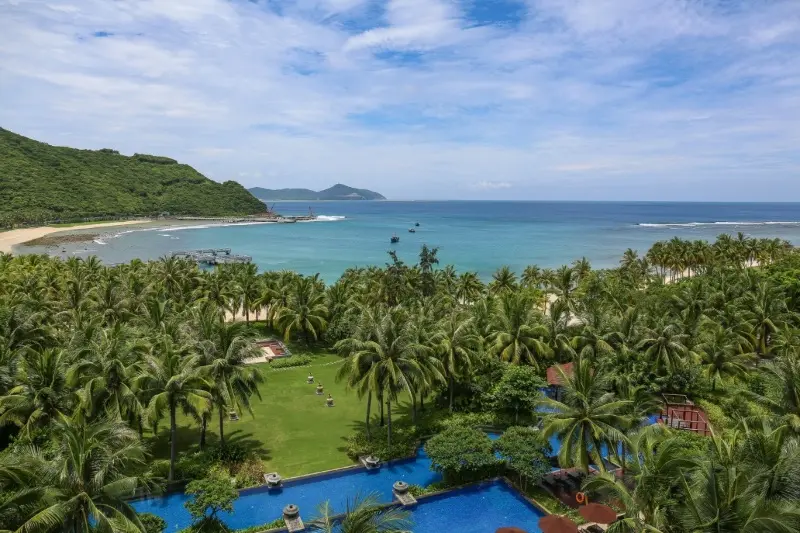
Sanya's coastline is carved into several main bays, each with a different function. To tourists, they're all "beaches"; to locals or long-term residents, each bay has its own character, crowd, and price bracket.
North–south sand differences
Sanya's beaches are completely different from northern coasts. Dalian's beaches are mostly pebbles and coarse sand—thick-soled shoes required. Sanya Bay's sand is fine enough to pick up barehanded. I know this because I brought a box of it home. This difference isn't just about tourism; it's geology and climate: tropical weathering is more thorough, and long-term deposition of coral fragments and shell powder creates fine calcium carbonate beaches.
Subjectively, Yalong Bay has the finest sand, followed by Dadonghai. Sanya Bay's sand is slightly coarser due to its proximity to downtown and river mouths, but still far superior to northern standards. Haitang Bay's sand is relatively coarse, but its draw isn't "playing in the sand", it's "staying in the hotel."
03 — A cost you've never had to think about
Tropical building logic in Sanya: ventilation over insulation.
In Sanya's village rentals, like Gangmen Village, you'll see a density that doesn't exist in northern cities: buildings so close that "you can reach out and touch the opposite wall." I remember this clearly from my 2016 stay: windows opening onto a neighbor's wall, close enough to reach out and touch. These "handshake buildings" are the physical carriers of the snowbird economy: low cost, high turnover, seasonally full occupancy. But the building details themselves are even more interesting.
Tropical building logic
Open lobbies: Sanya's high-end residences and hotels often have no lobby doors—not a design oversight, but climate logic. Tropical cities don't need to "seal tight"; airflow matters more than insulation. The lobby is an extension of public space; cross-ventilation is itself a cooling system.
Bar-style security doors: Unlike the heavy, sealed security doors of the north, Sanya commonly uses bar-style grilles, security with ventilation. In a place that doesn't need insulation, a building's primary enemy is stuffy heat, not cold.
Dense self-built housing: In village areas like Gangmen, 5-floor self-built buildings with 4 rooms per floor, rented to snowbirds for half the year, empty the other half. This is the capillary of Sanya's accommodation industry, and the physical form of the building my aunt rented and renovated.
These details are not "backward", they're adaptations to a tropical climate. When northern architecture thinks about how to retain heat, Sanya's architecture thinks about how to let heat escape. This difference is written into every window, every door, and every gap between buildings.
04 — The honest part
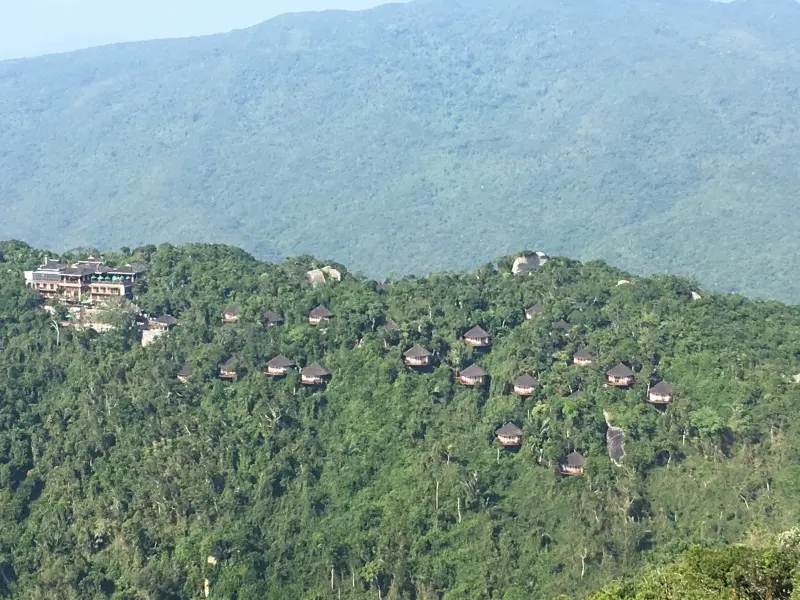
Sanya's snowbird economy: why it's called "Heilongjiang Province, Sanya".
This isn't a formal administrative division, it's a sociological fact. Sanya's winter population experiences a "seasonal inversion": in some neighborhoods, the density of Northeastern accents may exceed that of certain communities in Harbin.
This inversion has institutional markers:
- Administrative spillover: Harbin Public Security Bureau has a police station in Sanya; the Second Affiliated Hospital of Harbin Medical University has a branch here. These are institutional signs that "snowbirds" have graduated from "tourists" to "seasonal residents."
- Culinary colonization: Northeastern restaurants coexist with coconut chicken hotpot—Sanya's flavor map. The richness of Northeastern stews and the lightness of coconut chicken are opposites, and also a daily expression of migration culture.
- Rental economy: Buildings like the one my aunt runs in Gangmen—20 rooms across five floors—rented to Northeastern snowbirds for half the year, empty the other half. ¥3,500/month for a suite in December, ¥2,500–3,000 for a six-month booking. The price fluctuation itself is a calendar of migration.
There's a subtle tension between Sanya's local residents (Li and Han) and the snowbird migrants. Locals complain about peak-season congestion and rising prices; snowbirds complain about non-transferable healthcare and lack of belonging. The two groups share the same bay, but live on different timetables.
Demographically, Sanya's permanent population at the end of 2025 was 1.136 million, with a registered population of only 803,000, meaning about 30% of permanent residents are "outside" the household registration system. In winter, that proportion likely climbs higher. Of the 27.08 million overnight tourists, a significant number don't stay in hotels, they stay in "snowbird apartments" like those in Gangmen Village.
Population data: Sanya Municipal Bureau of Statistics 2025 year-end communiqué. "Heilongjiang Sanya" observation and the "seasonal inversion" of population structure are on-the-ground social descriptions, not formal census categories. The HMU Second Affiliated Hospital Sanya branch and Harbin Public Security Sanya station are documented public-service outposts. My aunt's rental details are personal recollection from a 2016 stay.
05 — Expats here, if you're arriving from North America
Where North Americans live in Sanya: Dadonghai and the west end of Sanya Bay.
The previous section named Sanya's "Heilongjiang" snowbird population, the Northeastern Chinese who fill apartment buildings in winter. What it didn't say: there's a smaller, quieter parallel population of Westerners, and they're concentrated in a different part of the map. Sanya's foreign-resident geography runs in three clusters, and all of them sit inside the bay geography this page already names:
| Area | Why here | Who you'll find |
|---|---|---|
| Dadonghai | Sanya's oldest foreign-oriented neighborhood, Russian tourists have been coming here since the 1990s. More recently, it's become the default first stop for independent Western travelers and digital nomads. | Russian long-stay tourists (the single largest foreign group), plus Europeans, Americans, and Australians, drawn by walkable beach access, budget guesthouses, and the most developed "foreigner infrastructure" in the city. |
| Sanya Bay — west end | Longer-term Western residents, retirees and remote workers, cluster in older condo buildings near the Coconut Dream Corridor. Lower rents, slower pace, and a handful of Western-run cafes. | Western retirees, remote workers, and North American snowbirds who prefer a quieter rhythm than Dadonghai's resort vibe. Many rent by the month from local landlords. |
| Yazhou Bay & Science City | Hainan's new frontier for foreign professionals, 163 foreign-invested firms, including Canadian, American, and European companies, have set up operations in the tech park. | Foreign researchers, engineers, and business professionals, a smaller but growing population, mostly in company-provided housing. |
This section describes where Sanya's foreign, primarily Russian and Western, population is known to concentrate, compiled from municipal urban-planning history, tourism reports, and community reporting, not a formal nationality-specific census. Treat the figures as directionally right rather than a precise headcount.
How many Westerners are actually here?
Numbers are hard to pin down, partly because of China's visa system and partly because few official sources break out nationality by city. A few data points frame the picture:
| Indicator | Figure | Source / note |
|---|---|---|
| Foreigners with work & residence permits in Sanya | 700+ | Sanya municipal government, May 2025, covers all nationalities |
| Foreign residents in Dadonghai community | ~80 | Local community reporting, from 20+ countries, including US, Germany, Russia |
| Foreign-invested enterprises, Yazhou Bay | 163 | Yazhou Bay Science and Technology City, 2026, includes Canada, US, Italy, France |
| Overnight foreign tourist arrivals, Sanya (2025) | ~200,000+ | Hainan provincial tourism statistics, vast majority are short-term visitors |
The 700 figure includes all work-and-residence-permit holders, not just Westerners; Russians are the single largest nationality. The Dadonghai figure is a neighborhood-level count, not citywide. Actual foreign-resident numbers across the whole city are likely in the low thousands. Treat the scale, not the exact digit, as the useful takeaway.
Two snowbird calendars, one city
The Northeastern Chinese snowbirds of §04 and the Western snowbirds of this section follow the same seasonal calendar—arriving in November, leaving in April—but they barely overlap on the ground. The Northeasterners cluster in Sanya Bay's village rentals and older walk-ups; the Westerners skew toward Dadonghai's beachfront guesthouses and the newer condo blocks at the west end of Sanya Bay. Same city, same season, different maps. The only place they reliably cross paths is in the seafood markets and the airport.
North Americans on the ground: what the public record shows
Direct reporting on North Americans in Sanya is sparse, but a few profiles emerge from local news and business reporting:
- American entrepreneurs: The most visible North Americans in Sanya are small-business owners—restaurateurs, cafe operators, and English-language school directors. One prominent example is a US-educated Korean-American who left a 30-year finance career to open a Western-style restaurant in Sanya, which has become a regular gathering spot for the foreign community.
- Canadian researchers: Yazhou Bay's tech park has at least a handful of Canadian-affiliated researchers and entrepreneurs, part of the 163 foreign-invested enterprises operating in the zone.
- Retirees: Anecdotal reports from Sanya's long-term rental agents suggest a small but steady flow of North American retirees, most in their 60s and 70s, who spend the winter months in Sanya, often renting the same apartment year after year. They're not visible in official statistics because they typically enter on tourist visas and don't register as residents.
Compared to Shanghai's Biyun and Lianyang communities, purpose-built to house thousands of foreign corporate employees, Sanya's Western population is an order of magnitude smaller, more seasonal, and more dispersed. It's not a corporate expatriate community. It's a snowbird community, just like the Northeastern one, but from the other side of the Pacific.
American entrepreneur and Canadian researcher mentions are drawn from publicly available local business and tech-park reporting, not a comprehensive survey. The "small but steady" retiree description is an informed summary based on interview-type accounts from local rental agents and community observers—treat as directional, not a statistical claim. For a full breakdown of reporting and method, see the city's source note.
06 — Who's actually here
Sanya's economy: duty-free, real estate, and the snowbird rental market.
Sanya's economy has three layers: the top tier is Haitang Bay's duty-free mall and high-end hotels; the middle tier is real estate (cycling from "snowbirds buying homes" to "regulatory restrictions"); the bottom tier is village self-built housing converted into "snowbird apartments", family-run short-term rentals are the capillaries of Sanya's accommodation industry.
| Layer | What it is | Who it serves |
|---|---|---|
| Top | Haitang Bay duty-free mall, Atlantis, high-end hotel clusters | High-spending tourists, duty-free shoppers |
| Middle | Real estate: second-hand avg. ¥35,000/㎡ in Tianya/Jiyang, ¥55,000/㎡ in Haitang, ¥18,000/㎡ in Yazhou | Snowbird buyers, investors |
| Bottom | Village self-built short-term rentals: Gangmen etc., single rooms ¥1,500–3,500/month | Long-stay snowbirds, wintering elderly |
In 2025, Sanya's total retail sales of consumer goods reached 57.306 billion yuan, up 12.7% year-on-year. Automobile sales (including duty-free) grew 125.3%; gold, silver, and jewelry grew 25.0%; grain, oil, and food grew 51.6%. The dividend of duty-free policy reform is still unfolding, the offshore duty-free quota of 100,000 yuan per person per year makes Sanya one of the most concentrated duty-free consumption destinations in China.
Real estate tells a more complex story. After the 2018 island-wide purchase restrictions, outsiders need to meet strict social security requirements to buy residential property; apartments became the alternative. This explains why Sanya's rental market is so active: many people want to live here, but they can't buy.
Sanya's GDP in 2025 was 103.388 billion yuan, with the tertiary sector dominating (tourism, retail, real estate). Urban per capita disposable income was 49,225 yuan/year (≈$570/month), rural 25,876 yuan/year. Tourism revenue of 98.426 billion yuan is nearly on par with GDP, showing that Sanya's economy is heavily reliant on external consumption.
Economic data: Sanya Municipal Bureau of Statistics 2025 year-end communiqué. Real estate prices: market monitoring reports, Jan 2026. Duty-free policy: Hainan Free Trade Port regulations, current as of 2026.
07 — The part North Americans don't believe
What food costs in Sanya: coconut chicken, Northeastern dumplings, and seafood markets.
Sanya's flavor map is a direct product of migration culture. Coconut chicken hotpot, using fresh coconut water as broth to poach Wenchang chicken, is a native expression of tropical produce: light, sweet, with a drinkable broth. I remember it vividly from my 2016 trip: the broth was so good I kept going back for more. The ubiquity of Northeastern cuisine, meanwhile, is the "culinary colonization" brought by the snowbird population.
Coconut chicken: a native flavor symbol
Coconut chicken is not a traditional Hainan dish, it was invented in Shenzhen and popularized in Hainan. But all its ingredients are local: coconuts from Wenchang or Wanning, and Wenchang chicken, one of Hainan's four famous dishes. A pot of coconut chicken hotpot costs about 80–120 yuan per person, mid-range for Sanya. Its lightness contrasts sharply with the richness of Northeastern stews, a metaphor for the city's population structure.
Northeastern food: the snowbird's nostalgia
On Sanya's streets, the density of Northeastern dumpling shops, Northeastern BBQ, and Northeastern iron-pot stews far exceeds expectation. These aren't for tourists, tourists gravitate toward seafood and coconut chicken. These dishes are for snowbirds: a group of elderly people who fly south every winter and north every spring, needing familiar flavors to anchor their lives away from home.
Seafood markets: where the uncle went
Sanya's seafood market ecosystem is well-developed, with clear tiers from tourist destinations to local shopping spots:
- First Market (155 Jianxin Street, Tianya District): The oldest, surrounded by seafood processing shops; freshest when new stock arrives at 3–5 PM. Most touristy, with the most touts.
- Train Head Seafood Plaza: More regulated, with real-time price displays; good for price-insensitive tourists.
- Chunyuan Seafood Plaza: Classic open-air food court style; processing shops lined up side by side for easy price comparison.
- Xin Honggang Market: Local shoppers' top choice; prices are fairer, small lobsters around ¥60 each, mantis shrimp with roe around ¥100/jin.
- Yazhou Central Fishing Port: The source market, farther from downtown, but you can buy the freshest catch directly.
One visitor recalled that an uncle went to one of these seafood markets, but couldn't remember which, only that it "seemed not close" to Gangmen Village. For snowbird families, buying seafood at the market and having a processing shop cook it is more economical than eating out. The delivery apps tell a similar story →
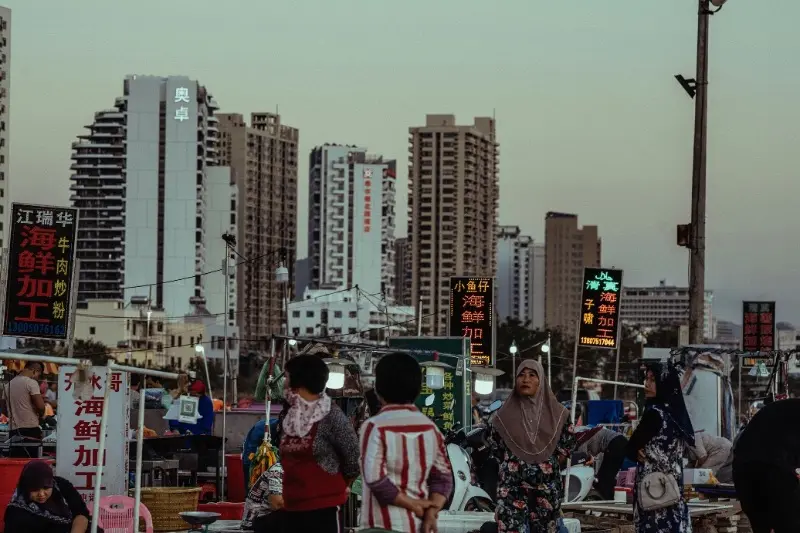
Seafood market descriptions compiled from Sanya tourism bureau materials and market guides (2026). Price examples are illustrative market rates, not fixed official prices.
08 — Getting around a city built for tourists
Getting around Sanya: free highways, pricey gas, and no metro.
Sanya's transportation has a unique paradox: highways are free, but fuel prices are among the highest in the country. This is because Hainan rolls vehicle maintenance fees (road tolls) into fuel prices, rather than collecting them through toll booths like on the mainland. During my 2016 stay, my cousin lent us a Mercedes V-Class, and we drove all over Yalong Bay, Haitang Bay, and everywhere in between. The roads were free, but the gas cost more than I was used to.
The fuel paradox
Hainan highways are free, but fuel includes a vehicle passage surcharge. In May 2025, 92-octane gasoline in Hainan was about ¥8.03/liter, 95-octane about ¥8.52/liter—about ¥1/liter higher than most mainland cities. For fuel vehicles, the more you drive, the more you "save" (since there are no tolls); for EVs, that logic doesn't hold.
As EV adoption grows, a question looms: when more and more vehicles no longer use fuel, how will Hainan's "road maintenance fee in fuel" system be sustained? Currently, EVs enjoy free highways in Hainan without paying into the system. A policy adjustment is only a matter of time.
Getting around town: buses, trams, and taxis
Sanya's bus system covers major attractions and downtown areas, with fares starting at ¥2, using distance-based pricing, requiring both boarding and alighting scans. The tram demonstration line (Sanya Railway Station–Jiangang Road) has a flat fare of ¥3, the province's first rail transit line, though more symbolic than practical due to its short length.
Taxis are divided into two classes: Class 1 (comfort) starts at ¥11/2.5km, Class 2 (economy) at ¥10/2.5km; beyond that, Class 1 charges ¥2.4/km, Class 2 ¥2.2/km. A 20% surcharge applies at night (11 PM–6 AM). Ride-hailing services (Didi, etc.) are usually slightly cheaper than taxis and offer transparent pricing.
For tourists, Sanya's transportation is friendly airport, high-speed rail, downtown, and attractions are all connected by public transport or ride-hailing. How urban transport works across Chinese cities → For residents, however, peak-season congestion is a reality: with winter tourists flooding in, traffic pressure on downtown roads and around scenic spots increases significantly.
Sanya has no subway (the tram doesn't count), nor does it have widespread bike-sharing (terrain and climate discourage cycling). In peak season, hailing a ride may require patience. For snowbird seniors, the bus pass (Tianya Xing app) is essential—free for ages 70+, half-price for 65–69.
Fuel prices: Hainan Provincial Development and Reform Commission, May 2025. Taxi fares: Sanya transport authority published rates. Tram fare: Sanya DRC approval, 2020. Bus elderly discount policy: Sanya DRC & Transport Bureau, effective Apr 2026. The Mercedes V-Class and the drives to the various bays are personal recollection from a 2016 trip.
09 — Questions people actually ask
Quick answers
How much does rent cost in Sanya?
Highly seasonal. A furnished one-bedroom in the city center runs about ¥2,500/month (≈$347) in low season (May–Oct), but can jump to ¥6,000–8,000 (≈$833–1,111) in high season (Dec–Feb). Suburbs / village rentals (e.g. near Gangmen) start around ¥1,500 (≈$208) in low season. For reference, my aunt's Gangmen building rents a suite for ¥3,500/month in December, dropping to ¥2,500–3,000 for six-month bookings.
Is Sanya actually cheap?
Compared to a North American salary, yes, especially in low season. Compared to local wages (urban disposable income ≈$570/month), no. Tourism premium affects everyday prices: restaurants, groceries, and services all carry a "beach tax" that locals pay year-round.
Do I need a car in Sanya?
Not strictly. Buses (from ¥2), the tram (¥3), taxis, and ride-hailing cover most needs. But if you plan to explore beyond the main bays, e.g. Yazhou Bay, remote beaches, a rental car or e-bike (about ¥40/day) adds flexibility. Remember: highways are free, but gas is expensive. We drove a Mercedes V-Class around all the bays in 2016—free roads, pricey fuel.
What's the best season to visit or stay long-term?
For cost: May–October (low season, cheapest rent, hottest weather, occasional typhoons). For comfort: November–March (dry, mild, but highest prices and crowds). The "shoulder" months of late October and early April offer a compromise.
Why is gas so expensive in Sanya?
Hainan province folds road maintenance fees into the fuel price rather than charging tolls. So highways are free, but every liter of gasoline includes a vehicle passage surcharge. As of 2025, 92-octane gas runs about ¥8.03/liter. Electric vehicles currently enjoy free highways without paying into the system—a policy gap that may close in the future.
Where do the Northeastern "snowbirds" actually live?
Concentrated in Sanya Bay (downtown, convenient), Dadonghai (beachfront), and in village rental buildings in areas like Gangmen Village. My aunt's building in Gangmen—5 floors, 20 rooms—is a perfect example of the model: rented to snowbirds half the year, empty the other half.
If you're thinking of going
Sanya, for a first visit or a long stay
- Best season for cost: May–October. Lowest rent, fewest crowds, but hot and humid with occasional typhoons.
- Best season for comfort: November–March. Dry, mild, but prices double or triple.
- Getting there: Sanya Phoenix International Airport (direct flights from most major Chinese cities); or Hainan Loop High-Speed Rail from Haikou (about 1.5–2 hours).
- Staying a while: negotiate monthly rent directly with landlords in Sanya Bay or village areas—often cheaper than platforms for long stays. My aunt's building in Gangmen is one of many; the model works.
- Getting online: sort a China travel eSIM before you fly. How to get connected in China →
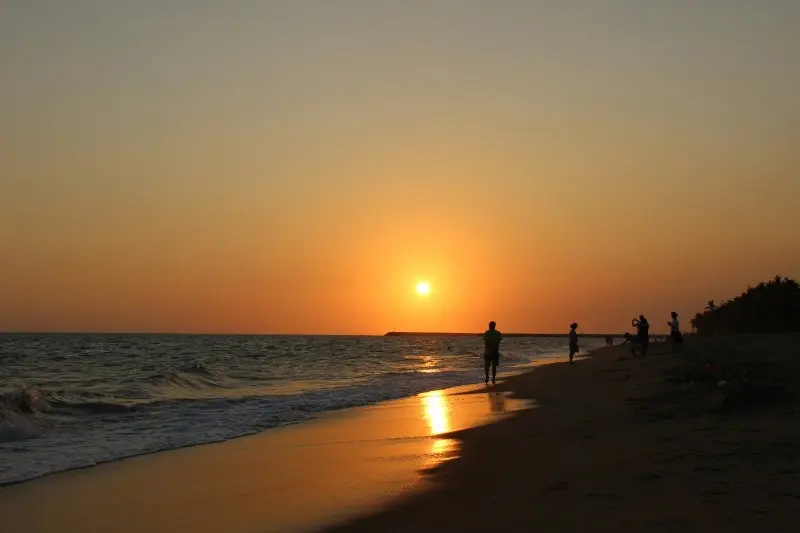
- Catch the sunset: Sanya Bay's Coconut Dream Corridor is the classic evening walk—free, and better than most paid attractions.
- Still deciding? Try the city match tool →; Answer 7 questions to find a better match →