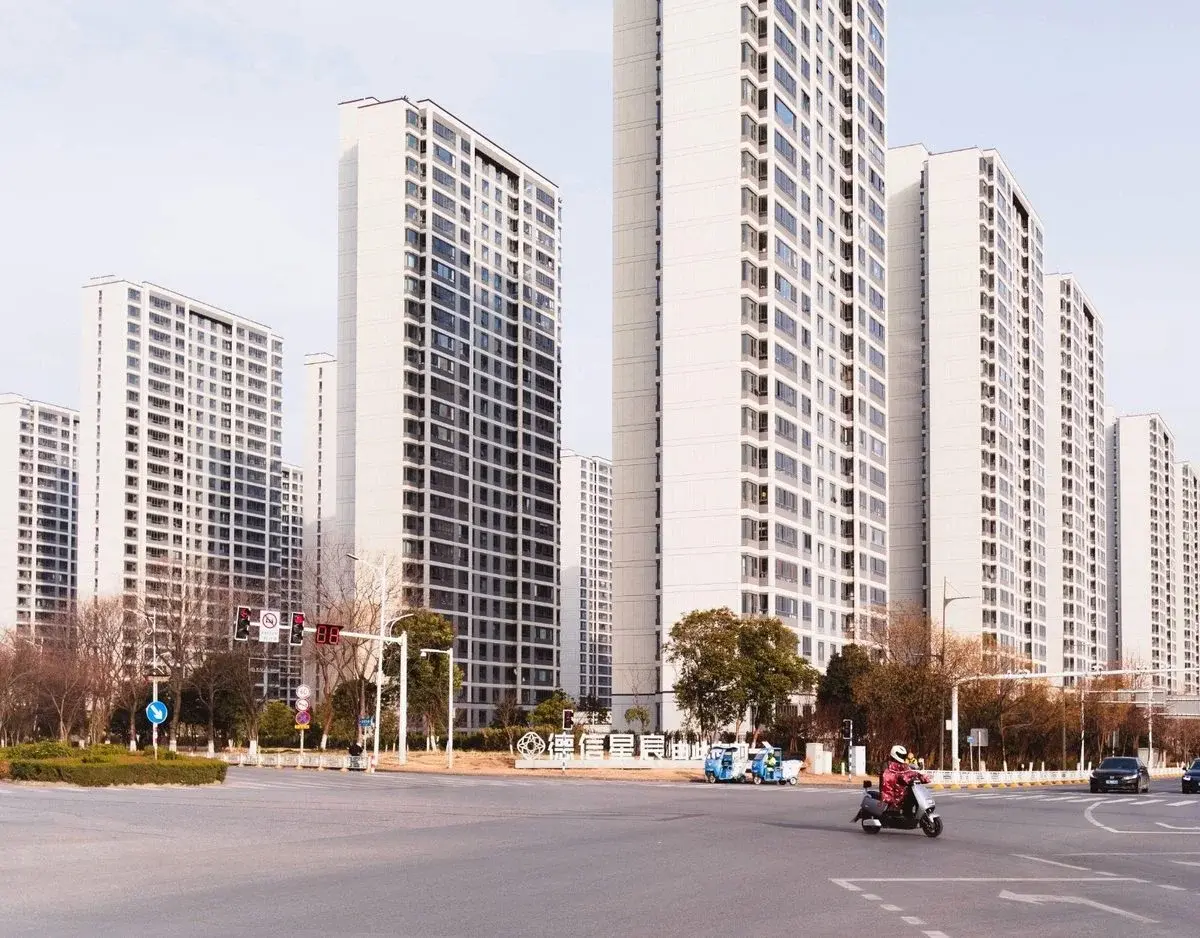

A downtown apartment here, and what the same money gets you back home
A one-bedroom in a decent, next-generation building near the center of Shanghai or Shenzhen — the kind of place a mid-career professional would actually live in — usually rents for less than a studio in most major North American or Western European cities, and often less than half. That gap is there before you even start comparing agencies or fees. It's the fact underneath everything else here: whatever you end up paying to find and sign for a place in China, you're almost certainly still paying less than you would at home for something smaller.
What complicates that simple story is that foreigners rarely pay what locals pay for help finding a place. The agencies built for non-Chinese-speaking tenants charge more, sometimes a lot more, than the ordinary storefront agent down the street. The extra cost isn't a trick. It's what it takes to have someone read listings, contracts, and landlord conversations you can't read yourself. That premium has a shape: what the service buys, what it costs city by city, and why it still doesn't flip which side of the comparison comes out cheaper.
01 — Who finds you the apartment
Four rental channels: big platforms, local agents, foreign agencies, word of mouth
Renting in China runs through about four channels, and each one trades off convenience, cost, and how much you can verify yourself.
Big platforms
Standardized listings, photos, and prices you can browse before you ever call anyone. Convenient and brand-backed, but young renters still swap stories about "formaldehyde apartments" fresh off a rushed renovation, or partitioned rooms carved out of one unit.
Ordinary local agents
Cheapest route, and the default for the vast majority of tenants. The catch for a foreign tenant is exactly what it sounds like: the whole process — listings, contract, negotiation — runs in Chinese, with no built-in translation layer.
Foreigner-facing agencies
Same job as a local agent, plus a translated contract, an English-speaking point of contact, and someone who shows up to the viewing and the landlord conversation. Costs more, sometimes a lot more.
Word of mouth
Cheapest and most trustworthy when it's available, but you can't plan around it — you either have the connection or you don't.
The two screenshots below show what browsing looks like on the two biggest listing platforms. This is the starting point for channel one and, in practice, the research step most foreigner-facing agents use before they ever pick up the phone.
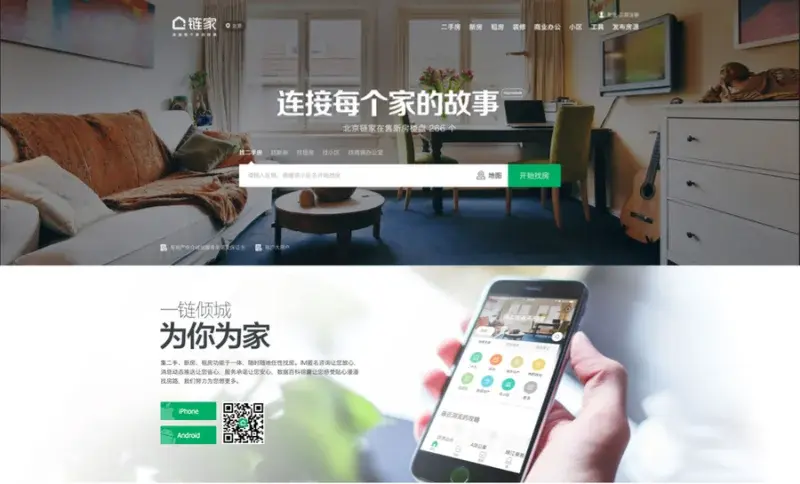

Lianjia and Anjuke, two of China's largest property platforms. Both cover sale, resale, and rental listings.
Rent depends on city, district, building age, and floor plan more than any single table on this page could responsibly show. For a live number, search your target city and district directly on Lianjia or Anjuke. For the figures verified and sourced for this site, see the relevant city guide.
02 — The deposit math and who pays what
"Deposit one, pay three" is the default nationwide
The standard payment structure when you sign is one month's rent as deposit, plus three months paid up front. Budget for four months of rent in cash before you get the key. This is only part of the upfront setup cost →
| Item | Typical figure | Note |
|---|---|---|
| Deposit | 1 month's rent | Standard nationwide |
| First payment | 3 months' rent | "Deposit one, pay three" |
The agency fee itself is where city habit takes over. It's always measured against one month's rent, but who pays what share — and whether that month gets split at all — is local custom, not a national rule.
| City | Agency fee, typical split |
|---|---|
| Beijing | ≈1 month's rent, tenant & landlord each half |
| Shanghai | 35% of monthly rent, each side (≈70% total) |
| Guangzhou | ≈1 month's rent, tenant & landlord each half |
| Shenzhen | ≈1 month's rent, tenant & landlord each half |
| Dalian | ≈1 month's rent, tenant & landlord each half |
| Chengdu | Varies by district — full month from tenant alone in some areas, half-and-half in others |
| Chongqing | ≈50% of monthly rent, split or tenant-only depending on the deal |
The standard rental deposit in China is "deposit one, pay three": one month's rent as deposit, plus three months paid up front.
Figures reflect general market practice reported across multiple Chinese legal-reference sources, cross-checked rather than drawn from a single source, current as of 2024–2025. Shanghai's distinct 35%-each-side agency fee convention and its municipal cap on agency fees (up to 70% of one month's rent) are from 66law.cn legal reference material. Dalian's agency-fee convention (≈1 month's rent, split evenly between landlord and tenant) is from fang.com and Jiwu.com local reader Q&A reporting, cross-checked against the same 66law.cn source used for other cities. Standard one-year lease terms, the lack of automatic renewal under Chinese contract law, typical 15–30-day renewal notice, and early-termination penalty norms (including the ~30%-above-actual-loss threshold courts commonly apply) are aggregated from 66law.cn and Huichenglawyer.com legal-reference reporting and case summaries, checked mid-2026. The pattern of foreign tenants renting sublet rooms above market rate through foreigner-facing agencies is discussed in a Zhihu community guide to renting in Shanghai (2022). Serviced-apartment positioning and typical terms are drawn from operator sites (Ascott, Fraser, and independent Beijing/Shanghai serviced-apartment listing platforms). The author's own rental experience in Shanghai, and the corporate-agency pattern observed through colleagues' relocations to Dalian and Shanghai, are personal accounts, current as of 2026.
The split matters less than the ceiling: Shanghai's municipal government caps agency fees at 70% of one month's rent, and most cities regulate this in some form. An agent quoting well above a month's rent for a standard lease is a signal to ask why, not necessarily a scam. Rental logic in different cities is rooted in different kinds of cheap →
How long you're signing up for
The default lease term is one year. Chinese law doesn't auto-renew a fixed term the way some Western leases quietly roll over. If neither side acts before the end date, the tenancy doesn't become a new one-year term. It just keeps going month-to-month. Either side can then end it with reasonable notice.
If you want to stay past the first year, it's on you to bring it up, typically 15–30 days before the lease ends. Renewal is a fresh negotiation, not an extension. The landlord can revise the rent then, but not mid-term: the figure in your current contract is locked until the lease runs out.
Breaking the lease early works on the same logic in reverse. Without a specific clause, the default consequence is simple: the landlord keeps the deposit, and that's the end of it. Most standard contracts do spell out a penalty beyond that, commonly one to two months' rent, or a percentage of the remaining term, and Chinese courts have pushed back on penalties that run well past the landlord's actual loss (a penalty over roughly 30% above documented loss is a common line where a court will cut it down). Whatever the contract says about early termination is what will happen, so read that clause before you sign, not after you need it.
03 — Why foreigner-facing agencies cost more
Why foreigner-facing agencies charge more: information gap, priced
I rented through a full-service agency myself in Shanghai: deposit one, pay three, agency fee split roughly 50/50 between landlord and me, though I don't remember the exact percentage anymore. Separately, at the company I handle finance for, we've had a steady stream of overseas colleagues working in Dalian and Shanghai. HR and admin handle finding the agency and accompanying new arrivals to viewings; I only see the paperwork when I approve the contract and the rent. It's not dramatic, but the pattern is consistent: the corporate agency fee runs noticeably higher than what an individual would pay renting alone.

That wall is where a meaningful share of the cheapest, landlord-direct inventory actually changes hands: handwritten, phone-number-first, invisible to anyone who can't read it or wouldn't think to look. A foreign tenant, understandably, is never going to work this channel alone. What a foreigner-facing agency is really selling isn't the apartment. It's everything between here and the apartment: reading this wall (or its digital equivalent) for you, translating the contract, negotiating with a landlord who now knows a company or an unfamiliar tenant is involved, and being the one who shows up if a deposit dispute happens at move-out.
The other side of this
Foreign tenants who went through one of these agencies often sublet rooms later at prices well above the going market rate. Not out of bad intent. They just never had a way to learn what the going rate was. The premium doesn't end at signing. It echoes through the whole tenancy.
None of this means the fee is unfair. It means the fee buys something specific, and it's worth knowing what that something is, rather than treating "foreigner agency" as one undifferentiated price tag.
04 — If you're only staying a few months
Serviced apartments: a different market for short stays under 90 days
Everything above assumes you're signing a standard year-long lease. That assumption stops making sense below a certain length of stay. For stays under three months, long-term agencies and "deposit one, pay three" contracts usually aren't the right tool.
Serviced and hotel-style apartments are built for exactly this. Brands like Ascott, Fraser, and Somerset, plus a long tail of local operators, offer furnished units, weekly cleaning, flexible month-to-month terms, and typically no separate agency fee layered on top. They cost more per month than a standard lease. But once you add up finding, furnishing, and eventually breaking a long-term contract early, the trade usually pays off for anything under 90 days.
Long-term agents and serviced-apartment operators are, in practice, two separate industries that rarely overlap. Which one you need is a question of how long you're staying.
05 — What moves the price
Location, building age, and type: what moves the rent more than the city
Within any Chinese city, location, building age, and building type move rent more than the city name does.
That decision, long-term lease or serviced apartment, is about duration. Once you've settled that, the bigger swing in what you'll pay comes from three variables that have nothing to do with how long you're staying.
| Variable | Cheaper end | Pricier end |
|---|---|---|
| Location | Suburban / outer ring | Downtown / inner ring |
| Building age | Older, walk-up | Next-gen, elevator, property management |
| Building type | Standard apartment | Villa / townhouse |
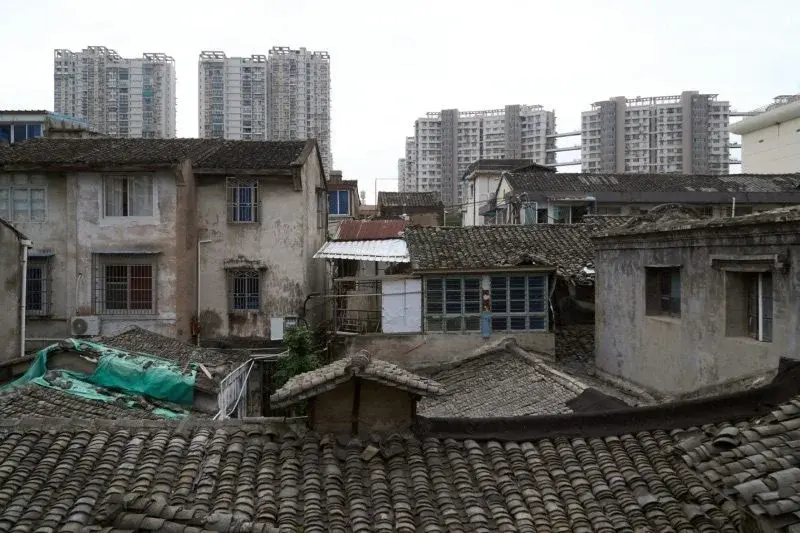
The old-versus-new gradient is easiest to see from one spot: the rooftop view in Wenzhou below shows a tiled, decades-old low-rise neighborhood in the foreground with next-generation high-rises rising directly behind it — two different eras of housing stock, and two different rent tiers, sharing the same block.
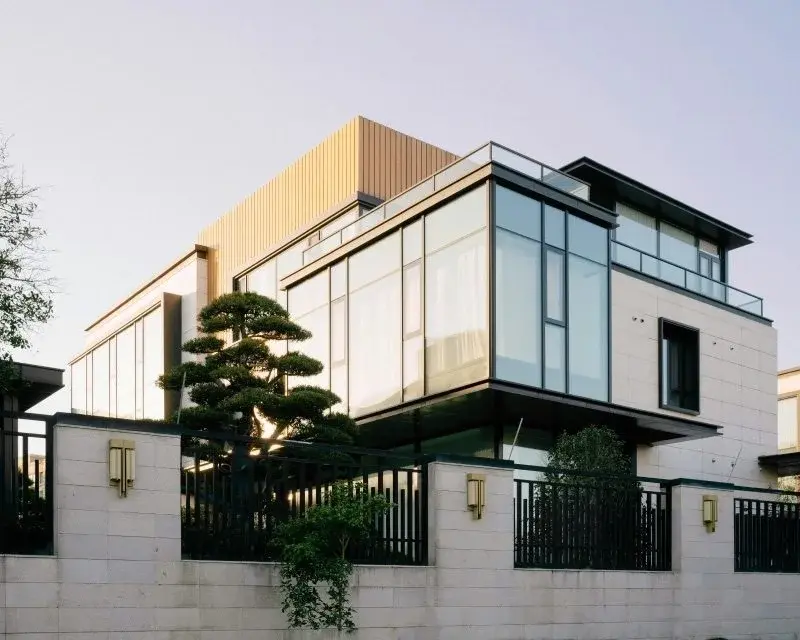
Villas sit in their own category, not at the top of the apartment scale. They're lower density and often gated. They're aimed at a small slice of tenants, usually relocating families or senior executives, not the ordinary rental market this page is mostly about.
None of this changes the comparison: even a downtown, next-generation apartment rented through the most expensive foreigner-facing agency in a first-tier Chinese city will, in most cases, still cost less per month than an ordinary apartment in a major North American or Western European city. The premium changes which number you're comparing. It doesn't flip which side comes out cheaper. For the actual yuan figures behind that claim, city by city, see the city guides. This page is about the system, not the specific number.
06 — Before you sign anything
A short checklist
- Ask for the fee split in writing who pays what share of the agency fee, and whether it's negotiable.
- Get the contract in both languages if you're not reading Chinese fluently — a foreigner-facing agency should provide this as standard, not as an upsell.
- Check the landlord's ID and property certificate before signing, to confirm they actually have the legal right to lease the unit.
- Register your residence at the local police station within 24 hours of moving in — a legal requirement for foreign nationals, separate from the lease itself.
- Clarify move-out deposit terms up front — what counts as normal wear versus damage is the single most common source of dispute at the end of a tenancy.
- Read the early-termination clause before you need it — know what happens to your deposit, and whether a penalty applies, if your plans change mid-lease.
06b — If the deposit doesn't come back
Three legal protections that matter for foreign tenants
The guidance below is based on the Housing Rental Regulations (effective September 15, 2025) and the Civil Code of China. I cross-checked these provisions through legal-reference sources (66law.cn) and verified practical enforcement with industry contacts in Shanghai, Dalian, and Shenzhen. The case study at the end is a public record from 2025.
1. The contract governs what can be deducted. Article 10 of the Housing Rental Regulations (effective September 15, 2025) requires that any deposit deduction must be explicitly stated in the contract. If it's not in the contract, the landlord cannot deduct for it. No "scratched wall" fee unless the contract says so.
What to do: Pull out your contract, find the deposit clause, screenshot or photograph it, and tell the landlord: "Under Article 10 of the Housing Rental Regulations, you cannot deduct for anything not written in the contract."
2. The contract must be registered, and if the landlord won't do it, you can. Article 8 of the Regulations requires landlords to register the lease with the local housing authority through the official platform. If the landlord drags their feet, you can do it yourself. A registered contract is your strongest evidence in any dispute.
What to do: Take your contract and passport to the local housing authority office and register it yourself. It's free.
3. Sale does not terminate the lease. Article 725 of the Civil Code states that a change in property ownership does not affect the validity of an existing lease. If the landlord sells the unit, the new owner must honor your lease until it expires. They cannot ask you to leave early.
What to do: If a new owner says "I bought this place, you need to move out," show them your contract and explain that the law is on your side. You have the right to stay until the lease ends.
Five common deposit dispute scenarios
| Landlord's claim | Reality | What you can do |
|---|---|---|
| "The unit hasn't been re-rented yet, so I'm keeping the deposit" | Not valid, the landlord is in breach | Cite Article 10 of the Housing Rental Regulations and demand a full refund |
| "Scratches on the wall / worn floor, I'm deducting for repairs" | Normal wear and tear is not your responsibility | Take dated photos at check-in; do a joint walkthrough at check-out and sign a move-out inspection sheet |
| "You broke the lease early, so I'm keeping the entire deposit" | Depends on the contract; if the penalty is excessive (far above actual losses), courts can reduce it | Check your contract; negotiate; escalate to complaint or court if needed |
| "The agency collected the deposit and they're gone" | The Regulations now prohibit agencies from collecting deposits on behalf of landlords | File a complaint directly with the housing authority. This practice is illegal |
| "The contract says I can deduct for this" | If it's actually in the contract, the landlord has the right | Read every deduction clause before you sign. This is the only scenario where you have little leverage |
Three escalation steps if the deposit isn't returned
Step 1 Negotiate. Send a WeChat message or email with screenshots of your contract and a reference to Article 10 of the Housing Rental Regulations. Keep a written record. This resolves most cases.
Step 2 Administrative complaint. If negotiation fails, call 12345 (the government services hotline) or file a complaint directly with the local housing authority. Have your contract, chat history, and payment receipts ready. This is the most underrated tool for foreign tenants, and it's free, no lawyer required, and 12345 offers translation services.
Step 3 Lawsuit. If the first two steps don't work, you can take it to court.
What foreign tenants need to know about going to court
- You don't need a residence permit to file a lawsuit. Your passport is sufficient to initiate a civil case in China.
- Your legal rights are identical to those of Chinese citizens. Under the Civil Procedure Law, foreign nationals enjoy the same litigation rights and obligations as Chinese nationals in Chinese courts.
- Language. Court proceedings are conducted in Chinese. If you request an interpreter, the court can provide one, but you will bear the cost.
- Important: The small claims procedure does not apply to foreign-related cases. Even for a deposit dispute, if one party is a foreign national, the case is classified as "foreign-related" and must go through ordinary procedures, which take longer than small claims.
A real case
In September 2025, a tenant in Tiemenguan, Xinjiang, had a 2,000 RMB deposit withheld by the landlord after moving out. The tenant went to the local dispute resolution center, which brought in a judge for mediation. The judge explained the legal provisions to the landlord, who agreed on the spot to return the full deposit.
Most deposit disputes resolve at the administrative mediation stage. You don't need to go to court. And the process is the same for foreign tenants as for locals: find the right channel, bring your contract, state the facts clearly.
The verdict
Even with the premium, the math doesn't flip.
This isn't a claim that foreigner-facing agencies are the best or only way to rent in China — plenty of long-term expats eventually learn to read the market themselves. What I can say honestly is that the premium those agencies charge has a real, traceable reason behind it, and that even with the premium included, the absolute rent in a Chinese city is still, for almost anyone coming from North America or Western Europe, a lot less money.
07 — Questions people actually ask
Quick answers
How much deposit do you pay when renting an apartment in China?
"Deposit one, pay three" is the default nationwide — one month's deposit plus a payment equal to three months' rent, though exact terms vary by landlord and agency.
Why do foreigner-facing rental agencies charge more in China?
The markup isn't really a service fee — it's an information gap, priced. Foreigner-facing agencies bridge a language and process barrier that a local renter wouldn't need to pay for.
What are the different ways to find an apartment to rent in China?
Four distinct paths exist, and they don't compete on the same things — each channel trades off differently between cost, convenience, and how much English-language support you get.
Is renting a serviced apartment in China different from a regular lease?
Yes, serviced apartments are a genuinely different market, built for people staying only a few months rather than signing a standard year-long lease.
What actually determines rent price more than which city you're in?
Location, building age, and building type do more work than the city name does — a newer, elevator building with property management commands a real premium over an older walk-up, regardless of city.
Can a landlord raise the rent partway through a lease in China?
No, the rent in your contract is locked until the lease term ends. A landlord can only propose a new figure at renewal, which is really a fresh negotiation rather than an automatic extension.