Living cost, at a glance
≈$368/mo
≈$183/mo
≈$460/mo
≈$828/mo
≈$643/mo
Rent from the §03 ledger. The non-rent line is Numbeo's own compiled "estimated monthly costs, excluding rent" for Chongqing (single person, pulled Aug 2026) — it already folds in food, transport, utilities and everyday extras as one figure. This is a more granular breakdown than the single ¥5,961 all-in figure already published in §03; Rent from Wise; the non-rent line is Numbeo's own compiled single-person estimate. Converted at ¥7.2 = $1.
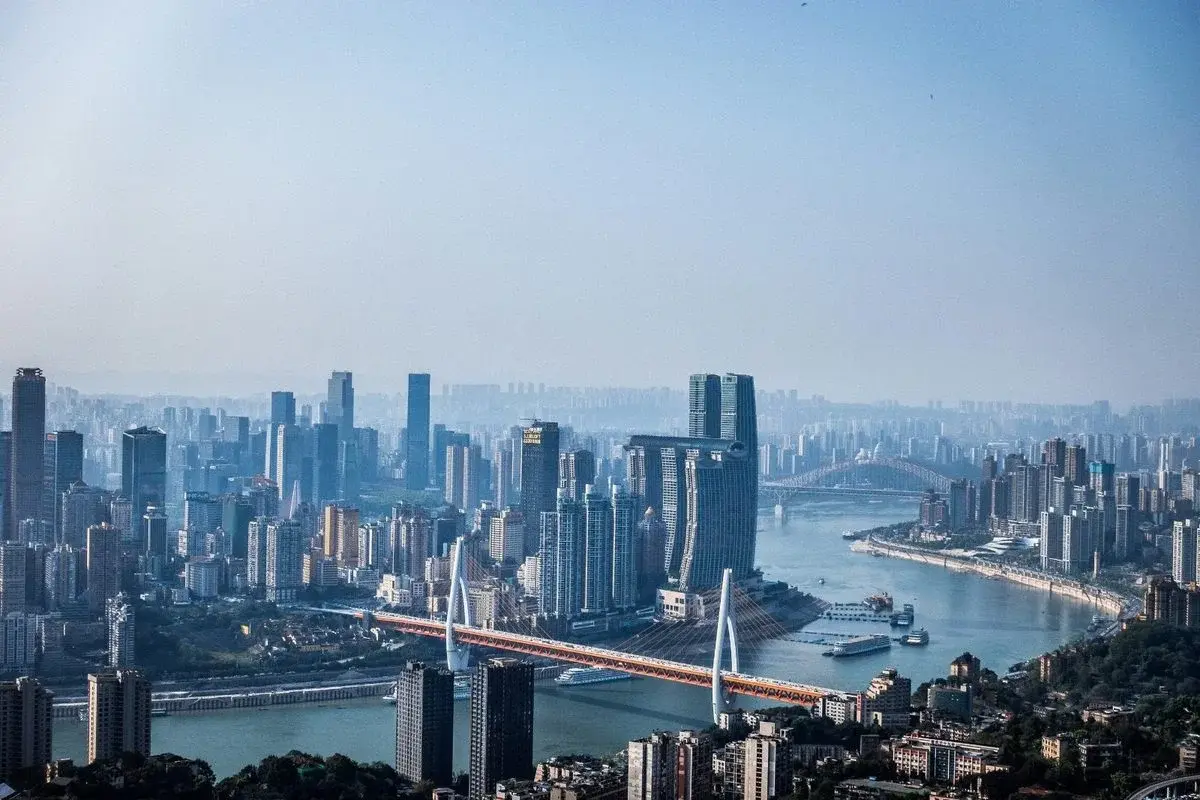
Chongqing is called shancheng, mountain city, so often that the phrase stops sounding like a description and starts sounding like a slogan. It isn't a slogan.
At Kuixing Lou Plaza in Yuzhong District, near Linjiangmen, the plaza itself sits at what reads as ordinary street level. The red-pillared, gold-roofed pavilion complex was rebuilt on its current site in the 1990s, after the original 1725 structure was demolished in 1953. Two suspended footbridges, built in 2014, lead off it. Each is about 23 meters long and roughly 65.8 meters above the ground. It connects the plaza directly to the 22nd floor of the office tower next door, Gaosheng Chuangfu Center. Cross one, and you're standing on what any visitor would call that building's ground floor. Then the elevator confirms it's the 22nd, with twenty-one more floors between you and the actual street.
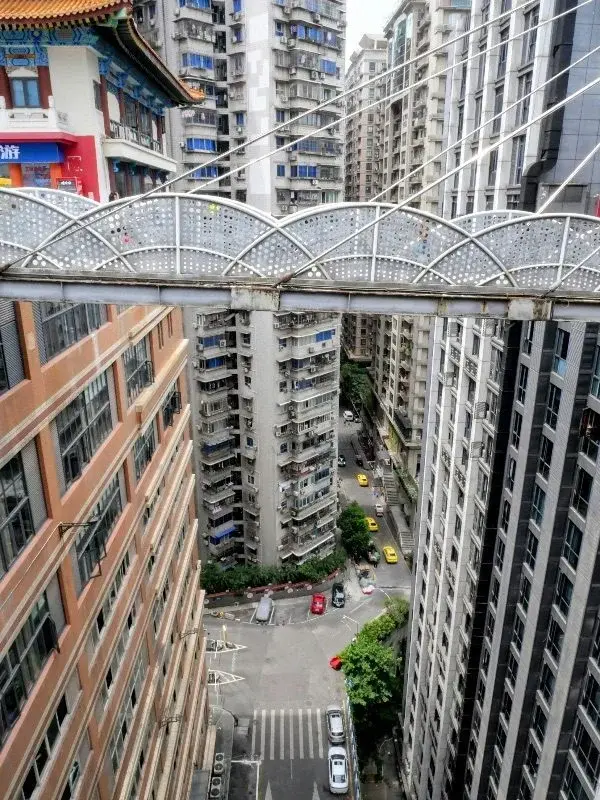
That confusion is the actual product this city sells. Not cheapness — Chongqing isn't especially cheap, once you check the numbers instead of trusting the feeling. What it sells is a specific, repeatable disorientation, built into the ground itself. This is the straight math on what it costs to live in Chongqing. My own two visits, nine years apart, are here only to mark where the ground fooled me, not to carry the argument.
01 — "Mountain city" as a load-bearing fact
A metro that climbs the mountain, and sometimes runs through a building
The plaza-that's-a-roof isn't a one-off trick. It's what happens everywhere the city meets this terrain, and the transit system tells the same story at least twice more. Qixinggang Station sits at the intersection of Pipashan Zhengjie and Xinglong Jie in Yuzhong District — an interchange between Line 1 (opened 2011) and Line 10 (opened 2023). It's built directly beside Tongyuanmen, the best-preserved surviving stretch of Chongqing's old city wall, and at the foot of Pipashan itself, the highest point in the old walled city. Getting from the platform to street level here means climbing that hill from underground, in stages.
The city's engineers have answered this terrain with infrastructure you won't find anywhere else in China at this scale. Qixinggang is the buried-in-the-hillside version; Liziba light-rail station is the inverted one. Line 2 runs straight through the sixth to eighth floors of a residential tower, the train and the building's own stairwell sharing the same structure. Throw in the cross-river cableway (Yangtze Ropeway), and the pattern is the same one Kuixing Lou already showed: the mountain decides where the ground is, not the blueprint.
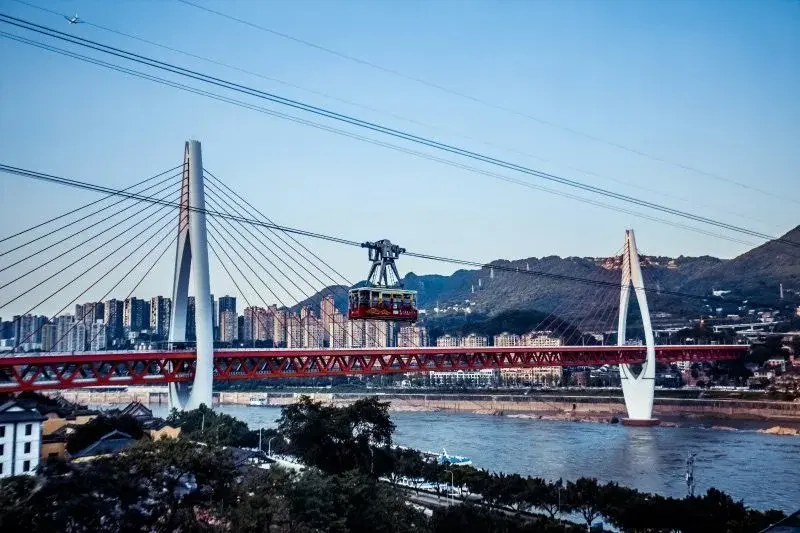
It used to be the primary way to cross the river at this point, before the bridges and metro lines caught up. Now it's largely a tourist ride, the queue for it longer than the queue for an actual commuter alternative. The price says as much as the queue does: ¥30 one-way, ¥50 round trip (about $4.17 / $6.94), against a ¥2 metro base fare. That's an attraction ticket, not a transit fare, even though the line opened in 1987 as exactly that. The bones of the "genuine transit, not a gimmick" story hold up historically. Minute to minute in 2026, they don't.
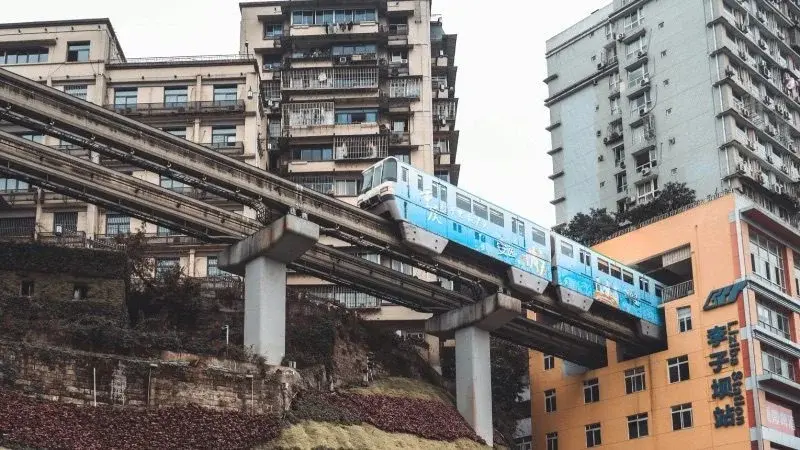
None of this is quaint. A metro that has to be dug deep enough to clear a mountain, a light-rail line threaded through a building's own structure, a cableway doing a bridge's job: these are all more expensive to build than flat ground would ever require. Chongqing's terrain is a real, uncounted cost. It just isn't paid in rent. It's paid upstream, by whoever had to engineer around a mountain to give that resident a way to get to work.
02 — Getting around, in numbers
What it costs to ride a metro built into a mountain
Behind the Liziba spectacle and the cableway sits an ordinary transit system with ordinary fares. As of early 2025, Chongqing's rail network ran 13 lines across roughly 575 kilometers and 263 stations. Only the eighth Chinese city to cross the 500-kilometer mark, alongside Beijing, Shanghai, and Guangzhou. Fares start at ¥2 and rise by distance. The longest single trip on the network — a run of nearly 88 km — tops out at ¥11.
| Trip | Fare |
|---|---|
| Base fare | ¥2 |
| Longest single trip (≈88 km) | ¥11 |
Network size and station count: Chongqing Rail Transit reporting, as of January 2025. Fare schedule effective July 30, 2025. Converted at ¥7.2 = $1.
We haven't found a metro map for Chongqing that we're confident redistributing, and given the terrain, a flat schematic wouldn't tell the real story anyway. For the current network layout, go straight to the operator: Chongqing Rail Transit — official line map →
Outside the rail, the national trio of shared-bike apps barely registers here. Chongqing is one of only three Chinese cities — alongside Dalian and Qingdao — where hills have kept shared bikes from ever really catching on. The reason needs no explanation once you've climbed one staircase street. Ride-hailing and buses fill the gap. Buses pull more weight here than in flatter cities: a bus route can follow a switchback road that a bike never could.
03 — The number I had wrong
Rent against income: healthier than I remembered
A one-bedroom in Chongqing runs about $368 a month, roughly 35% of the median after-tax wage of $1,058. That's a healthier ratio than Chengdu's 36% or Dalian's 37%. Stop there, though, and you've missed what Chongqing charges instead. The city's real price is the ground: a footbridge that drops you on the 22nd floor of the building next door, a metro that climbs through hills and occasionally through a building, and an errand that keeps turning into an expedition. The rent number is calm. Everything around it takes something out of you.
Before I checked, my honest impression, built from two visits and gut feeling, not any spreadsheet, was that Chongqing's cost of living sat roughly on par with Dalian and Chengdu. Comparable, unremarkable, no edge either way. The numbers say otherwise.
Rent and take-home figures from Wise's cost-of-living data, mid-2026, converted at ¥7.2 = $1; ratios calculated, not sourced pre-computed. Treat as indicative ranges.
What I remembered was the difficulty, not the cost. The terrain makes every errand feel like an event: the stairs, the elevators standing in for streets, the phone confidently routing you across a bridge that turns out to be sixty meters up. That effort gets filed away as expense in memory. It isn't. The city's actual price of admission is calmer than its reputation. What it charges instead is attention: the tax of never quite trusting that "ground floor" means the same thing on both sides of the block. The cognitive kind of cheap →
What that ≈35% ratio looks like, item by item
Typical 2026 costs for one person in the urban core, pulled from public cost-of-living data. Yuan converted at roughly ¥7.2 to $1.
Rent, meal, transit, and take-home figures from Wise's cost-of-living data for Chongqing, mid-2026, converted at ¥7.2 = $1 — including the 1-bed outside-center figure, which Wise tracks directly for Chongqing. We couldn't find a comparably sourced 2-bed figure, center or outside it, and are leaving both blank rather than estimating. Utilities uses this site's own standardized calculation — see below.
What that ≈¥223 a month for utilities gets you
Electricity, water and gas are all tiered: use more, pay more per unit. Chongqing's electricity, unusually for a city this far inland, is settled annually rather than billed month to month. That's closer to Beijing and Shanghai's convention than to Chengdu's, where a hot month shows up on the very next bill. A Chongqing household effectively banks a full year's allowance. It only pays the higher tier once the running annual total crosses the threshold.
| Tier | Annual usage | Rate |
|---|---|---|
| 1 | 0–2,400 kWh/yr≈200 kWh/month equivalent | ¥0.52/kWh |
| 2 | 2,401–4,800 kWh/yr≈201–400 kWh/month equivalent | ¥0.57/kWh |
| 3 | 4,800+ kWh/yr≈400+ kWh/month equivalent | ¥0.82/kWh |
| — | Shared-meter buildings | ¥0.54/kWh flat |
| Tier | Annual usage | Rate |
|---|---|---|
| 1 | 0–260 m³ | ¥3.50/m³ |
| 2 | 261–360 m³ | ¥4.22/m³ |
| 3 | 361+ m³ | ¥5.90/m³ |
| — | Shared-meter buildings | ¥3.50/m³ flat |
This is a combined rate: base water price plus a ¥0.10/m³ resource fee plus a ¥1.00/m³ sewage charge, bundled into one number. We couldn't find a public breakdown that separates them further, so we're not guessing at one. Tier thresholds are set for a 4-person household; the standardized single-occupant figure (15 m³/month) sits well inside Tier 1 either way.
| Tier | Annual usage | Rate |
|---|---|---|
| 1 | ≈0–500/540 m³Upper bound varies by district (500 or 540) | ≈¥2.23/m³ |
| 2 | ≈501–660/720 m³Upper bound varies by district (660 or 720) | ≈¥2.41/m³ |
| 3 | ≈661/721+ m³Lower bound varies by district | ≈¥2.77/m³ |
The per-unit rates are standardized across the municipality's main gas utilities, but the exact annual tier volumes are set district by district. We found a 0–500/501–720/721+ m³ split for one district and a 0–500/501–660/661+ split for another, close enough to use as a directional range but not close enough to state as one universal number. Unlike the tier prices, we're not going to pretend more precision than the source data actually has.
Electricity: Chongqing municipal residential rate schedule, ¥0.52/¥0.57/¥0.82 per kWh, annually settled. Water: Chongqing main urban area residential schedule, current 2026. Gas: current standard residential tier rates (¥2.228–2.238/2.408–2.417/2.758–2.768 per m³ depending on district notice, rounded here), which is the citywide rate even though tier volumes vary by district. Converted at ¥7.2 = $1.
Standardized comparison figure, applied the same way across every city on this site: 220 kWh electricity + 15 m³ water + 25 m³ gas per month, a single-occupant baseline that excludes winter heating, run against each city's own published tiered rates above. At Chongqing's rates that's ¥115 electricity + ¥52 water + ¥56 gas ≈ ¥223 (≈$31)/month. This replaces the earlier ¥250–300 range, which was this site's own older, cruder estimate from the same tier schedules.
Your daily choices shape the bill more than the city does →
One thing Chongqing's gas schedule does not have, despite genuinely cold, damp winters: a separate higher tier for winter heating gas, the way some northern cities do. The heating-season price adjustments that do exist here apply only to commercial and industrial gas users. Residential heating-season pricing is explicitly excluded, to keep household bills stable. Add in the fact that Chongqing, like most of central and southern China, has no centralized municipal heating system at all. Winter here means space heaters and higher electricity bills, not a separate gas tariff. The costs that don't show up in the table →
04 — Under the confusion, a decade at the country's center
For nine years, this was the capital nobody expected to last
That attention tax has a history behind it, and it starts further back than any bridge or elevator: with an entire country's government showing up here as refugees, nine decades ago.
From 1937 to 1946, as the war with Japan pushed the Republic of China's government west out of Nanjing, Chongqing became the wartime capital, the peidu, the "substitute capital." Factories, universities, and the entire machinery of a government were dragged upriver into the mountains because the mountains themselves were the defense. The terrain that makes the city so hard to walk through also made it hard to bomb flat. It held the center of the country's resistance for nine years. Then, when the war ended and the government moved back east, Chongqing went back to being a large regional city, not the capital of anything, its decade at the center already receding.
Jiefang Bei, or Liberation Monument, sits at the middle of that history, a clock tower first built in 1940 as a monument to the war effort and rebuilt after the war to mark victory. Today it's the neon core of the city's shopping district, with tour buses and luxury storefronts pressed up against a monument whose original name had nothing to do with commerce.
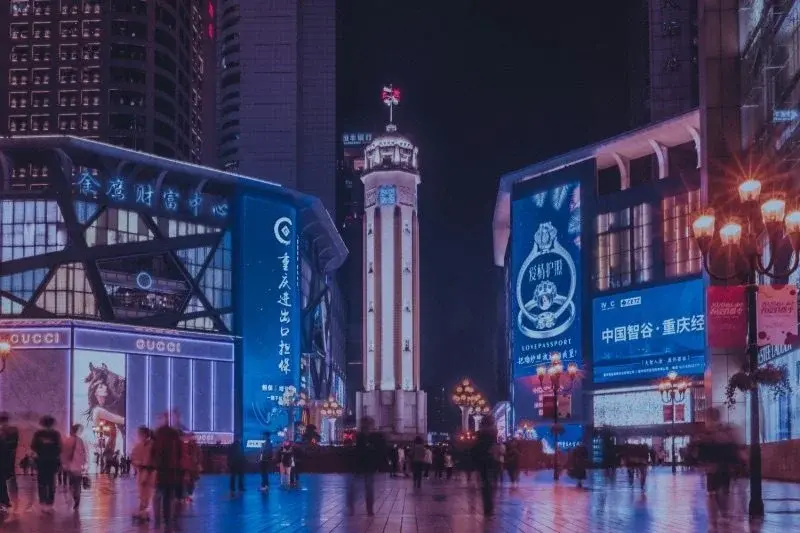
A city that was the center of the country for nine years, then wasn't. My own family passed through it for less than a decade, then went home. Neither of us stayed long enough to belong to it. We both just left something here.
05 — Another wave that came through and didn't stick around
Who lives here, if you're arriving from North America
Everything above describes a city built, more than once, by people who arrived, stayed a while, and left. A wartime government for nine years, my own family for less than a decade. A much smaller, much more recent version of the same pattern is playing out around Jiefangbei right now. A foreign professional population clusters in a handful of places, none of which it's lived in for generations.
| Area | Why here | Who you'll find |
|---|---|---|
| Jiefangbei CBD | Chongqing's central business district since the city became a directly-administered municipality in 1997 — finance, retail, hospitality and hotel groups concentrated here first | Foreign corporate management, finance professionals |
| Shapingba university district | Anchored by Chongqing University, which reports more than 1,800 international students on its own campus | Foreign teachers, international students |
| High-Tech Zone Western Science City | Chongqing's innovation and tech-investment district — the local immigration authority runs a dedicated foreign-talent service point here | Recruited tech and R&D talent |
None of these three has the decades-deep institutional roots that Tongzilin has in Chengdu or Liangmaqiao has in Beijing. Chongqing's foreign-resident geography is newer, thinner, and more obviously tied to where the money currently is rather than to an embassy that's been there since the 1980s. Chongqing's foreign population — like its wartime government, like my own family — is still mostly a story of people passing through rather than settling permanently.
This section describes where a foreign, largely North American, professional population is known to cluster and roughly who they are, pulled together from public reporting on Chongqing's CBD, university, and tech-zone geography, not a formal census. Treat the neighborhood names as directionally right rather than as a precise headcount.
06 — Character, explained by geography and history, not by stereotype
Mahjong at 2am, and a spice with two different jobs
Sichuan-Chongqing mahjong culture is well documented, but the structural explanation matters more than the folklore. This is a river-port city built on itinerant dock labor, seasonal cargo work, and, going back further, waves of migration into a basin that never had one dominant clan network the way parts of coastal China did. Where the social unit isn't a lineage or a work unit, a card table becomes a fast, cheap way to rebuild a temporary community every single night. A mobile labor population needs a portable social technology, and mahjong is cheap, fast, and doesn't require anyone to have known each other yesterday.
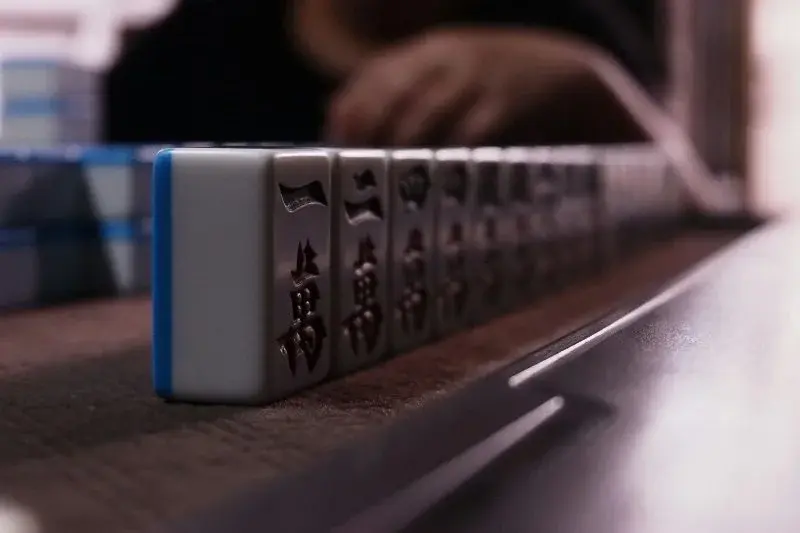
The spice works the same way: two different things wearing one name. The everyday chili oil, ground fine as cornmeal, barely registers as hot; it's aromatic before it's fierce. The mala duck head I ate with a colleague's hometown friends on a later evening brought me to tears. It's plausibly a dish with roots outside Chongqing proper, and I never confirmed which region actually claims it. Same city, two entirely different relationships to heat, and neither one is "the real Chongqing spice."
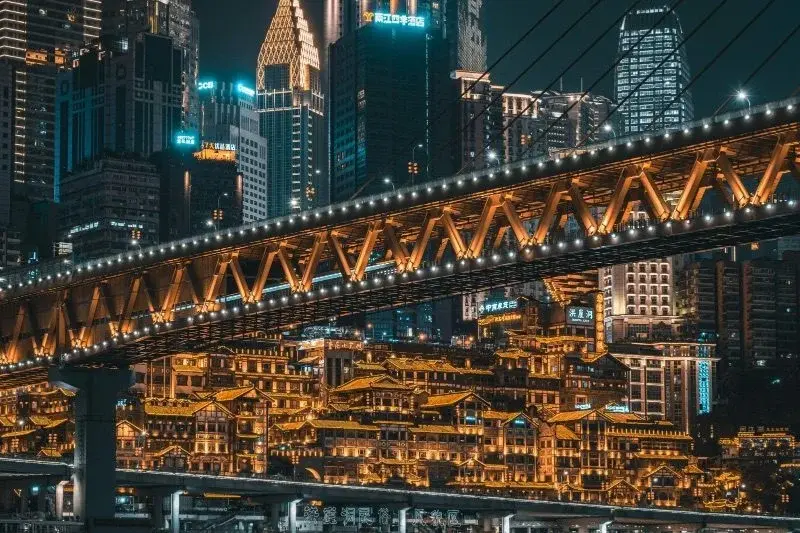
07 — The same river-port logic, plated
Hotpot started as what dock workers could afford to throw in a pot
The same structural story behind the 2am mahjong game explains the food, too. Chongqing hotpot's most common origin story traces to the docks at Chaotianmen, where the two rivers meet. Riverside slaughterhouses produced cheap beef tallow and offal that dock and boat workers couldn't otherwise sell. They simmered it with chili and Sichuan peppercorn in a shared pot, divided into compartments so several diners on tight schedules could each claim a section, eat, and go. That's the same labor pattern as the card table, itinerant, mobile, no time for ceremony, solved with a pot instead of a deck of tiles.
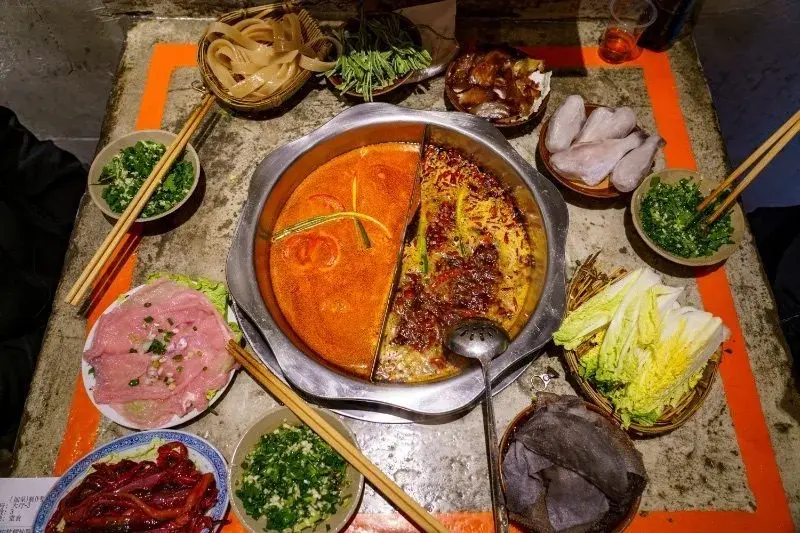
The wider category is jianghu cuisine, literally "rivers and lakes," the old term for the itinerant, semi-outlaw world of boatmen and traveling tradespeople. Dishes like mao xue wang (associated with the old town of Ciqikou) and spicy pickled-fish stews are built on cheap ingredients, heavy chili, and a cook's willingness to improvise rather than follow a fixed recipe. It's a working cuisine, not a court one, and it reads that way on the plate. For breakfast, the equivalent is xiaomian: a bowl of noodles in chili oil and lard, sold for the price of a coffee back home, eaten fast, standing up if needed, on the way to somewhere else.
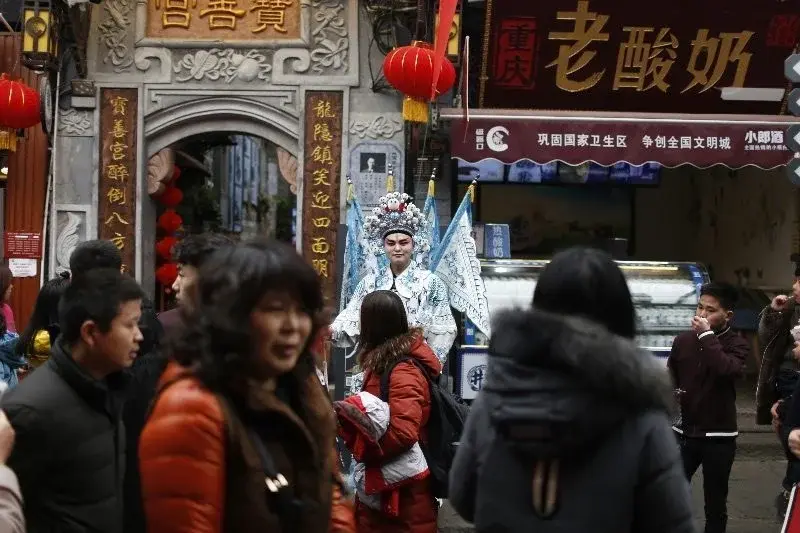
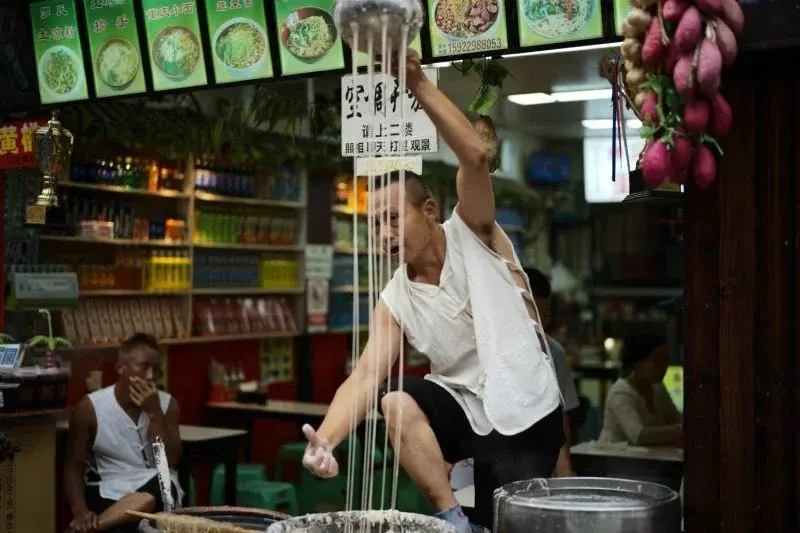
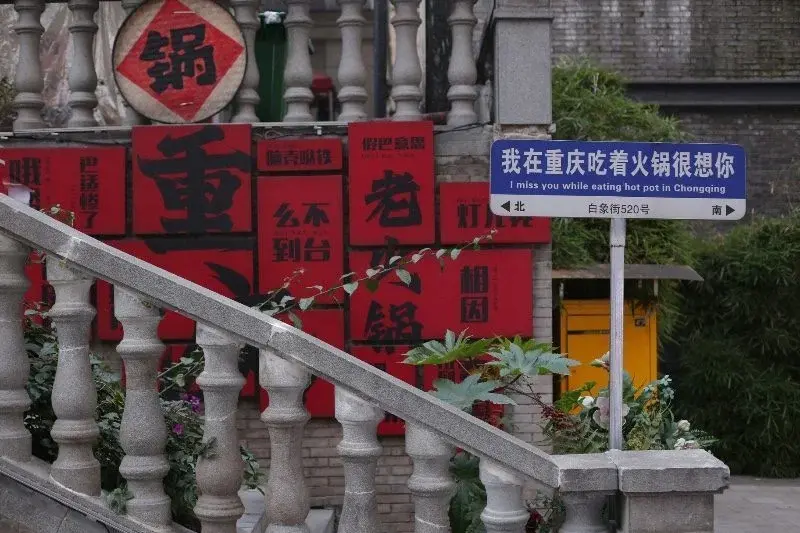
One more texture: a huge share of Chongqing's small hotpot shops carry names in the same rhythmic pattern, a syllable repeated, ABB-style, the way a nickname sticks before a proper name does. It's the kind of detail nobody plans and everybody notices once it's pointed out.
None of this means Chongqing households eat hotpot every night, or never cook. Hotpot and jianghu cuisine are the going-out register: the thing you eat when you don't have time to cook, or when the whole point is not cooking. The wet market still runs the daily budget for most households, and the everyday math looks a lot less dramatic than a divided pot of chili oil.
What the ingredients cost, at the market
| Item | RMB | USD |
|---|---|---|
| PorkLeg cut, wet-market retail | ≈¥12.1/500g | ≈$1.68 |
| EggsWet-market retail | ≈¥6.9/500g | ≈$0.96 |
| Vegetables30-item basket, wet-market retail average | ≈¥3.3/500g | ≈$0.46 |
| Beef | Not shown — see note | |
Pork, eggs, and vegetables: Chongqing Municipal Commerce Commission weekly necessities monitoring report — a genuinely city-specific monitor, not a provincial stand-in — pork and vegetables from the week of July 6–12, 2026, eggs from the week of June 22–28, 2026 (the two most recent reports with each figure at time of writing). We couldn't find a Chongqing-specific retail figure for beef; rather than substitute a national or livestock-auction number that isn't really answering the question, we're leaving the row blank. Converted at ¥7.2 = $1.
One thing this table won't do: unlike Chengdu, we didn't find a distinctive imported-ingredient story for Chongqing worth forcing into this table, no obvious salmon-import-hub angle, nothing that earned its place the way Chengdu's did. So this table stays at four rows instead of five. Padding it with a generic import just to match another city's pattern would be the wrong instinct.
The chili oil and mala duck head discussed above sit inside this same tradition, not apart from it — different points on one continuum built by people who never had the luxury of an unhurried meal.
08 — The honest brake
What two visits, nine years apart, can and can't tell you
My first trip was one person with no schedule, free to get lost at 2am on purpose. My second was four people, two of them children, and my attention split accordingly: I watched crosswalks and stair landings more than I watched the city. That's a limit on what I absorbed, not a complaint about Chongqing.
The rail network's size, fare schedule, and the history behind hotpot and jianghu cuisine are research, cross-checked against public sources, not personal memory. I ate the food and rode the trains without knowing any of that backstory at the time. And Chongqing's status as a directly-administered municipality the size of a small country — 31.9 million people across 82,403 km², an area on the scale of Austria — means almost everything in this piece describes the urban core, not the vast rural majority of the municipality's land and population.
09 — Questions people actually ask
Quick answers
How much does rent cost in Chongqing?
A one-bedroom in the city center runs about ¥2,650/month (≈$368); outside the center it's about ¥1,318 (≈$183).
Is Chongqing actually expensive, given its reputation as a confusing, chaotic city?
No, its rent-to-income ratio turns out to be one of the healthiest in this series, closer to Chengdu's (≈36%) and Dalian's (≈37%) than its confusing reputation would suggest. The real cost here is confusion, not money.
Why does Chongqing's metro climb through buildings?
The "mountain city" nickname is literal, not decorative. The terrain forced transit planners to route lines through steep elevation changes a flat city never has to solve. Sometimes that means running a light-rail line through a building's own structure.
How much does transit cost in Chongqing?
A one-way ticket starts around ¥2 (≈$0.28), rising by distance like most Chinese metro systems.
Was Chongqing ever the capital of China?
Yes, for nine years, during a wartime period the city itself treats as an interlude rather than a permanent status.
If you're thinking of going
Chongqing, for someone living here
- Rent is not the city's real cost. At a ~35% rent-to-income ratio, Chongqing is closer to the affordable end of this series than to the expensive end. Budget your effort, not just your yuan: for stairs, elevators, and a phone map that will occasionally lie to you about what "ground floor" means.
- Pick a neighborhood by its topography, not just its price. The same rent can mean a flat street or a daily climb of several hundred steps. Visit at street level before signing anything a map alone can't tell you.
- The heat has two settings. Don't assume "Chongqing spice" means one thing: the everyday chili oil and a dish like mala duck head are not the same intensity, and a menu won't warn you which one you ordered.
- Chongqing is also one of China's hottest cities in summer — a furnace city by reputation, alongside Wuhan and Nanjing — so factor cooling costs into a summer budget the way you'd factor heating into a Harbin winter.
- Still deciding? Not sure this is the right fit? Try the city match tool → ; Answer 7 questions to find a better match →
The verdict
Should you live in Chongqing?
If the number is what worries you, it shouldn't. Chongqing's ratio is one of the calmer ones in this series, not one of the harsher ones, and I say that as someone who arrived with the opposite assumption. What should actually worry a prospective resident is spatial: whether you can live somewhere without being permanently, daily disoriented by a city that treats "up" and "down" as negotiable. Some people find that disorientation delightful for exactly as long as a visit lasts. Whether it stays delightful for the length of a lease is a different question, and it's the one this piece can't answer for you. I've only ever gotten lost here, never lived here long enough to stop.