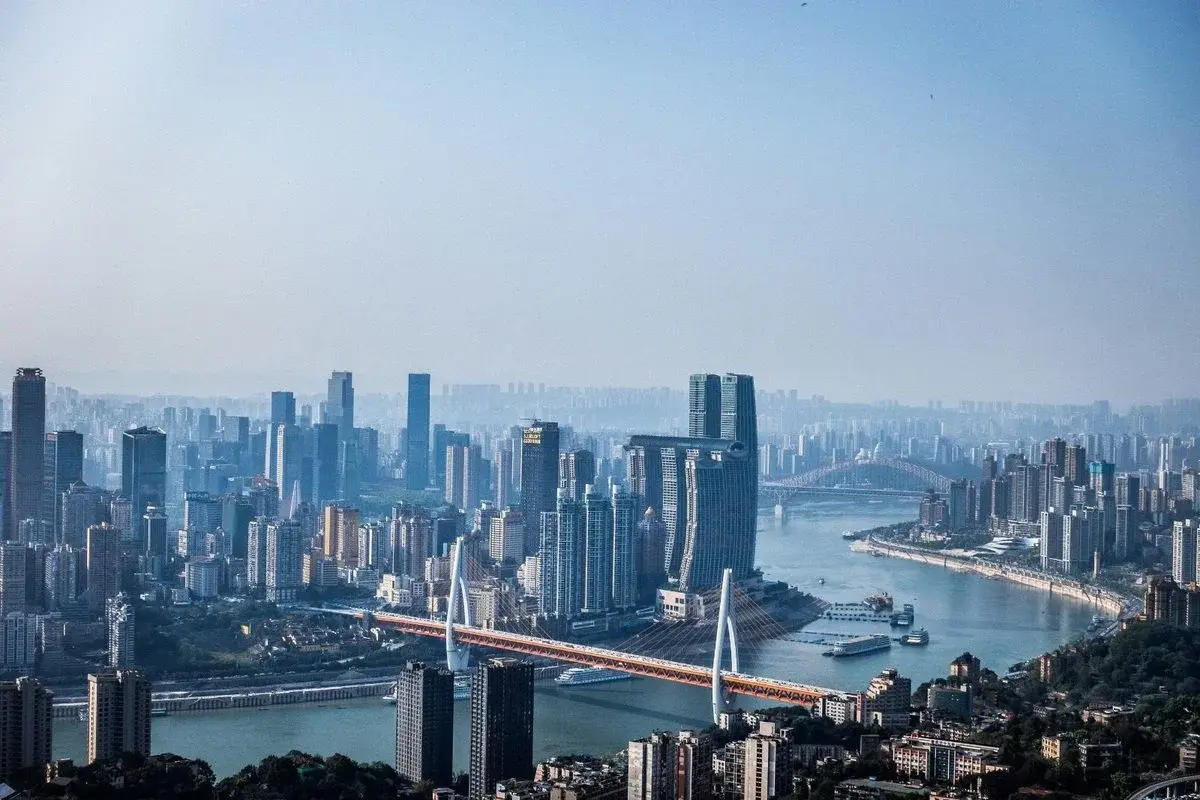

Neither of these cities was ever supposed to be permanent. Chongqing became the wartime capital of the Republic of China in 1937 because Nanjing had fallen and the mountains offered cover a flat capital couldn't. Philadelphia became the temporary capital of the United States in 1790 because the real capital, on the Potomac, hadn't been built yet. One arrangement was forced by war; the other was scheduled by law. Both lasted about a decade. Both ended with the center of government packing up and moving somewhere else, on purpose, leaving the city that had held it behind.
That's the shape of this comparison: two cities that briefly mattered more than their permanent status ever claimed, and then went back to being what they actually are — one a mountain metropolis of over 30 million, the other a mid-sized East Coast city that never got the capital back.
 Chongqing
 Philadelphia
Left: Chongqing's towers, stacked and joined mid-air. Right: Philadelphia's City Hall, still the tallest thing on its own skyline by law until 1987. Photos by Erin With and Juan Carlos Pavón.
01 — The money doesn't quite cancel
Chongqing vs Philadelphia: 35% vs 42% of wages on rent.
Chongqing's city-center one-bedroom runs $368 a month, roughly 35% of the median after-tax wage of $1,058. Philadelphia's center one-bedroom runs $1,944 a month, about 42% of its median after-tax wage of $4,618. On rent alone, the gap is real, but it is smaller than the utility gap and smaller than the dining gap. The everyday layer tilts toward Chongqing harder than the headline rent number suggests. The story both cities share is what they lost: one was pushed out by war, the other was scheduled to leave from the start. Both held the center of a nation, and both watched it move on.
Not confidently sourced / Derived, see note—≈$2,983Derived
Not confidently sourced / Derived, see note—≈$1,761Derived
Chongqing's 1-bed and take-home figures are from Wise's cost-of-living data for Chongqing, already published on this site's Chongqing deep-dive; we couldn't find a comparably sourced 2-bed figure for Chongqing, center or outside it, and are leaving both blank rather than estimating one. Philadelphia's figures are a fresh Numbeo pull (June 2026) — 1-bed and 3-bed are directly tracked; the 2-bed rows are derived by taking the midpoint between Philadelphia's own 1-bed and 3-bed figures, flagged as derived rather than directly sourced, the same convention this site uses elsewhere. This replaces a slightly older, lower rent/wage estimate this page carried previously. Converted at ¥7.2 = $1.
Philadelphia's 1-bed city-center rent runs roughly 5.3 times Chongqing's; its take-home pay roughly 4.4 times. Those multiples don't cancel as cleanly as they do in some pairs on this site — and where they don't cancel, Chongqing comes out ahead. On the honest, unglamorous rent-to-income measure, the mountain city that gets mocked for being confusing to walk through is the more affordable one to actually live in. If you want to run your own numbers instead of going by the average, the move calculator will do that math against your own salary.
Buying rather than renting is a different question, with sourcing problems on both sides — Philadelphia runs roughly $380 per square foot in the city center by Numbeo's own crowd-sourced figure, and Chongqing's foreign-purchase restrictions make an apples-to-apples number harder to pin down than the rent comparison above. We're not building that case here; it's a real gap, just not this page's argument.
Same city, different lifestyle — the bill gap can be even bigger →
02 — The everyday layer
Chongqing vs Philadelphia: utilities gap is wider than rent.
The rent multiple above (5.3x) is the number most people look for first. What's less obvious is that the everyday costs underneath rent — power, water, gas, groceries, a night out, a phone plan — don't move in lockstep with it. Some gaps are wider than rent. One, oddly, is narrower.
Utilities: two completely different pricing philosophies
Chongqing prices electricity, water, and gas the same way this site has documented elsewhere: tiered, per-unit, use-more-pay-more, settled annually for electricity. Philadelphia's three utilities don't work that way at all — PECO's residential rate resets twice a year off wholesale power costs, Philadelphia Water Department charges a flat, non-tiered volumetric rate no matter how much you use, and PGW's Gas Cost Rate passes through supplier costs with zero markup, adjusted quarterly. Neither city's system is more "honest" than the other's — they're just answering completely different questions about who eats the cost of a usage spike.
Chongqing rates as published on this site's own Chongqing deep-dive, sourced from municipal and district rate-setting notices. Philadelphia: PECO's residential Price to Compare, effective June 2026, plus separately regulated distribution charges (an all-in effective rate has to be computed from the published tariff components, not quoted as one number — a third-party rate-tracking analysis puts the effective residential total near 16–20¢/kWh; we're using the higher end as the more conservative "typical bill" estimate). Philadelphia Water Department's own rate notices, effective September 2025 and proposed for 2026. PGW's own Gas Cost Rate filings and its December 2025 rate settlement. Numbeo's bundled "basic utilities" figure for Philadelphia, pulled June 2026. Converted at ¥7.2 = $1.
Add up Philadelphia's three utilities from their own typical bills and the total runs closer to $335 a month — noticeably higher than Numbeo's own crowd-sourced bundled estimate of $220. We're showing both rather than picking one: the official per-utility bills are the more rigorous number, but the bundled crowd figure is what actually gets compared to Chongqing's own bundled self-estimate above. Either way, Chongqing's utility gap (roughly 6–9x) is wider than its rent gap (5.3x) — the opposite of what the rent numbers alone would suggest about which cost matters more.
Utilities are what you pay to the meter, whether you notice or not. Groceries are the cost that actually shows up in your bag, every week.
What the everyday shopping and eating actually costs
Chongqing's wet-market prices, already published on this site's Chongqing page, come from the city's Commerce Commission weekly monitor — genuinely local, not a national stand-in. Philadelphia's grocery prices below are Numbeo's crowd-sourced figures for the city itself, except where noted.
Chongqing: Chongqing Municipal Commerce Commission weekly necessities monitor, as published on this site's Chongqing page. Philadelphia: Numbeo crowd-sourced city data (pork substituted with chicken fillet, since no Chongqing-comparable pork cut is tracked for Philadelphia; vegetables shown as potatoes specifically, not a basket average — these are directional, not exact, matches, flagged as such). Egg conversion assumes ≈60g per egg to get from Chongqing's 500g retail unit to a dozen; redone from scratch as a check before publishing. Converted at ¥7.2 = $1.
The restaurant-meal gap (≈7.2x) is wider than the rent gap and wider than most groceries above — eating out, not renting, is where Philadelphia pulls away from Chongqing the most. Groceries move less dramatically: eggs run about 4x apart, but that's doing real unit-conversion work (Chongqing prices by weight, the U.S. by the dozen) rather than a clean multiple.
None of that touches the one bill that shows up whether you cook or eat out: the phone.
Phone and internet: the one place the gap nearly disappears
Chongqing's city page doesn't carry a telecom line item — this is a compare-page-only dimension, sourced fresh on both sides.
This is the one line in the whole comparison where the multiple (roughly 3–10x, depending on plan) is smaller than the rent gap — telecom infrastructure is one of the few things China has built out at a genuinely lower unit cost than the U.S., independent of the rent story entirely.
Telecom is infrastructure too — so is the thing that gets a resident to work every morning.
Getting around: two systems built for opposite geographies
Chongqing's rail network, detailed on this site's Chongqing page, ran roughly 575 kilometers across 263 stations as of early 2025 — built, largely, to fight a mountain. SEPTA, the Philadelphia region's transit authority, is large in a different way: about 450 miles (720 km) of combined track across all its modes (subway, trolley, light rail, regional rail), 290 active stations, and 196 routes, serving flat terrain spread wide rather than compressed vertically.
Chongqing rail figures as published on this site's Chongqing deep-dive, sourced from Chongqing Rail Transit reporting. Philadelphia/SEPTA network size and station count from Wikipedia's infrastructure entries for SEPTA and SEPTA Metro (a stable tertiary source, not either system's own promotional figures); base fare from Numbeo; monthly TransPass price from SEPTA's own fare page, reflecting the September 2025 increase. Converted at ¥7.2 = $1.
A single ride at the turnstile costs about the same in both cities — a rare place where this comparison nearly cancels out. It's the monthly commuter's real spend where they diverge again: Chongqing has no single tracked "unlimited pass" product the way SEPTA does. That's itself a small data point about how differently each city's residents actually pay for transit day to day — not just a gap in this page's sourcing.
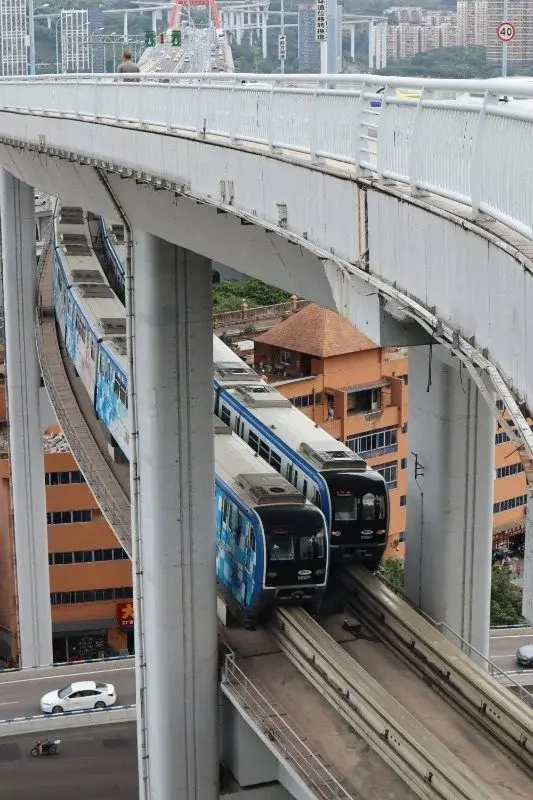 Chongqing
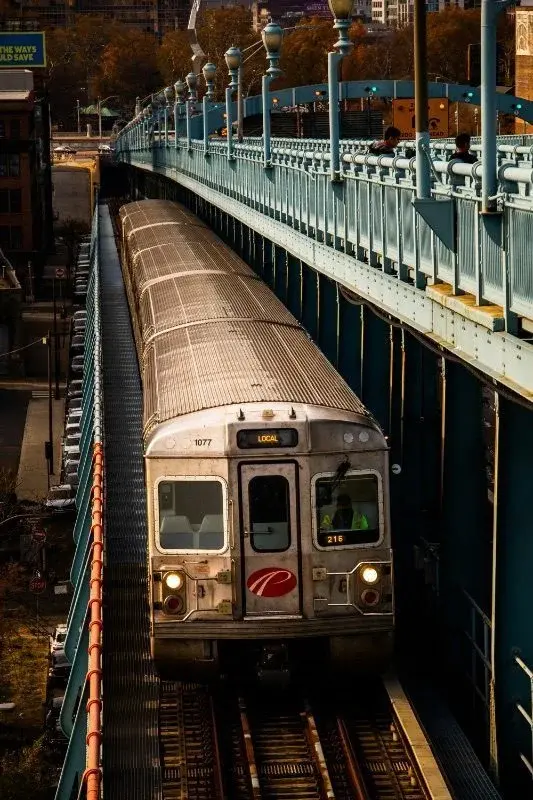 Philadelphia
Left: Chongqing's monorail, stacked below a road bridge on its own curved viaduct. Right: SEPTA's Market-Frankford "El," elevated the old-fashioned way — straight, flat, and over a century old in concept. Photos by Hayase Yuuka and Jimmy Woo.
03 — What the terrain hides, on both sides
Chongqing vs Philadelphia: what the terrain hides in each city.
Utilities, groceries, a phone plan, a train ride — that's the everyday layer, real money spent every week, but not where either city's real character shows up. That's underneath, in what each city makes a resident work to figure out. Chongqing's real cost, as this site's city deep-dive argues, isn't financial — the rent-to-income ratio is one of the calmer numbers in the whole project. What the city actually charges is attention: the tax of navigating terrain that puts one building's ground floor at another building's twentieth. Philadelphia hides something different, in a way that isn't financial either: precision about its own history. Independence Hall — a few streets from the skyline pictured above — is where the Declaration of Independence was adopted in 1776 and the Constitution was drafted in 1787. But the federal government's decade as the nation's working capital, 1790 to 1800, actually happened next door, in the purpose-adapted Congress Hall. Independence Hall is the building that made the country's founding documents. Congress Hall is the building that ran the country day to day, for exactly the ten years this comparison is about. Most visitors — this writer included, at first — collapse the two into one landmark.
This site's founding instinct — a number means nothing until you check it against the record — turns out to work just as well for a building as for a rent figure. Get the address right, and the history gets sharper. Get it wrong, and you've quietly flattened a decade of difference into a single postcard.
 Chongqing
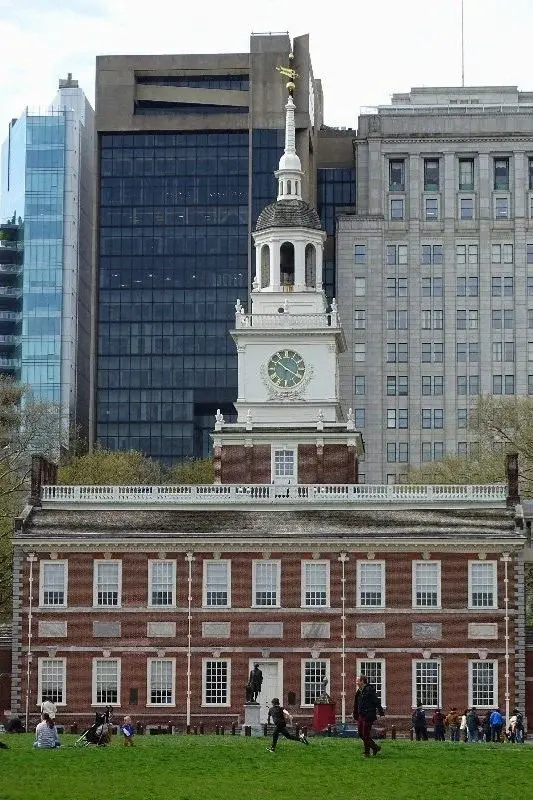 Philadelphia
Left: an older Chongqing, stacked up a slope, lanterns strung between the levels. Right: Independence Hall's own steeple, the thing everyone photographs, backed by the towers nobody's looking at. Both cities keep their oldest layer standing in the shadow of what came after. Photos by Reetu Akkanen and Miguel Ángel Sanz.
That's what each city hides in its geography and architecture. What they don't hide — because both put an exact date on it — is how the arrangement at the top ended.
04 — Two capitals, two ways of losing the job
Chongqing vs Philadelphia: two temporary capitals, two endings.
This is where the two cities' decades at the center actually diverge — not in how long they lasted, but in whether each one knew the arrangement would end.
Chongqing
1937–1946
Wartime capital (peidu) of the Republic of China
~9 years, ended by the war's end
Became the capital because Nanjing fell and the mountains offered cover from bombing that flat terrain couldn't match. Nobody picked the end date — the war did, and when Japan surrendered in 1945, the government headed back east within about a year.
An arrangement forced by circumstance, ended by circumstance.
Philadelphia
1790–1800
Temporary U.S. capital under the Residence Act of 1790
Exactly 10 years, by statute
Became the capital by a specific act of Congress that named its own expiration date before the decade even started — the government would sit in Philadelphia only until the permanent capital on the Potomac was built. The 1793 yellow fever epidemic killed roughly 10% of the city's population mid-decade, but the calendar, not the crisis, ended Philadelphia's turn.
An arrangement scheduled by law, ended on schedule.
Both cities held the center of a nation, and both watched it move on. One didn't know the date. The other had it written down before it started.
05 — The honest brake
Chongqing vs Philadelphia: three honest caveats.
First, this pairing runs on a structural echo — "briefly held the capital" — not on anything deeper. Chongqing is a river-basin mountain metropolis of over 30 million people in a one-party state; Philadelphia is a mid-sized East Coast city of about 1.6 million in a federal republic. The parallel is real and, I think, genuinely useful for understanding both cities' relationship to their own history — but it doesn't claim these cities are twins the way some pairs on this site are.
Second, and this is a limit on me, not on the cities: I've visited Chongqing twice and never lived in either city. Philadelphia's entire side of this page is built from public sources — Numbeo's cost data, PECO/PWD/PGW rate filings, SEPTA's fare page, the U.S. House and Senate historical archives, the Encyclopedia of Greater Philadelphia — not from a sidewalk. Weigh the Philadelphia column accordingly.
Both cities once held the center of a country that no longer needed them to. Neither one got a vote on when that ended.
If you're choosing between them
Deciding on more than the number
- The money favors Chongqing, and not just modestly, once you look past rent. The rent multiple (5.3x) is real, but utilities run 6–9x apart and dining out runs about 7x — the everyday layer tilts toward Chongqing harder than the headline rent number suggests. Telecom is the exception, running the other way less steeply than everything else.
- Price the terrain, not just the rent. Chongqing's real cost is mental and physical — stairs, elevators, a city that demands more navigation effort per errand than almost anywhere else in this series. Philadelphia's is comparatively flat and easy to read, in every sense.
- Know which history you're actually standing in. If Philadelphia's founding-era history matters to you, get the buildings right — Independence Hall made the documents; Congress Hall next door ran the decade this page covers.
06 — Questions people actually ask
Quick answers
How much cheaper is Chongqing than Philadelphia?
Costs run roughly 5x apart, while wages run about 4x apart — the ratio tilts toward Chongqing, not Philadelphia.
Were Chongqing and Philadelphia both once national capitals?
Yes — Chongqing held China's wartime government for nine years; Philadelphia held the US federal government for ten. Both then watched the political center move on permanently.
What's the bigger cost gap between Chongqing and Philadelphia — rent or utilities?
Utilities turn out to be the bigger gap, even though rent is the headline most people compare first.
Does Chongqing's hilly terrain affect its cost of living?
Yes — the terrain hides real costs in stairs and extra infrastructure, the same way Philadelphia hides its history in the building next door; both cities carry costs that don't show up in a simple rent comparison.
How did each city lose its status as a capital?
Differently — Chongqing got pushed out by the end of the war, while Philadelphia's loss of federal-capital status was scheduled from the very start of the republic.