Many foreign-held-residence-permit remote-workers living in inland Chinese furnace cities have begun copying a well-established local lifestyle: temporary seasonal relocation to cooler locations for June, July and August. What starts as an intuitive heat-avoidance solution quickly collides with real-world frictions that do not appear on any global cost-of-living aggregator. During my 2026 field visits across summer-escape hubs, I repeatedly saw expats misjudge expenses, administrative overhead and day-to-day livability purely by trusting yearly-average price datasets.
Numbeo, Expatistan and similar platforms compile blended annual numbers. They cannot isolate the sharp price shifts that only exist within China’s short summer migratory window. They also ignore permit-holder-specific red tape and climate-driven utility costs tied to high humidity rather than air-conditioning load. This article works from local listing samples and on-site observations to unpack where these dataset gaps come from, what actual cost pressure looks like, and who this partial-year summer-escape lifestyle realistically suits.
A summer-hub apartment can sit empty nine months a year and still cost the landlord less than the three months of peak rent it earns.
For background on year-round recurring bureaucratic and financial burdens for long-term foreign residents, see hidden recurring costs.
What you need to know: Summer-escape migration is a 2-3 month seasonal move from China's furnace cities to cooler high-elevation or coastal destinations. Expect to pay 35-100% above 12-month baseline rent during June-August peak season. The hidden costs — address-registration paperwork, dehumidifier electricity, and community rebuilding — are real and often exceed what global cost tables show.
The data disconnect: why yearly averages mislead summer migrants
When evaluating summer-escape plans, most expats reference three distinct sets of numbers, yet they rarely draw clear boundaries between them:
- 12-month baseline residential rent: for locals staying full calendar-year; lowest per-unit pricing, inaccessible to short-season migrants.
- Global-dataset blended yearly average: mixes peak-summer high prices and off-season empty-stock low prices into one static figure.
- Actual June-August peak-season short-month asking rent: what seasonal summer-escape movers will realistically be quoted.
The gap between blended dataset figures and real-world peak-season offers is not minor. Across the destinations I sampled, furnished one-bed short-month rates during summer peak sit 35-100% above 12-month baseline levels. Some resort-specialised summer towns push above 100% premium. Critically, unlike winter-oriented migratory locations, these summer-focused resort towns have huge rental-stock vacancy (60-85% for vacation-targeted apartments) from September through May. Even though apartments sit empty most of the year, landlords concentrate nearly all their annual revenue inside the two-to-three-month summer window. There exists no viable workaround: you cannot “borrow” off-season discounted lease terms and apply them to summer-peak tenancy.
Rental-price layers (illustrative furnished one-bed unit, Jun-Aug 2026 field samples)
12-month residential baseline
Full-year local-resident contract; premium: 0% (baseline). Accessible only to tenants committing to 12 consecutive months on-site.
Global-dataset yearly blended average
Platform-computed mix of peak-summer and off-season listings; the premium vs baseline: +10-25%. This is the number most expats read, but it does not represent June-August real-world asking prices.
June-August peak short-month lease
One-to-four-month seasonal tenancy; the premium vs baseline: +35-100%, in mature urban hubs, up to +150% in niche resort towns. This is the price summer-escape migrants will actually encounter.
Note on data ranges: The examples below use specific field-sample figures (e.g. Kunming ¥4,100 summer-peak). Table 1 shows broader multi-sample ranges. Both are drawn from the same field observations — individual listings vary by building, floor, and negotiation skill.
Sources: cross-check of OTA seasonal-rental industry reports plus author local-listing pull-samples Jun-Aug 2026. All figures are illustrative observations, not formal market-wide survey averages. Currency conversion ¥7.2 = $1.
How local rental markets create these summer-price dynamics
Two parallel rental ecosystems co-exist in every popular summer-escape destination, but their relative weight shifts dramatically between summer-peak and rest-of-year. Neither system is built around the specific needs of foreign-permit-holder seasonal movers.
Holiday-focused short-month ecosystem serves multi-month summer stays and tourist-adjacent occupancy. Demand surges late-June through mid-August. This pool absorbs overlapping pressure from three distinct groups: retired domestic summer-escapers, families on K-12 school summer vacation, and location-flexible workers. School-holiday-driven family demand is a purely summer-specific pressure point absent from winter snowbird-migration patterns, further tightening available short-term-rental supply.
Standard 12-month residential ecosystem exists for year-round permanent residents. Rates are insulated from summer-seasonal spikes, delivering the lowest monthly costs, yet require full-year residency commitment.
Because summer-resort-oriented towns earn most annual rental revenue inside a very narrow seasonal window, landlords have little incentive to offer price concessions for short-term summer arrivals. Even though apartments stand empty nine months each calendar year, discount logic for off-season vacancies cannot transfer into the high-demand summer window. This structural reality is the root cause of the large-scale rental-premiums expats face.
Citizen vs foreign-permit-holder friction gap. Chinese nationals face almost no internal-move-related paperwork burdens when relocating seasonally. For foreign residents holding valid Chinese permits, every single change of physical residential address triggers mandatory police-station residence-registration requirements. A casual seasonal shift for locals generates repeated, time-consuming administrative overhead for expats.
Who participates in summer-escape migration & its societal drivers
Behind the rental-market price signals sits a well-developed domestic migratory culture built over the past 10-15 years. Four distinct participant cohorts can be observed, each with different priorities and stay-length patterns:
Retirees from Yangtze-river furnace cities (Chongqing, Wuhan, Changsha) constitute the core volume of summer-escape traffic. Many spend two-to-four consecutive summer months in high-elevation plateau or mountain towns before returning to home-cities in autumn. In certain dedicated summer-resort towns, seasonal incoming retiree population can outnumber permanent local inhabitants.
Families with school-age children: K-12 summer vacation creates a predictable multi-month relocation window; family-group rentals add extra competition for limited furnished short-term housing stock, unique to summer migratory cycles.
Domestic digital-nomad and self-employed cohorts: location-flexible Chinese nationals seeking work-friendly indoor temperatures for home-based work, escaping oppressive inland summer heat inside apartments.
Small-but-growing foreign-permit-holder remote-workers: observe local summer-escape routines and attempt replication. Unlike domestic participants, they must navigate recurring address-registration obligations for every city-to-city move.
Three large-scale structural enablers underpin this whole phenomenon:
- Chronic extreme heat and high-humidity conditions across central-inland China that degrade sleep quality and create measurable heat-related health discomfort for vulnerable population groups.
- Expanded high-speed-rail networks making cross-province multi-month seasonal relocations logistically feasible and financially accessible for ordinary households.
- Large-scale purpose, build of furnished short-term-rental housing stock inside plateau and mountain resort-towns, constructed explicitly for June-August multi-month summer-only occupancy.
Summer-escape destinations snapshot — comparison table
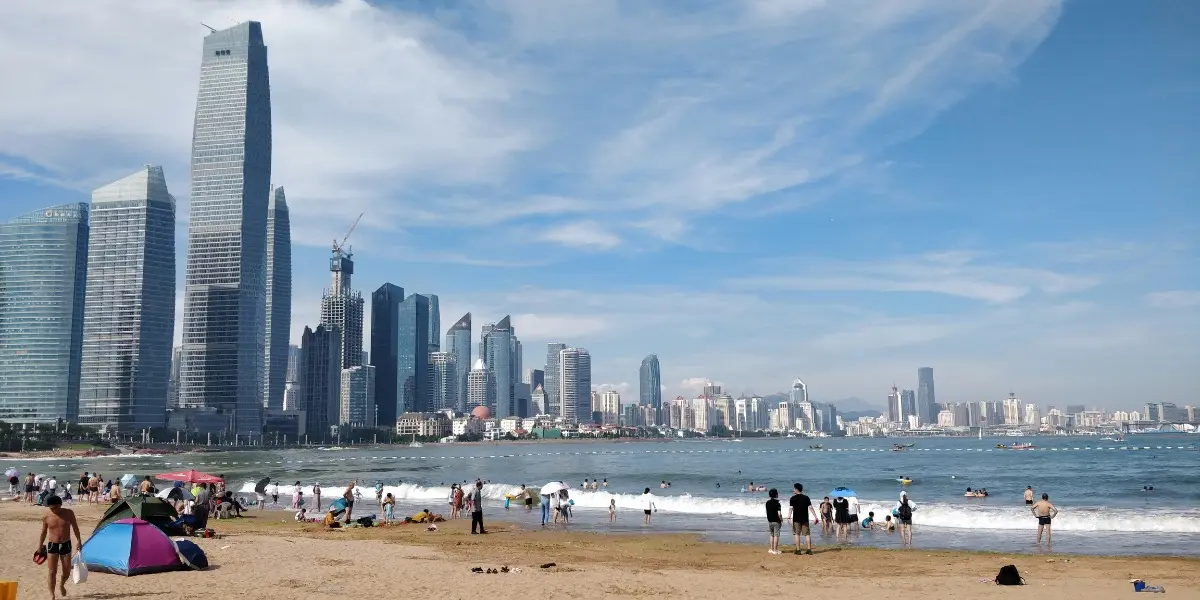
The summer-escape landscape divides sharply into two buckets: mature full-service urban hubs - Kunming, Dalian, Qingdao and niche summer-specialised resort-focused locations - Guiyang, Liupanshui, Changbaishan resort-town cluster. Important: resort-oriented destinations are optimised for Chinese-speaking domestic retirees; expat-focused coworking, bilingual services and international-grade medical resources are sparse or non-existent.
Table 1 — Mature urban summer-escape hubs
| Metric | Kunming | Dalian | Qingdao |
|---|---|---|---|
| Setting & natural traits | High-elevation plateau “Spring City”; dual-season migratory hub; year-round mild climate | Northern coastal city; temperate marine climate; mild summers; comprehensive urban infrastructure | Northern coastal tourist-heavy city; marine-influenced mild summer climate |
| Summer short-month furnished 1-bed rent (¥ / $) | ¥3,800-5,200 / $525-720 | ¥4,000-5,500 / $550-760 | ¥4,200-5,800 / $580-800 |
| 12-month baseline furnished 1-bed rent (¥) | ¥2,600 | ¥2,945 | ¥2,800 |
| Summer-peak premium | +46-100% | +36-87% | +50-107% |
| Core strengths | Mature expat community; reliable remote-work infrastructure; dual-season livability | Established business-oriented foreign-resident circles; reliable internet; mild summer temperatures minimise AC-requirements | Vibrant urban lifestyle; solid remote-work infrastructure; active expat social circles |
| Notable drawbacks | Sizable summer-rental inflation; higher baseline cost vs small mountain resort towns; seasonal humidity creates dehumidifier demand | Persistent coastal humidity forces regular dehumidifier runtime; peak-season tourist inflow amplifies rental-premium; high cross-country relocation travel-costs from inland furnace cities | Severe tourist-driven summer-rental spikes; coastal-humidity-linked utility overhead; tight short-term-rental availability July-August |
| Best-fit profile for foreign remote-workers | Long-term expat remote-workers; multi-month stable-base seekers prioritising urban amenities | Corporate-background remote-workers; expats prioritising complete city-service ecosystems | Socially-oriented remote-workers doing 2-3-month summer stays; prioritising city-lifestyle over strict budget optimisation |
Table 2 — Niche resort-focused summer-escape destinations
| Metric | Guiyang (Guizhou) | Liupanshui (Guizhou) | Changbaishan area (Jilin) |
|---|---|---|---|
| Setting & natural traits | High-elevation provincial capital “Summer Capital”; cool summers, frequent rainfall, persistently high ambient humidity | Small-scale high-altitude plateau city branded “China’s Cool Capital”; purpose-built for summer-escape tourism | Mountain-resort-town cluster; alpine-type cool-summer climate; forested terrain, heavy summer-tourism orientation |
| Summer short-month furnished 1-bed rent (¥ / $) | ¥3,200-4,500 / $440-620 | ¥2,800-3,800 / $385-525 | ¥3,000-4,000 / $415-550 |
| 12-month baseline furnished 1-bed rent (¥) | ¥1,800 | ¥1,600 | ¥1,700 |
| Summer-peak premium | +78-150% | +75-138% | +76-135% |
| Core strengths | Lower absolute rental price-points; authentic urban local-life; cooler-than-inland-furnace-city temperatures | Lowest absolute summer-rental costs among major summer-escape destinations; extremely mild summer thermal conditions; low-stress quiet living environment | Consistently cool alpine-summer conditions; distraction-free quiet working environment; natural-scenery advantages |
| Notable drawbacks | Very high humidity requires near-daily dehumidifier-use; limited expat coworking; scarce bilingual and international-medical resources; strict local-enforced address-registration rules for foreigners | Nearly zero expat-oriented infrastructure; heavy humidity-driven power-consumption; fully seasonal local-economy; strict foreign-resident registration enforcement | Tourism-dominated local-economy; almost no expat-community or remote-work-support infrastructure; minimal bilingual and international-medical access; repeated address-registration overhead for every relocation |
| Best-fit profile for foreign remote-workers | Budget-conscious remote-workers; expats with strong Chinese-language capability, prioritising temperature relief over expat-targeted amenities | Self-sufficient solo remote-workers with advanced Chinese-language skill; strict-budget-focused, no requirement for expat-specific services | Short-duration quiet-focused work-retreat participants; self-reliant expats working within tight summer-time budgets |
Notes on sources & limitations:
- Kunming, Dalian, Qingdao: Baseline 12-month-lease rent figures draw from site internal city-page datasets. Summer-peak short-month rent and observed-premium cross-checked against OTA seasonal-rental industry reports plus author local listing-pull samples collected June-August 2026.
- Guiyang, Liupanshui, Changbaishan area: There are no dedicated full city deep-dive pages for these locations on this site. Short-term-rental figures are illustrative observations from author local-listing pulls June-August 2026 and are not formal market-wide survey averages. Supplementary tourism-visitor statistics for Guiyang sourced from Guiyang Culture-and-Tourism Bureau and Xinhua Guizhou. Liupanshui climate-habitat ranking sourced from Shanghai Jiao Tong University 2026 summer migratory-habitat index. Changbaishan is a resort-town cluster rather than a single administrative city; comprehensive official residential-rent statistics do not exist for this area.
- USD conversions calculated at ¥7.2 = $1 and used for illustration purposes only.
- Seasonal-vacancy estimates apply exclusively to vacation-oriented short-term-rental-purpose apartments, and do not reflect overall general-purpose city residential housing vacancy.
- Real-world costs vary by apartment condition, floor, negotiation skill, lease-length, and exact move-in timing. Always verify live local listings before making relocation plans.

Quantifying hidden recurring costs: beyond inter-city train tickets
Most people planning summer-escape only add high-speed-rail fares to their budget sheet. Three measurable categories of recurring overhead are systematically omitted from global cost-of-living tables, alongside intangible quality-of-life penalties.
Address-registration & administrative friction for foreign permit-holders
Every cross-city move requires fresh mandatory address-registration formalities for foreign long-term permit-holders, to be completed within 24 hours of arrival. If handled independently, it consumes multiple half-day police-station visits, compounded by potential language-barrier-related delays. Many expats engage local specialised agents to handle paperwork: per-relocation one-off service-fee range ¥300-800. This expense repeats for every summer-season move, a burden Chinese citizens never encounter. See hidden recurring costs for broader context.
Lease-length penalty plus moving-and-storage logistics burden
All-city cheapest monthly-rent rates are locked behind 12-month-commitment contracts. Summer-escape participants accepting only 2-3-month seasonal-tenancies automatically absorb short-term-rental-premiums. Using Kunming’s field-sample one-bed furnished-unit as arithmetic example:
- 12-month baseline monthly rent: ¥2600
- Summer-peak short-month asking rate: ¥4100
- Monthly incremental rent penalty: ¥1500; for typical 2.5-month summer-stay, total incremental rent penalty ≈ ¥3750
Additional tangible logistics expense arises: transporting or storing dehumidifiers, home-office monitors and household-goods between cities. Per-move one-off moving-and-storage-cost range ¥400-1200, recurs each year for repeat summer-escape practitioners.
Location-locked utility burden: humidity is the hidden power-cost
Widespread misconception: “cool summer climate equals negligible electricity bills”. In practice mild temperatures suppress air-conditioning runtime, yet sustained high humidity forces heavy dehumidifier operation, creating steady monthly power-draw. This cost mechanism is almost never captured in international cost datasets.
Utility-cost comparison: inland furnace city vs summer-escape destinations
| Location scenario | Main power draw | Extra monthly summer electricity cost | Notes |
|---|---|---|---|
| Inland furnace city (Chongqing / Wuhan / Changsha) | Air-conditioning heavy runtime | ¥380-620 | Long-duration cooling requirement June-August |
| Northern coastal escape (Dalian / Qingdao) | Dehumidifier; minimal air-conditioning | ¥80-140 | Marine-source humidity; typical dehumidifier daily runtime 6-10 hours |
| Guizhou high-land escape (Guiyang / Liupanshui) | Dehumidifier; almost zero air-conditioning | ¥90-160 | Frequent rainfall plus persistently high relative-humidity; mould and electronics-damage risk motivates near-daily dehumidifier-use |
Sources: NDRC national-average residential-electricity-tariff benchmark ¥0.60/kWh Official. Consumption-ranges are illustrative samples; real-world bills shift by apartment-size, hardware-efficiency, local-humidity and personal-device-runtime habits. Author field sample.
Important practical takeaway: When you relocate away from your furnace-city origin you cut down large air-conditioning expenses, but you simultaneously take-on humidity-linked electricity-costs in your cool-summer-destination. A net monthly financial saving is not guaranteed; outcomes differ based on exact destination and household-equipment-usage patterns. Global-cost-of-living tables do not separate utility-spending according to local-seasonal-humidity profiles.
The non-financial toll: compressed-stay social-capital erosion
Budget spreadsheets can tabulate rent, agent-fees and power-bills, but they cannot quantify quality-of-life losses. Building trusted local-service-providers, coworking acquaintances and comfortable daily-routine usually consumes multiple consecutive months of stable residency.
Summer-escape stays are characteristically compressed: most participants only reside June-August, roughly 2-3 months total. By the point you start establishing local connections, summer-peak already concludes and you need to relocate-out. For comparison: many winter-snowbird-migration participants occupy their secondary-base for 4-6 months, giving substantially longer settlement-time. The “routine-tax” weighs proportionally heavier for summer-escape expats.
Summer-escape still works, but it's not a clean break from the heat — it trades one set of costs for another.
Destination decision guide: matching expat-remote-worker profiles to summer-escape bases
Mature urban hubs (Kunming / Dalian / Qingdao)
Best-suited for the majority of foreign-permit-holder remote-workers. Dual-track rental markets exist: both long-term-lease and seasonal-short-month options. They deliver established expat-communities, coworking resources, bilingual services and international-medical-care. Expect non-trivial summer-peak-rental-premiums as trade-off for complete urban amenities.
Guizhou high-land hubs (Guiyang / Liupanshui)
Best-fit for budget-focused, highly self-reliant expats with fluent Chinese-language capability. They deliver effective heat-relief at comparatively low absolute-rent-levels. Caveat: local-infrastructure is built primarily for Chinese-speaking retired summer-escapers; expat-oriented amenities are scarce or absent entirely.
Changbaishan resort-town cluster
Only appropriate for short-duration distraction-free work-retreats, not sustained multi-month remote-work-base. The whole local-economy is tourism-centred; supporting infrastructure for long-term foreign-resident remote-work is minimal.
Key contrast-note: Unlike many winter-snowbird-migration destinations, summer-specialised resort-towns offer no option to extend-stay into off-season to capture discounted lease-rates. The high-demand summer-window is narrow; you are forced to accept peak-period-pricing.
This article analyses summer-focused migratory patterns. For winter-oriented partial-year-stay trade-offs read companion article Snowbird-migration living.
For a broader framework on how to evaluate a city's true cost, see Five Kinds of Cheap.
For city-by-city cost breakdowns, browse our full city index.

Final takeaways for expats evaluating summer-escape relocation
- Do not plan summer-escape budgets relying exclusively on static yearly-average cost-of-living datasets. Always separate three distinct figures: 12-month-baseline rent, platform blended-yearly-average rent, and real-world June-August peak-season short-month asking-rent. Summer-peak-premiums can run from 35-70% above 12-month-baseline; niche resort-towns can go higher.
- Build-out full-scope personal-budget projections including three categories of overlooked-burdens: per-move administrative-agent-costs, recurring moving-and-storage logistics-expense, and humidity-driven summer-electricity-increments. Your visa-category and Chinese-language-proficiency will directly determine how onerous these overheads feel for you personally.
- Draw a sharp practical distinction between tourist-holiday-spots and viable multi-month remote-work-bases. Many well-known summer-escape-destinations are optimised for domestic-retiree tourism. They may lack stable internet-quality, expat-targeted coworking-spaces, bilingual-support and international-grade-medical-services, independent of how attractive short-term-rental-listings look.
- Public price-tables can answer: “What is average apartment-rent across a full calendar-year in this city?” They cannot answer: “What will I actually pay, and what compromises must I accept, chasing cool-summer-weather as a foreign-permit-holding remote-worker during June-August?”
If you are still unsure which city fits you best, take the seven-question city matching quiz. For a personalised estimate of your monthly budget, try the should-you-move calculator.