Maya taught English in Chengdu for two years when her contract quietly ended, and her residence permit gave her exactly forty more days. She had two options nobody in her life understood. Fly home to a job market that read her China years as a gap on a résumé. Or stay, point a phone at the city she already knew, and try to turn "living in China" into income paid in dollars by YouTube and Patreon.
She did the math on a napkin, Chengdu rent, a VPN bill, the cost of a visa run, how many months her savings would actually last, and found that staying was cheaper than flying home. What she did not find, in any of the cheerful "be a creator in China" posts she read that night, was the sentence that mattered: this can get you detained and banned from re-entering China for five years. That part comes later, and it is the part that decides whether Maya's math was survivable.
That is the whole deal. Interest in China content is at a ten-year high, and the number of resident Western creators feeding it is startlingly small. But the cold start is six to twelve months with no income, and the visa is a live wire. If you want the fantasy, close this tab. If you want to decide with open eyes, keep reading.
The short version
You read the range, the haircut, and the leash. Here is what changes with it: two routes, one number (runway), and a visa line that decides whether any of it survives.
Route A (overseas-facing): English content, you keep your home audience, but the visa is entirely your problem.
Route B (domestic-facing): Chinese platforms pay more, but you need fluent Mandarin or an MCN, and a work visa is mandatory.
Runway is everything: the cold start is six to twelve months with no income. Pick the city that buys you the most months, and treat the visa as a hard ceiling, not a formality.
What a million followers actually earns
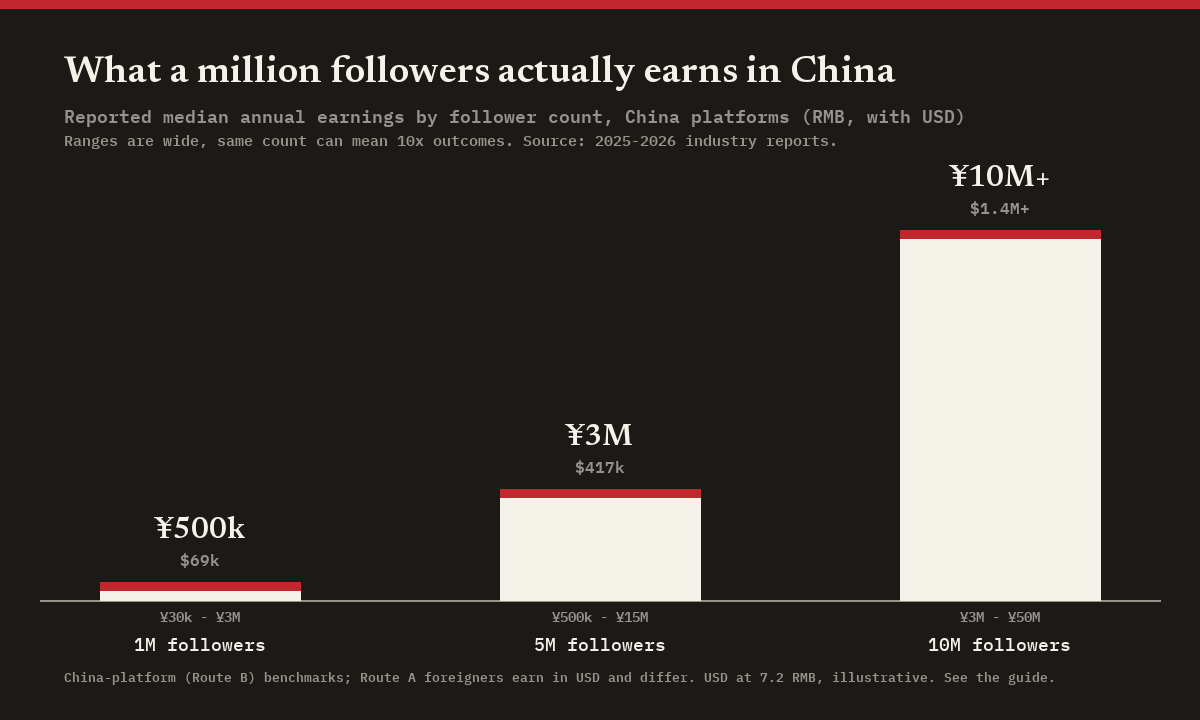
You read the range, the haircut, and the leash. Here is the math behind it, with the China-platform benchmarks and the full split. These are China-platform (Route B) benchmarks from 2025 and 2026 industry reports. They are not foreigner-specific: a Route A creator earns in USD through AdSense, Patreon, and affiliate, and starts far smaller (see Step 4).
| Follower count | Median annual (RMB) | Reported range | What changes at that level |
|---|---|---|---|
| 1M | ~¥500k | ¥30k – ¥3M | The spread is the story: dormant accounts vs sharp niches |
| 5M | ~¥3M | ¥500k – ¥15M | A team, a supply chain, and management costs enter the picture |
| 10M | ¥10M+ | ¥3M – ¥50M | Head tier; the visa is held by an employer or MCN rather than by you |
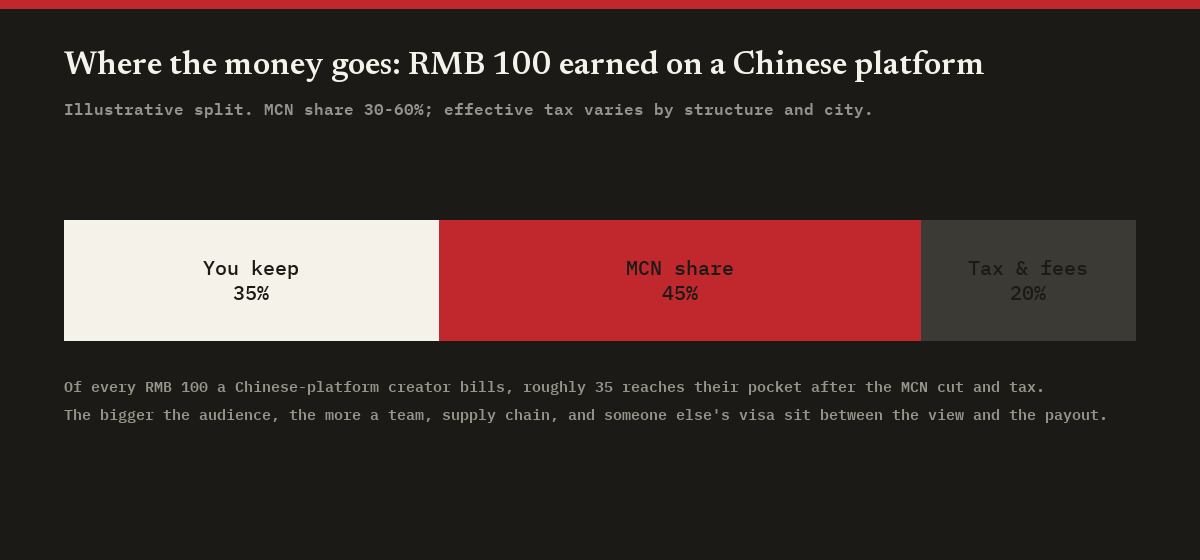
The gap between the headline number and what reaches a creator's pocket widens with every zero. For a foreigner it widens further, because domestic earnings must route through an MCN employer to stay legal (Step 5). That is the math behind the fantasy, and it is the reason Route A starts small and stays yours.
0. The window is open, but the bar is rising
Two things changed the game in 2024–2025. First, "China Travel" and the "China maxxing" wave turned overseas curiosity about China into a genuine content category. Second, on 17 December 2024 China extended transit visa-free stay from 72/144 hours to 240 hours (10 days), which pushed a wave of short-visit creators to film in China.
That last point is the trap. The 10-day visitors are flooding tier-1 cities with first-impression content. The durable opportunity is the opposite: deep, lived-in content from someone who actually resides in China. As one Bilibili executive put it, top foreign YouTubers deliver the "first impression," but it is the foreigners who live in China who surface the depth.
Reality check: the market is growing, but the dropout rate is brutal. Most newcomers die in the 6–12 month period with no income. Your savings (your runway) is the single biggest factor in whether you make it. Keep that word in mind; we return to it at every step.
Why now: China maxxing and the North American opening
If you are North American, the timing argument matters as much as the how-to. Through 2025 and into 2026 a "China maxxing" wave spread across TikTok and Instagram, Western young people posting the "typical Chinese life" they found appealing: drinking hot water, eating congee, practicing qigong. It is, in part, recoil from Western hustle culture, and it points straight at the audience that matters here: Westerners curious about actually living in China, not just visiting. The #BecomingChinese thread alone has drawn billions of views, with a large share of that engagement coming from U.S. users.
The two case studies below can obscure one thing: those men did not close the window, they show it is real. The newcomer's question is not "did I miss it?" but "how empty is the lane?" The answer: still very empty. Our estimate of all foreign creators residing in China and publishing to overseas platforms is only about 1,700–2,700 people, a sliver against a Western audience of hundreds of millions curious about living in China. Short-visit "China Travel" content has flooded in over the past 12 months, but residents producing sustained, lived-in coverage are far fewer, and native-English residents are the thinnest slice of all. Demand is rising; the resident-creator supply is not keeping pace. That gap, not any one creator's success, is the real window.
Our 1,700–2,700 figure is a bottom-up estimate, not a census: we summed named overseas-China creators with 1k+ followers tracked in public directories and creator roundups, then applied a multiplier for the sub-1k long tail. Treat it as an order-of-magnitude.
One North American creator proves the English, overseas-facing ceiling is real, and another shows the domestic lane's scale, with a caveat:
- Ethan Robertson ('Wheelsboy'): from North Carolina, six years in China, 210k+ YouTube subscribers reviewing Chinese cars from a Western perspective, and a separate following on Chinese platforms. Proof that a focused English niche compounds into a real channel, and a reminder that the two routes are not mutually exclusive.
- Ryan Norman, "Lei Ge" (雷哥): from California, ~20 years in Rizhao, Shandong, with a cross-platform following reported at 5M+ as of late 2026. The caveat: his audience is almost entirely domestic, dialect, market-life vlogs on Chinese short-video platforms, so he is a Route B–type creator, not an English Route A example. He proves that long-term presence compounds; he does not prove that English content scales. We list him under Route B in Section 7.
Step 0: Who are you talking to? (get this wrong and you rebuild from zero in month four)
Most "create in China" articles open with camera gear. The only question that actually matters comes first, and it is sharper than it looks:
Are you making videos for people outside China, or people inside China?
Same passport, same city, same phone in your hand, yet two completely different careers.
Two foreigners, two different games
The domestic-platform star (Route B). He films in fluent Mandarin on Douyin and Bilibili and, within a few years, pulls 10–20 million Chinese followers. Income lands in RMB from Chinese brand deals and livestream commerce. To do it legally he needs a Z work visa sponsored by an MCN, so he lives where the agency sits, usually Hangzhou or Shanghai. The playbook is visible in creators like Ahmed Jabar ("Lao Wang in China," 老王在中国), who built ~20 million followers across Chinese platforms after arriving as an Arabic teacher and mastering Mandarin; Jason Lightfoot ("Jason在中国"), running a bilingual channel since 2015 with 2M+ Douyin followers; Tyler ("Tiedan'er," 铁蛋儿), an American based in Dalian whose food-and-dialect channel reached ~3.2M Douyin and ~2.5M Bilibili followers (early 2025) without relocating to an MCN hub; and Vlavlav (伏拉夫), whose overt "I love China" persona became 13M Douyin followers and a lucrative ad business, a lane now so crowded and contested that newcomers rarely repeat it.
The overseas-facing expat (Route A). She posts in English on YouTube for Westerners curious about living in China. Money comes in dollars from AdSense, Patreon, and affiliate links. No Mandarin required, no MCN, no work visa, but also no safety net: she lives in Chengdu on a tight budget, uploads through a VPN in a zone of explicit legal risk, and prays her savings outlast the cold start. Creators like Abhinav Singh ("Desi Boy in China") do exactly this, turning grocery prices and daily routines into a cost-of-living channel; the Hangzhou-based Italian couple Rachele & Luca bank 140k+ YouTube subscribers on real-China vlogs. North American creators are especially well positioned for this lane, North Carolina's Ethan Robertson ("Wheelsboy") shows the English-language ceiling (more in the "Why now" section).
One is a Chinese-media career. The other is a bootstrapped expat hustle. The mistake newcomers make is treating them as the same thing.
| Dimension | Route A, Overseas audience (the expat hustle) | Route B, Domestic audience (the platform star) |
|---|---|---|
| Audience | Westerners / people considering moving to China | Chinese domestic viewers |
| Main platforms | YouTube, Instagram, TikTok (global) | Bilibili, Douyin, Xiaohongshu (RedNote), Kuaishou, Weibo |
| Language | Mostly English | Mostly Mandarin (or strong subtitles) |
| Monetization | AdSense / Patreon / affiliate, USD | Brand deals / livestream commerce / platform share, RMB |
| Visa | Explicit legal risk (no digital-nomad visa in China) | Essentially requires a Z work visa + a Chinese MCN |
| City logic | Driven by cost & footage (Chengdu / Kunming / Changsha; Shenyang & Jinan as niche budget picks) | Clustered in MCN hubs (Hangzhou / Shanghai / Guangzhou / Beijing) |
| Content logic | Authentic daily life, cost-of-living, cross-cultural | Resonant, often praise-China or contrast framing for Chinese netizens |
Hard fact about Route B that most guides hide: As of early 2025, Douyin and Xiaohongshu do not allow foreign-passport real-name registration. A ByteDance vice-president confirmed Douyin has not opened overseas registration and foreign passports cannot pass verification, you need a Chinese permanent residence permit (外国人永久居留证) to register. Bilibili's international app, launched in August 2026, dropped real-name verification for browsing and is actively recruiting Western creators, but the exemption stops at the login screen: to upload videos, enable monetization, or withdraw earnings, an overseas creator must still pass passport and residence-proof verification. And its promised monetization rails (ad-share, brand marketplace, live tipping) are not yet fully live, so do not count on income from it yet. That is the exception, not the rule. In practice, an ordinary foreigner without PR who wants the domestic audience usually has to go through an MCN that holds the account, which loops straight back to a Z work visa. Route B is possible for a newcomer, but a much heavier lift than Route A.
For the rest of this guide, Route A (overseas audience) is our main track, because it is the realistic path for most expats, foreigners who want to build a life in China, not just pass through it.
Step 1: Independent, or sign a Chinese MCN? (mostly decided by Step 0)
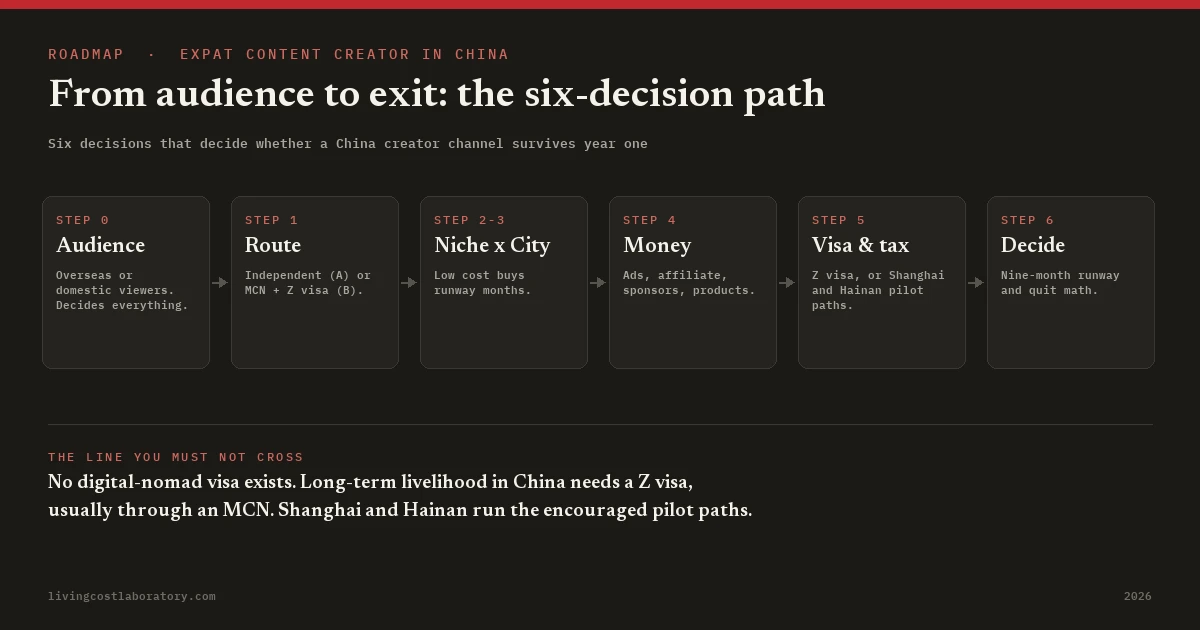
Route A almost always means independent. Route B almost always means MCN + Z visa.
Independent (Route A default)
- Pros: Full creative control (no one forces you into clickbait-for-Chinese-netizens scripts); 100% of AdSense / Patreon / affiliate revenue stays with you; city freedom; low contract risk.
- Cons: You handle your own visa and taxes; no local business connections; you learn the hard way by trial and error.
Sign a Chinese MCN (Route B default)
- Pros: The MCN sponsors your Z work visa and residence permit; they connect you to domestic brands, studios, supply chains, and translation help.
- Cons: 30–50% revenue share is normal; they may steer your content toward domestic-platform logic that undermines an overseas-facing brand; your city is effectively locked to the MCN's base (usually Hangzhou, Shanghai, or Guangzhou); and if the MCN's content breaches rules, the account is in your real name, you carry the liability.
Rule of thumb: Newcomer + tight budget + expat-life content → independent, Route A. Want domestic brand deals and need a work visa sorted → consider an MCN, Route B, based in Hangzhou / Guangzhou / Shanghai.
Step 2: Pick your niche
Overseas-facing niches
- Expat life / cost-of-living vlogs → low-cost provincial capitals: Chengdu, Kunming, Changsha, plus Shenyang and Jinan as "extreme-budget + under-filmed" picks (caveat: tiny expat community, almost no MCN, no supply chain, bad for product reviews).
- Food / slow living / digital nomad → Chengdu, Kunming, Dali, Anji, Huizhou. Dali runs around ¥3,000/month; Huizhou rents can drop to ¥800/month.
- Made-in-China / sourcing reviews → Shenzhen, Yiwu, Guangzhou. Only move here after you are already monetized; do not start here as a broke newcomer.
- Not for newcomers: Shanghai and Beijing. Rent is high and the expat-creator space is saturated.
Domestic-facing niches
Dictated by Chinese-platform trends (cultural contrast, "real China" framing, city life). Creators cluster in MCN cities. Success here typically requires fluent Mandarin or an agency, see the examples in Section 7.
Step 3: City selection, niche × cost
Estimated monthly cost of living (single person, excluding rent) per livingcost.org, March 2025:
| City | Monthly cost (excl. rent) | Fit for overseas-facing newcomer |
|---|---|---|
| Shanghai | $1,097 | High rent, saturated, not for starters |
| Beijing | $1,016 | Same as above |
| Shenzhen | $916 | Sourcing niche only, post-monetization |
| Suzhou | $868 | Quiet, decent footage |
| Hangzhou | $805 | MCN hub (Route B) |
| Guangzhou | $774 | Sourcing / MCN |
| Chengdu | $623 | Top pick: low cost, real community, good footage |
| Xi'an | $587 | Good budget alternative |
| Changsha | $577 | Top budget pick |
Runway math: why city choice is a survival decision
Illustrative monthly totals (rent + living), because the table above excludes rent:
| City | All-in monthly (illustrative) | $8,000 savings lasts |
|---|---|---|
| Chengdu | ~$900 | ~9 months |
| Shanghai | ~$1,700 | ~4.5 months |
That gap is the whole ballgame. In Chengdu you get nine months to find your audience; in Shanghai less than five. Niche → city → burn rate → survival. This is the chain the whole guide is built around, and the part most cheerful "be a creator in China" posts skip.
A real month on Route A (anonymous creator, Chengdu, month 4 of the cold start)
The runway math above is an average. One plausible month in the red, because the only number that predicts survival is runway, not talent.
| Line item | Monthly (USD) | Note |
|---|---|---|
| Income | ||
| YouTube AdSense | $0 | Below the 1,000-sub / 4,000-watch-hour threshold, pays nothing yet |
| Affiliate links (gear / "before you move" list) | $70 | First real clicks; lumpy, not salary |
| Patreon (2 founding members) | $14 | Meaningful only past ~5,000 loyal subs |
| Total income | $84 | Essentially symbolic at this stage |
| Fixed costs | ||
| Rent (Chengdu, one-bedroom, non-center) | $330 | Why the city choice is the survival decision |
| Food (mostly local / street, cook at home) | $210 | Local/home cooking ~$210; livingcost's $623 is the full baseline incl. a Western lifestyle |
| Phone + home broadband | $22 | |
| Variable / creator costs | ||
| VPN (multi-device, stable nodes) | $12 | Non-negotiable: YouTube is blocked, uploads run through it |
| Camera + mic (amortized, one-off ÷ 24 mo) | $30 | A phone can start you; this is the upgrade tier |
| Editing / AI tools subscription | $25 | Script drafts, auto-captions, cleanup |
| Buffer | ||
| Visa-run reserve (set aside monthly) | $80 | Border run or status change, fund it every month, don't be surprised by it |
| Total burn | $709 | |
| Net for the month | –$625 | Covered entirely by savings |
| Savings left | ~$5,200 | At this burn, ~8 more months of runway |
Read that table slowly. Same setup in Shanghai (all-in ~$1,700) turns those $5,200 into about three months, not eight, same dream, different odds. That is the niche → city → burn rate → survival chain in one screenshot. (The VPN line is singled out because it is the hidden ticket of "live in China, publish to the world", almost no guide mentions it.)
Step 4: Monetization map
Route A (overseas audience)
| Channel | Typical income | Notes |
|---|---|---|
| YouTube AdSense | ~$400/mo at 100k views (global $4 CPM); higher with a North American audience | Threshold 1,000 subs + 4,000 watch hours. CPM runs $2–20 by niche and region. Supplementary early, not survival money. |
| Patreon / members | $2–10 / member / mo | Meaningful after ~5,000 loyal subscribers. |
| Affiliate marketing | $50–2,000+/mo | No follower floor. Fits cost-of-living and "things to buy before you move" content, and matches our own model. |
| Sponsorships | $200–5,000+/video | Start at 5k–10k subscribers; overseas brands. |
| Courses / paid products | $1k–20k / launch | e.g. "moving to China" courses. |
| Consulting | $100–400/hour | Relocation or sourcing advice. |
Which platform to start on:
| Platform | Discovery & reach | Monetization | Best for |
|---|---|---|---|
| TikTok / Instagram Reels | Fast reach; where China maxxing content gets found | Weak; no AdSense | Top-of-funnel discovery |
| YouTube Shorts | Fast, same as above | Pays less per view than long-form | Quick reach, lower ceiling |
| Long-form YouTube | Slower to build | Strongest AdSense, sponsorship, affiliate economics | The durable "deep China" brand |
| Patreon | Builds on your audience | Membership income | Readers considering a move pay willingly for insider detail |
Practical default: use TikTok / Instagram for discovery, then build the durable audience and income on long-form YouTube + Patreon.
Route B (domestic audience)
Brand deals (RMB), livestream e-commerce, and platform revenue share, almost always routed through an MCN that also handles your visa.
Payment infrastructure (read this before you earn a cent)
Mainland Chinese bank accounts cannot directly receive AdSense payouts (forex and AML rules; AdSense does not accept mainland China as a payee country by default). As a foreigner, the working setup is:
- Register AdSense with your home-country identity and submit a W-8BEN tax form.
- Receive to a home bank, or to a virtual USD account from Payoneer (most stable; ~$5.98 wire fee, ~99% success), Wise (transparent FX), or, since 2025, PayPal Hyperwallet (official AdSense option).
- Withdraw to a Chinese bank card for local spending, within the $50,000/year per-person forex conversion quota.
Operating hurdle you must respect
YouTube is blocked in mainland China. Uploading and checking analytics requires a VPN. Personal VPN use in China is technically illegal and monitored. This is the quiet cost of "living in China while publishing to the world", state it honestly, do not pretend it is risk-free.
Reality income tiers
| Subscribers | Monthly income | Reality |
|---|---|---|
| 0–10k | None stable | You are spending savings. |
| 10k–100k | $800–3,000 | Ads + affiliate + light Patreon. Covers life in China, rarely makes you rich. |
| 100k+ | $3,000–15,000+ | Ads + sponsors + affiliate + products. |
Avoid the trap: Domestic Douyin livestream e-commerce aimed at Chinese viewers requires a Z visa and conflicts with an overseas-facing brand. Do not assume you can "just also do TikTok/Douyin."
AI-assisted production (a force multiplier, not a replacement)
You can use AI to compress the solo-creator workload: drafting scripts, generating B-roll ideas, auto-generating subtitles and translations, cleaning up edits, and mocking up thumbnails. For an independent expat with no team, this is how you publish consistently on a low budget.
But the differentiation that makes overseas China content work is real, lived daily life, the ordinary market, the bus ride, the apartment you actually rent. AI cannot manufacture that, and audiences smell synthetic filler instantly. Use AI for speed; protect the authentic voice that only you, on the ground, can provide.
Step 5: Visa & tax reality (the part that gets people deported)
- There is no digital-nomad visa and no freelance visa in China.
- Route A, explicit legal risk, not a gray zone: Earning foreign-currency income from platforms based outside China is not, by itself, illegal, the money and the platform are both overseas. But living in China long-term and making that your main livelihood without a work visa is a clear violation of China's Exit and Entry Administration Law. If enforced, consequences range from visa cancellation to detention, deportation, and multi-year entry bans (commonly five years). And note the Route B reality per the same law: "work" includes paid livestreaming, so doing it on a tourist or student visa can bring fines, detention, and a 1–5 year entry ban. Nobody should tell you Route A is clean. The full entry-visa process is covered in our China visa & residence guide.
- Route B clean path: a Z work visa plus a work permit, usually via the MCN that employs you.
- K visa (effective 1 October 2025): for young tech talents, no employer required, but it does not cover pure content creators, and as of early 2026 the detailed eligibility rules are still thin, so treat it as "watch this space," not a usable path yet.
Tax, the 6-year rule most guides omit: Spending 183+ days in China in a tax year makes you a tax resident, theoretically liable on worldwide income. But a foreigner without a domicile who hits 183+ days for fewer than six consecutive years, and files a record with the tax authority, is exempt from Chinese individual income tax on income sourced outside China and paid by an overseas entity, which covers YouTube / Patreon paid by overseas platforms. Hit six consecutive years (or take a single trip abroad exceeding 30 days in any of those years, which resets the clock) and worldwide income becomes taxable. File the record; do not assume.
We are not your lawyer or tax advisor. Confirm current rules with Chinese immigration and tax authorities before you commit. For a baseline estimate of your own China income tax as a foreign employee, our expat income tax calculator works out the resident-or-non-resident question and your net take-home; it does not model the six-year rule, so treat the result as a starting point.
Legal paths that are actually encouraged: Shanghai's 滬九條 and Hainan FTP
There are, in fact, two policy openings where China actively courts foreign creators, worth knowing before you assume the only route is the risky one.
Shanghai, "滬九條" (the nine measures)
From July 2025, Shanghai rolled out a package explicitly supporting global content creators and MCNs: it encourages agencies to sign overseas creators and eases their visa and residence procedures, offers rewards of up to ¥100,000 per outstanding work, and for AI-content projects can cover up to 30% of qualifying costs (capped at about ¥20 million). If your plan is Route B (domestic audience) and you want a clean, supported path, Shanghai is the city where the policy is most concrete.
Hainan Free Trade Port, the legal alternative for livestreaming
Hainan has built a cross-border livestream base and offers a strikingly fast track: work and residence permits can be applied for jointly in about 3 working days (roughly 70% faster than the standard process), high-end talent pays a 15% personal-income-tax cap, and enterprise income tax is also 15%. For a North American creator who hits the Route B registration wall on the mainland, Hainan is the legitimate, policy-friendly door, though you will still need Mandarin or an agency to actually run a China-facing channel.
Step 6: Decision framework
Run the chain in order:
- Audience? Outside China (Route A) or inside China (Route B).
- Path? Independent (A) or MCN + Z visa (B).
- Niche? Expat-life / food / sourcing / other.
- Monthly budget? This sets your city.
- City? Low-cost provincial capital for A; MCN hub for B.
| If you are… | Then… |
|---|---|
| Broke newcomer, English, expat-life focus | Route A independent → Chengdu / Kunming / Changsha |
| Want domestic deals + need a visa | Route B MCN → Hangzhou / Guangzhou / Shanghai |
| Sourcing / product reviews | Build audience cheap first, then Shenzhen / Yiwu / Guangzhou |
North American newcomer default path: If you are unsure where to start, take Route A (independent, overseas-facing) in Chengdu, Kunming, or Changsha, and use the ~9-month runway to test your content before worrying about monetization. Only consider Route B (an MCN in Shanghai/Hangzhou, or the Hainan livestream base) once you are fluent in Mandarin and genuinely want the domestic-brand business.
The 5-minute self-check: which track are you actually on?
Answer honestly, then tally which side your answers fall on.
| # | Question | If "yes," it points to → |
|---|---|---|
| 1 | Do you speak fluent Mandarin (HSK 5–6, can joke on camera)? | Route B (domestic) |
| 2 | Do you hold a Chinese PR card, or has an MCN already offered to sponsor a Z visa? | Route B (domestic) |
| 3 | Is your money coming (or planned) from AdSense / Patreon / affiliate in USD? | Route A (overseas) |
| 4 | How many months could you fund a $0-income run on current savings, minus rent? | < 6 mo → not ready; 6–12 → Route A, low-cost city only; 12+ → any |
| 5 | Can you tolerate explicit legal risk, VPN use, no work visa, deportation exposure, for a livelihood? | No → Route B (clean path) or don't do this |
| 6 | Do you want domestic brand deals and livestream commerce (RMB)? | Route B, and it requires the Z visa |
How to read it: Mostly 1 / 2 / 6 yes → Route B. You need Mandarin and/or an agency (Hangzhou / Guangzhou / Shanghai, or the Hainan livestream base). Heavier lift, but a legal, supported path exists. Mostly 3 / 5 yes → Route A. Independent, overseas-facing, start in Chengdu / Kunming / Changsha, and let the runway, not the algorithm, set your timeline. Any runway answer under 6 months → stop. The single biggest predictor of failure is a short runway, not a weak niche. Get the money right before the camera.
7. Real creators doing it (so you know it is possible)
Overseas-facing peers (Route A):
- Ethan Robertson ('Wheelsboy'): North Carolina, six years in China, Western-perspective Chinese-car reviews, the English-language ceiling. YouTube ↗
- Abhinav Singh ('Desi Boy in China'): Indian choreographer, six years in China, documenting grocery prices and daily routines. YouTube ↗
- Rachele Longhi & Luca: Italian couple in Hangzhou, 140k+ YouTube subscribers on real-China vlogs. Bilibili ↗
- Luke O'Farrell & Alex Short: Irish brothers in Nanning, Guangxi; hundreds of travel and culture videos. YouTube ↗
Domestic-facing (Route B, note the bar):
- Jason Lightfoot ('Jason在中国'): British, in China since 2015; 2M+ Douyin followers. YouTube ↗ · Douyin ↗
- Tyler, "Tiedan'er" (铁蛋儿): American in Dalian; ~3.2M Douyin / ~2.5M Bilibili (early 2025). Douyin ↗
- Vlavlav (伏拉夫): 13M Douyin followers on the overt "I love China" persona. Douyin ↗
- Ahmed Jabar, "Lao Wang in China" (王立轩): Iraqi, in China since 2014; ~20M followers, the ceiling of Route B. Douyin ↗ · Bilibili ↗
- Pamela Reif: German fitness creator (9.68M YouTube) who entered China through a management agency. YouTube ↗
- Ryan Norman, "Lei Ge" (雷哥): California, ~20 years in Rizhao; 5M+ domestic-platform followers, full profile in "Why now" above. Douyin ↗ · Bilibili ↗
Route A rewards presence and authenticity; Route B rewards Mandarin fluency and/or an agency. That is why, for most newcomers, Route A is the honest starting line.
Watch these creators
Real channels referenced above, open to see how they do it
- Route A · YouTubeWheelsboy, YouTube ↗
- Route A · YouTubeDesi Boy in China, YouTube ↗
- Route A · Bilibili路卡和瑞丽 (Rachele & Luca), Bilibili ↗
- Route A · YouTubeLuke & Alex, YouTube ↗
- Route B · YouTube / DouyinJason在中国, YouTube ↗ · Douyin ↗
- Route B · Douyin铁蛋儿 (Tyler), Douyin ↗
- Route B · Douyin伏拉夫 (Vlavlav), Douyin ↗
- Route B · Douyin / Bilibili老王在中国 (Ahmed Jabar), Douyin ↗ · Bilibili ↗
- A/B · YouTubePamela Reif, YouTube ↗
- Route B · Douyin / Bilibili雷哥 (Ryan Norman), Douyin ↗ · Bilibili ↗
8. When to quit (the section optimistic guides skip)
The cold start is 6–12 months of no income. Signs it is working: watch hours trending up, first affiliate clicks, a Patreon founding member. Signs to leave gracefully: savings past the halfway point with flat growth, content burnout, or visa pressure you cannot resolve. Your runway math (Step 3) should decide this before you are broke in a foreign country. Quitting is not failure; it is a controlled exit.
One real exit, anonymized: a teacher we'll call "D" ran a cost-of-living channel from Xi'an for seven months on $6,000 in savings. He reached ~3,800 subscribers and ~$40/month in affiliate, but watch-hours flattened after month five and his visa extension fell through. He left with $900 to spare and a channel he could revive later, the exit you want, not the one where you run out of money at the airport. The difference was a number on a spreadsheet, decided in advance.
Takeaways
- Audience (outside vs inside China) is the first and biggest decision, it decides everything downstream.
- Niche → city → burn rate → survival. Pick the city that buys you the most months.
- Route A (overseas) is the realistic path for most expats; Route B (domestic) needs Mandarin fluency or an MCN + Z visa.
- AdSense will not save you early; affiliate and Patreon compound slowly. Plan for zero income for half a year minimum.
- YouTube is blocked in China; VPN use is illegal and monitored. Know the operating cost.
- No digital-nomad visa exists. Route A carries explicit legal risk (earning overseas income isn't illegal, but long-term livelihood without a work visa is); the 6-year tax rule can exempt your overseas income if you file. Shanghai's 滬九條 and Hainan FTP are the legal, encouraged alternatives if you want Route B.
- AI speeds up production, but real daily life is your only defensible edge.
Questions people actually ask
Quick answers
Can foreigners legally be content creators in China?
Yes, but it depends on the route. Overseas-facing creators publishing in English to platforms like YouTube or Patreon are not employed in China and usually hold a student, work, or family residence permit. Domestic-facing creators who earn on Chinese platforms almost always need a work visa arranged through an MCN or employer, because paid work without the correct permit can lead to detention and a multi-year re-entry ban.
How much runway do I need before starting?
Plan for six to twelve months with little or no income. Your savings, your runway, is the single biggest factor in whether you survive the cold start. Lower-cost cities such as Chengdu, Dalian, or Hangzhou stretch those months further than Shanghai or Beijing.
Is using a VPN legal in China?
Unauthorized VPN use is restricted in China and is a recurring cost and compliance risk for creators who need access to YouTube, Patreon, or Google tools. Budget for it, but treat it as a serious consideration that sits in the same legal gray area as the visa itself.
Which Chinese cities are best for foreign content creators?
For overseas-facing newcomers, lower-cost cities like Chengdu, Hangzhou, and Dalian offer the longest runway. Shanghai and Beijing are saturated and expensive, better suited to post-monetization scaling than a cold start.
Before you go
Get the next guide, when it's ready
One short email when a new guide or city breakdown goes live, the real numbers, and the life behind them. Written by someone who lives in China and does the math in yuan.
No spam. One click to unsubscribe.