

I've flown into Hangzhou more times than I can count over the past twenty-some years — always for work, never once to live there. I have never set foot in Denver. So this comparison runs on two very different kinds of knowledge: one built from two decades of arriving and leaving, the other built entirely from public numbers, read at a distance. I've marked the difference where it matters.
What puts these two cities in the same conversation isn't geography or history. It's the shape of their economies: both became famous, in roughly the same span of years, for riding a boom they didn't start — Hangzhou through the platform-commerce wave that Alibaba anchored, Denver through the remote-work migration that COVID-era relocation sent its way. Neither city's median paycheck grew as fast as its skyline did.


Postcard landmarks aside, here's what actually decides whether either boom is livable: the math.
01 — The number, side by side
Hangzhou vs Denver: 41% vs 45% of wages on rent.
Hangzhou's city-center one-bedroom runs $534 a month, roughly 41% of the median after-tax wage of $1,291. Denver's center one-bedroom runs $2,030 a month, about 45% of its median after-tax wage of $4,487. On rent alone, Denver eats a slightly larger share of the average paycheck than Hangzhou does. But the real story of this pairing is not the rent gap. It is where the boom money came from. Hangzhou built the platform economy. Denver rode one somebody else made. In Hangzhou, the top salary is earned inside the engine. In Denver, it often arrived with the person, brought in from somewhere else. Both cities got rich on a boom. Neither salary caught up to what the boom did to rent.
Both sides estimated — see note
Both sides estimated — see note
Hangzhou: Numbeo, city-contributed data, April 2026, salary and 1-bed rent; 2-bed rows are this site's own estimate from a local rental-market guide, weaker sourcing than the 1-bed figures. Denver: Numbeo, city-contributed data, July 2026 — this replaces an earlier, staler estimate this page carried for Denver's rent and salary; 2-bed rows are our own interpolation between Numbeo's tracked 1-bed and 3-bed figures, not an independently tracked line. Converted at ¥7.2=$1.
Laid out fresh, the rent-to-salary ratio no longer sits as close as this page once suggested — Denver actually eats a slightly larger share of its average paycheck on a one-bedroom near the center than Hangzhou does. The absolute numbers are still worlds apart; the squeeze, if anything, leans a touch harder on the Denver side. If you're running these numbers for a real move, not just curiosity, the should-you-move calculator runs the same comparison against your actual salary, not the city average.
How to actually rent an apartment in China — deposits, agent fees, what a lease looks like — is covered separately on the renting an apartment systems page.
Same city, different lifestyle — the bill gap can outrun the city gap →
02 — Where the boom money came from
Hangzhou vs Denver: one built the boom, the other rode it.
Hangzhou's boom has an address: Alibaba's Yuhang headquarters, and the live-streaming and logistics economy that grew up around it. The platform was invented here, and the city's top salaries trace directly back to it.
Denver's boom, from what I can find researching it, has no single headquarters behind it. Colorado's population and housing costs surged as remote workers priced out of San Francisco, Seattle, and New York relocated for the mountains and the lower (if still rising) cost of living — a boom of arrival, not invention.
That difference matters if you're actually pricing a move. Hangzhou's top salaries are earned inside the platform economy — join the right company and you're close to the source. Denver's boom, by the research I could find, mostly benefited people who arrived already earning a coastal salary and kept it after relocating. The local median, cited by more than one source as sitting well under what's needed for a comfortable single-person budget, tells a much harder story for anyone earning purely local Denver wages.
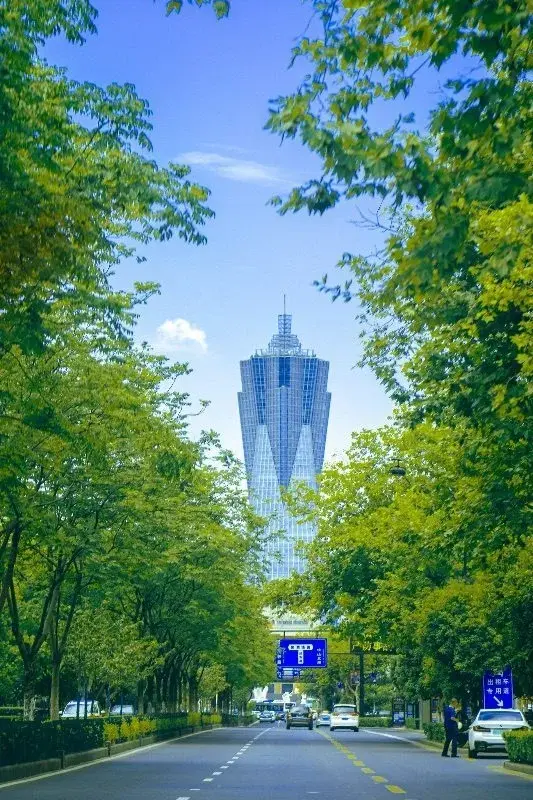

At street level, the two booms even look like different pitches. Hangzhou's tree-lined boulevards are the same greenery Alibaba's own campus photos lean on — a platform economy selling itself as leafy and livable, not just profitable. Denver's selling point is standing right there in the snow: the mountains, the four seasons, the outdoor-lifestyle pitch that did as much to pull remote workers west as any job listing did.
Before the numbers, one small honesty check on where I actually stood in each of those two economies.
02b — Two rituals, two economies
Hangzhou vs Denver: tea vs espresso, two rituals.
There's a small irony in this pairing worth naming: when I was making those OTIS-era trips to Hangzhou, I was a coffee drinker who'd have felt more at home at the Denver cart than the Hangzhou mat. It's only in the years since — after the trips had already thinned out — that I came around to Chinese tea culture. So the pairing below isn't really "my city vs. someone else's." It's closer to two versions of me, twenty years apart, standing on opposite sides of the same photo.


What both images actually show runs slower than either city's headline economy: two places that turned a daily ritual into something worth setting up a stall or a mat for, in the middle of a boom that otherwise runs at platform speed. That slower layer sits on top of a faster one — and the faster one is where the money question actually lives.
03 — Two salaries in the same skyline
Hangzhou vs Denver: what the average salary hides?
Average vs. the person actually earning it
Hangzhou
~$12.5k
reported entry-level graduate pay
vs. $15.5k platform-adjacent average
Numbeo's own contributors flag the average as skewed toward higher earners; a fresh graduate outside the Alibaba-adjacent ecosystem is commonly reported to earn meaningfully less than the citywide figure this page otherwise quotes.
The number is a ceiling, not a floor.
Denver
$62.3k
median local salary (annual)
vs. ≈$96.8k needed to live comfortably
One 2026 local-wage analysis puts a gap of roughly $34,500 a year between what a comfortable single-person budget requires and what the typical local worker actually earns — a gap widened, not closed, by the wave of remote-salaried newcomers.
The comfortable number belongs to the newcomer.
Both cities publish one average. Neither average describes the person renting the cheap apartment.
Renting is one exit from the average. Buying, and paying to route a kid around it, is another — and the two cities charge oddly similar prices for that second exit.
03b — Two exit fees
Hangzhou vs Denver: buying in and paying your way out.
Buy prices and childcare: Numbeo, city-contributed data, July 2026, both cities. These are compare-page-only figures — neither city's own deep-dive page carries them. Converted at ¥7.2=$1.
The center number flips once you're outside it, and the reversal is the point. Hangzhou costs more to buy right in the middle — the CBD and West Lake fringe sit on land that can't expand, and Zhejiang's own non-local purchase curbs keep demand stacked on a fixed supply. But push out to the edge and Denver's outer neighborhoods actually price higher per square foot than Hangzhou's outlying districts. Denver can't sprawl its way to cheap land forever either — the Front Range runs out, eventually, into the mountains it was named for; Hangzhou's outer ring, meanwhile, is still bound by the same scarcity and the same restrictions as the core, just at a smaller markup. Two cities, two different reasons their suburbs don't act the way the textbook says they should.
The childcare row is the stranger of the two. Hangzhou holds Numbeo's ranking for the single most expensive international-primary-school tuition in Asia, out of 96 cities tracked — and once converted, it lands within a few hundred dollars of what an equivalent international school charges in Denver, a city with nearly three and a half times Hangzhou's average take-home pay. Both numbers are, in a sense, the same purchase: a platform-economy family and a remote-transplant family are both buying their way out of the system that comes free by default, and the sticker price for that exit turns out to be nearly identical in absolute dollars, no matter which side of the Pacific it's charged on.
Buying in and paying the exit fee both assume you've already arrived. Before any of that, there's the actual arrival point — and the two cities' front doors say something the price tags don't.
03c — Two front doors
Hangzhou vs Denver: two train stations, two arrivals.
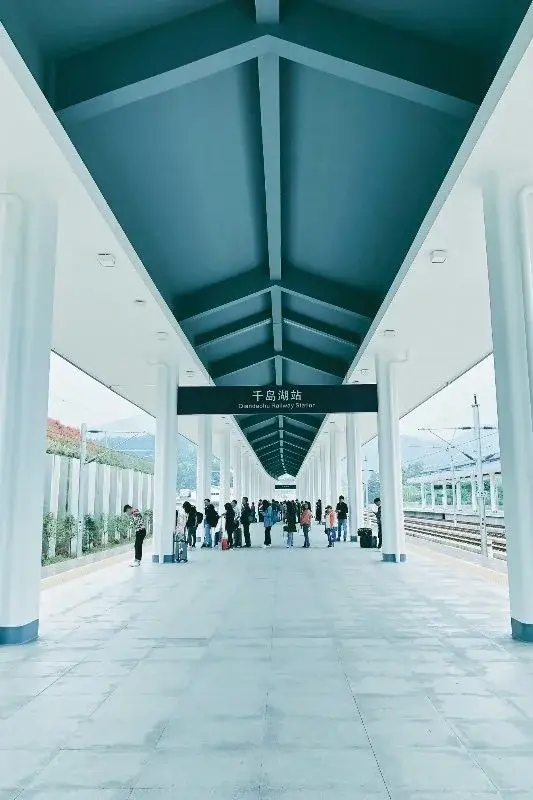

These two stations make a different point from what a matched pair of downtown hubs would. Qiandaohu Railway Station isn't in Hangzhou's city center at all — it sits out in Chun'an County, more than 100 km from downtown, built new in 2018 for a scenic lake district that had no rail service before it. A high-speed ticket in from Hangzhou East costs about ¥70 and takes roughly an hour; the same investment logic that wired Alibaba's platform economy into the national grid also reached out to wire a rural tourist county into the high-speed rail network — on the same rails, at the same speed. Denver's Union Station makes the opposite argument: an early-1900s depot preserved and wrapped in a modern transit canopy, repurposed rather than replaced, sitting exactly where it always did in the middle of downtown.
One country built a new station to bring a county current with the boom; the other kept an old station standing and let the boom arrive around it.
Big arrivals aside, most of what either city actually costs shows up in smaller, duller bills — the ones that land every month whether a boom is happening or not.
04 — The everyday layer
Hangzhou vs Denver: utilities, groceries, and transit.
Rent and salary get the headline treatment because they're the numbers that decide whether a move even makes sense. But a household's actual monthly rhythm is built from smaller, duller charges — the meter, the market, the phone bill — and those don't scale with a platform-economy salary or a remote-work relocation the way rent does.
The meter: electricity and water
3 tiers, settled annually
time-of-use, no simple tier
Tier 1, incl. sewage
Tier 1, indoor use only
Hangzhou electricity and water: Zhejiang provincial and Hangzhou municipal published schedules, as cited on the Hangzhou city page. Denver electricity: Xcel Energy's time-of-use residential schedule and its own 2026 average-bill figures — Xcel doesn't publish a single flat per-kWh rate the way Hangzhou's tiers do, so the range shown is the on-peak/off-peak spread, not a tier structure. Denver water: Denver Water's 2026 published Tier 1 rate and fixed charge, converted from $/1,000 gallons. Converted at ¥7.2=$1.
The meter is one recurring bill. The market, paid in cash every few days, is another.
The market: what a basket of basics costs
converted from ¥5.6/500g at ≈60g/egg
28-item basket avg.
Hangzhou eggs, pork, and vegetables: Hangzhou Municipal Bureau of Commerce weekly market report, as cited on the Hangzhou city page — genuinely city-specific. Hangzhou milk: Numbeo, July 2026 (no city-specific milk monitor found). Denver, all items: Numbeo, city-contributed data, July 2026 (national BLS figures were the fallback checked and weren't materially different). *Denver has no tracked city-specific pork or Chinese-style loose-vegetable price; beef round and tomatoes stand in as the closest available items and are not the same product — treat both starred rows as directional, not a true item-for-item match. Converted at ¥7.2=$1.
Neither city's grocery basket moves the needle the way rent does — this is the layer where a boom economy's paycheck outruns its bills the fastest, in both cities. It's also the layer that shows up on Hangzhou's own city page as evidence that the everyday stuff, salary aside, sits close to a national mid-tier baseline. Denver's everyday layer runs an order of magnitude higher in raw dollars, which is exactly what a much larger paycheck buys. Eating out and staying connected run the same way.
Eating out and staying connected
The Hangzhou side of the connectivity row draws on the same mobile-and-broadband market covered in more depth on the getting connected systems page — the plans, the SIM options, and what actually differs from a US carrier.
Both cities: Numbeo, city-contributed data, July 2026, same methodology on both sides. Converted at ¥7.2=$1.
One root cause, not two separate multiples
Dining out runs about 3.4x more in Denver; the phone-and-internet bundle runs about 5.9x more. Different multiples, same underlying story: both are priced against American labor and American commercial rent, the same forces that set Denver's own apartment rent above Hangzhou's. Hangzhou's telecom and food-service pricing, by contrast, rides on a logistics and labor base the platform economy itself helped build cheap — the same economy this page opened with.
04b — Getting around
Hangzhou vs Denver: rail network vs car-shaped city.
Hangzhou's rail network runs 12 lines, roughly 516 kilometers, and 262 stations as of mid-2026 — a distance-based fare starting at ¥2 for the first 4 km; the urban transportation systems page covers how that fits into the rest of a Chinese city's transit options, bikes and buses included. Denver's RTD runs a smaller system built later and around a different city shape: 10 rail lines (6 light rail, 4 commuter rail), 77 stations, and about 113 miles (182 km) of track, carrying roughly 19.2 million rail boardings in 2025 against Hangzhou's much larger ridership base. A single RTD ride costs about $2.75–3, close to a single Hangzhou ride at the turnstile — but RTD's monthly pass runs about $88, while Hangzhou has no comparable unlimited product tracked on this site; a regular rider there is paying per-ride against a ¥120 monthly-average some sources cite, a different kind of number rather than a directly equivalent one.
Denver's rail system was built almost entirely after 1994, funded by a voter-approved expansion program — a newer network trying to retrofit transit onto a city that grew up around the car — the same way Denver's boom itself arrived rather than being built in place. For route details, go straight to the operator: RTD Denver — official site →
05 — The honest brake
Hangzhou vs Denver: three honest caveats.
I've been to Hangzhou more than twenty times across two decades — I can tell you what the aircraft on that route used to look like, what a hotel mooncake tastes like on a solo Mid-Autumn work trip, and that I still couldn't grade a cup of Longjing if my life depended on it. None of that is Denver. Everything on the Denver side of this page came from public cost-of-living trackers, salary analyses, and local guides, read from a distance, never from a sidewalk.
That asymmetry cuts a specific way. I can vouch for Hangzhou's texture and I can only vouch for Denver's numbers. Weigh the Denver column accordingly, and treat the Hangzhou column as closer to lived, if never fully resident, knowledge.
One city I've flown into for twenty years without ever staying. The other I've never flown into at all. Neither honestly counts as knowing a place — but they're not the same kind of not-knowing.
If you're choosing between them
Deciding on more than the number.
- Ask which side of the average you'd land on. Both cities have a real boom-economy salary and a real everyone-else salary; the gap between them is wider than either city's headline cost-of-living figure suggests.
- Currency risk cuts both ways. A ¥9,298 salary and a $4,487 salary aren't just different numbers — they sit in different tax systems, different rent-control norms, and different cost trajectories. Don't compare the raw figures without converting the whole basket, not just the headline rent.
- Weigh proximity to the source. In Hangzhou, working close to the platform economy itself is the clearest route to the top salary. In Denver, the top salary more often arrived with the person, brought in from somewhere else.
06 — Questions people actually ask
Quick answers
What do Hangzhou and Denver have in common economically?
Both got rich on a boom neither city fully controlled — Hangzhou on e-commerce (Alibaba's home turf), Denver on remote-work migration.
Does Hangzhou or Denver have a bigger gap between average and typical salaries?
Both cities show a real gap between their headline average and what everyday residents actually earn — driven by different sectors in each city, but present in both.
Has the author of this comparison actually lived in both Hangzhou and Denver?
No — written by someone who visited Hangzhou for twenty years but researched Denver from a distance.
How does transit compare between Hangzhou and Denver?
Hangzhou has built out a 12-line rail network; Denver remains a largely car-shaped city still in the process of building out its own rail system.
What does “buying in” cost in Hangzhou vs Denver?
Both cities have their own version of an exit fee — a cost of buying property or buying your way past the local default option — though the specific mechanics differ between Hangzhou's housing market and Denver's.