Living cost, at a glance
≈$188/mo
≈$167/mo
≈$250/mo
≈$438/mo
≈$417/mo
Rent from the §02 ledger, drawn from a very small Numbeo sample for Hohhot (3 entries, 2 contributors in the past year) — treat as directional. The non-rent line is a same-region estimate, not a Hohhot-specific Numbeo compilation (Numbeo does not publish a separate "excluding rent" total for Hohhot). Converted at ¥7.2 = $1.
Hohhot — "blue city" in Mongolian — is the capital of the Inner Mongolia Autonomous Region: 3.45 million permanent residents across four districts, four counties, and one banner, sitting on the Tumd Plain south of the Daqing Mountains. The economy is real, and it doesn't run on tourism — it's headquarters to Yili and Mengniu, two of China's largest dairy companies, plus a growing national-level big-data and new-energy sector. Downtown looks like what that economy would produce — modern high-rises, wide boulevards, a two-line metro — rather than the ethnic-heritage postcard its reputation promises.
This page draws on standard published sources for the city itself, plus a single family trip in summer 2025 — mostly grassland and desert day-tours, one night in a yurt camp — for texture where it's flagged as such.
01 — The city, and who actually lives in it
A 2,300-year-old name, a 1572 walled city, and a skyline that's almost entirely 21st century.
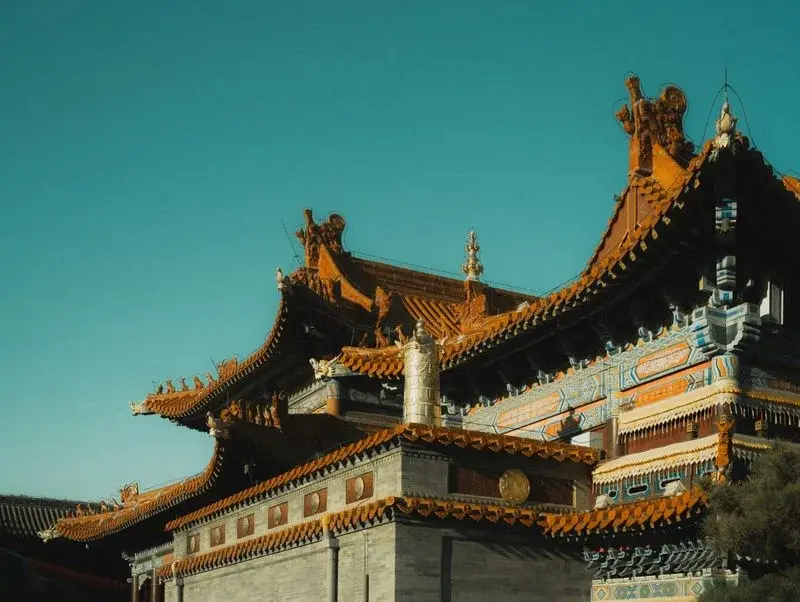
The name Hohhot — "blue city" in Mongolian — is centuries old. The settlement goes back more than 2,300 years, and the walled town that gave the modern city its shape was built in 1572 under the Tumd Mongol leader Altan Khan. That history is real. What greets a visitor on the ground is almost entirely newer: Hohhot Baita Airport opens onto wide expressways and a skyline of ordinary Chinese high-rises, and downtown — Xincheng, Huimin, Yuquan, Saihan, the four core districts — reads like any mid-sized regional capital in northern China, not a heritage town.
The demographic picture matches the built environment. Per the 2020 census, this is not a majority-Mongolian city on the ground:
| Group | Share of Hohhot's population |
|---|---|
| Han Chinese | 85.4% |
| Mongolian | 11.6% |
| Other (Hui, Manchu, Korean, Daur, Ewenki, Oroqen, and others — 36 groups recorded) | 3.0% |
Seventh National Population Census (2020), reported by the Hohhot Municipal Statistics Bureau. Hohhot's Mongolian share is roughly comparable to Inner Mongolia's region-wide average (about 17.7%), not dramatically higher, the region as a whole is majority Han Chinese too.
Our driver for the week, arranged through a local tour operator, was Han Chinese, surnamed Yang, with a trace of a Shaanxi accent — unremarkable rather than an exception, on these numbers.
None of this is a claim that Mongolian culture is thin here. The throat singing, the horsehead fiddle, the grassland feast described in §03 and §05 — those were the single most striking part of the trip. It's a claim about geography. That culture is concentrated in specific venues and destinations outside the everyday downtown, not distributed through it the way a first-time visitor tends to imagine.
02 — The number, and why you shouldn't trust it too far
Hohhot's rent looks like the cheapest number on this whole site. It might just be the least-measured one.
The city-center rent number will hit you first. A one-bedroom in Hohhot runs about $188 a month, roughly 25% of the median after-tax wage of $764. That is the lowest rent burden on this entire site. But if you stop there, you have missed the most important thing about this number: it is drawn from just 3 Numbeo entries submitted by 2 contributors. The city itself is real, 3.45 million people, headquarters to Yili and Mengniu, a growing big-data and new-energy sector. The rent sample is not yet stable. Treat these numbers as a rough floor, not a confident average. The grassland and the throat singing are unforgettable. The rent data still needs more people to submit their actual costs.
Unlike Beijing, Shanghai, or Chengdu, Hohhot doesn't have a deep crowdsourced sample behind its numbers. Numbeo's entire Hohhot dataset, as of this writing, comes from 3 entries submitted by 2 contributors in the past year. That's the same problem this site flagged for Jingdezhen — a real number, just not a stable one. Treat everything below as a rough floor, not a confident average.
What the table above doesn't capture: the deposit, agency fee, visa medical, and household kit that hit before month one. The real bill in week one goes well beyond rent →
All figures: Numbeo, Hohhot page, last data update 30 September 2025 (3 entries, 2 contributors in the trailing 12 months). Numbeo tracks a 3-bedroom figure for Hohhot rather than a 2-bedroom one, unlike most cities on this site, we're showing the 3-bed line rather than inventing a 2-bed estimate. Converted at ¥7.2 = $1. Unlike our other city pages, we don't have an independent second source to cross-check these against; verify current listings directly if this number matters to your decision.
What it costs to keep the lights on
Source: Hohhot Municipal Development and Reform Commission, effective 1 April 2026. Billed quarterly, based on a 3-person household.
Compiled local-rate summary, August 2026. Billed by annual usage. Optional time-of-use pricing also available.
Source: Hohhot Natural Gas Co., effective April 2023, confirmed unchanged under a 2025 price-linkage review. Billed by natural-year cycle (Jan 1–Dec 31), not rolling. Households with more than 4 registered residents can apply to raise the tier thresholds.
Standardized comparison figure, applied the same way across every city on this site: 220 kWh electricity + 15 m³ water + 25 m³ gas per month, a single-occupant baseline. At Hohhot's Tier 1 rates that's roughly ¥104 electricity + ¥35 water + ¥56 gas ≈ ¥195 (≈$27)/month — noticeably below Beijing's ¥239, consistent with the lower cost-of-living picture elsewhere on this page.
Those tiered rates are the visible part. The annual settlement, the heating season, and the charges that don't show up in a monthly ledger are the rest. The monthly costs you won't find in the table →
Against the rest of the site
Even allowing for the thin sample, Hohhot's 1-bed city-center rent (≈$188) undercuts every other city on this site, including Harbin (≈$423) and Xi'an (≈$311), the next-cheapest deep-dives. Whether it holds up under a larger sample is exactly the kind of thing worth re-checking before treating it as gospel.
03 — What Hohhot actually eats
The ceremonial feast is unforgettable. The everyday food is what you'll actually live on.
Split this in two. They don't cost the same, and they don't mean the same thing. There's the grassland ceremonial layer, the feast you book as an experience. And there's the everyday Hohhot table: mutton, noodles, and dairy, priced like any ordinary regional Chinese city.
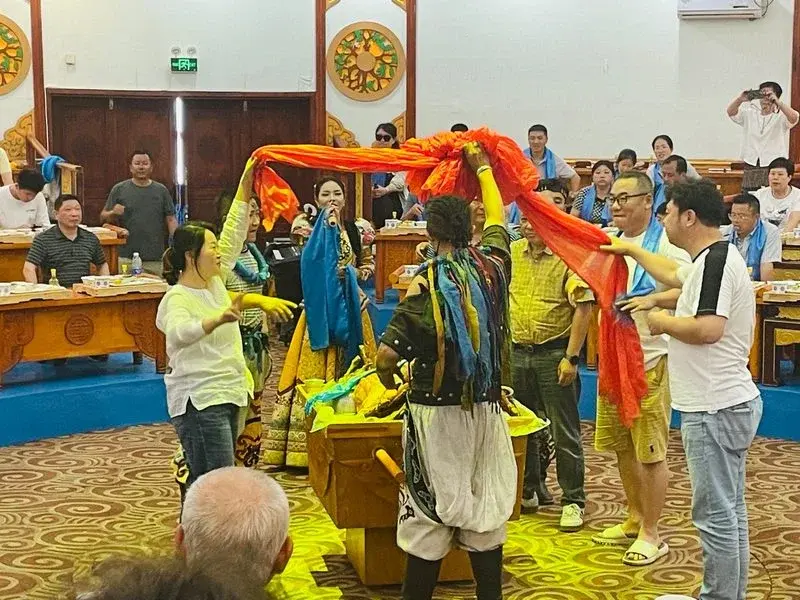
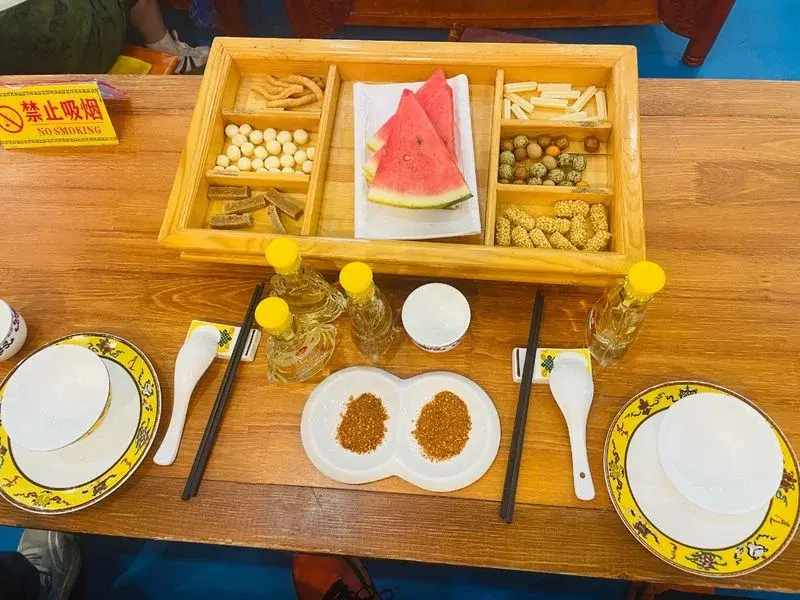
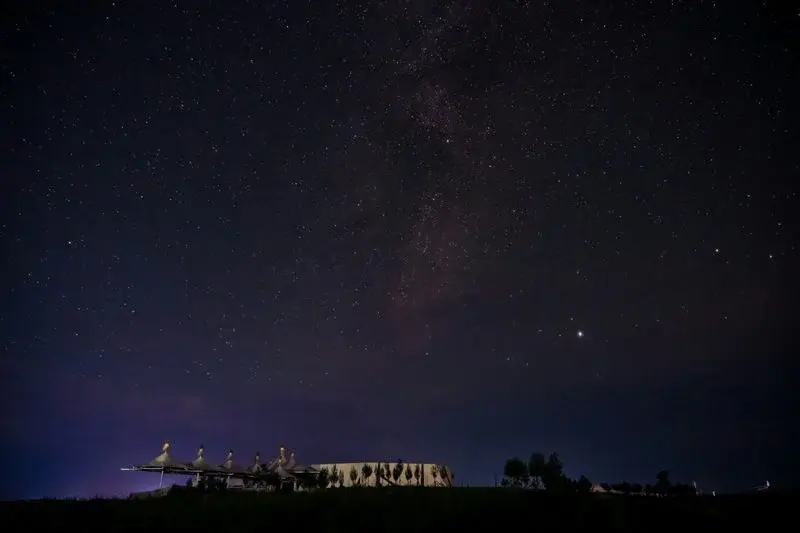
We ate a zhamayan (诈马宴) — a Naadam-style whole-lamb banquet — on the night we stayed in a yurt camp near Ulanqab, on the way back from the desert. It's bundled into grassland tour packages rather than sold as a standalone meal, and the food is only half of it: throat singing (呼麦) and the horsehead fiddle (马头琴), both male and female voices, low and resonant in a way I hadn't expected and won't forget. The food itself is generous but heavy, mostly meat, courses I could barely make a dent in, and the local liquor poured throughout is baijiu, mostly the sauce-aroma (酱香) style, strong and rough enough that finishing a glass took real effort.
Back in the city, two dishes carry the everyday table
In Hohhot proper, two dishes came up again and again, and both earned it. The first is shaomai (烧卖), thin-skinned steamed dumplings, here filled with mutton rather than the pork version common elsewhere in China, remarkably soft and smooth. The other is a mutton hotpot-style stew (羊肉锅), rich and warming, suited to the region's big daily temperature swings even in summer.
| Dish | What it is |
|---|---|
| Shaomai 烧卖 | Steamed mutton dumplings, thin wheat skin, soft texture, Hohhot's signature snack |
| Yangrou guo 羊肉锅 | Mutton stew / hotpot, rich broth |
| Naicha 奶茶 | Mongolian milk tea, salted rather than sweet |
| Zhamayan 诈马宴 | Ceremonial whole-lamb banquet with live performance, tourist-experience pricing, bundled into tours |
Dish descriptions from firsthand experience during the trip described above, cross-checked against standard published accounts of Inner Mongolian cuisine. We don't yet have current per-dish retail prices for Hohhot restaurants, so we're not guessing here.
But the city is only half the story. How you live day to day moves the final number more than the city itself →
We don't yet have a verified weekly wet-market price table for Hohhot the way we do for Beijing and Shanghai. This section will be updated once we source one from the city's own price-monitoring channels, rather than estimating from a neighboring region's numbers.
04 — Getting in, getting out, and getting to the grassland
Hohhot Baita Airport, two metro lines, and a highway network built for reaching the grassland.
Hohhot Baita Airport sits east of downtown, connected directly to Metro Line 1. Hohhot East Railway Station is the newer of the city's two rail stations and the closer one to the airport; the older Hohhot Railway Station sits on the west side of downtown.
The metro: two lines, a flat published fare schedule, uncapped by distance
Hohhot's metro is real, running, and still young. Line 1 opened December 29, 2019 — Inner Mongolia's first metro line, and the 38th system to open in mainland China. It runs 21.72km across 20 stations. Line 2 followed in 2020: an L-shaped 27.32km line with 24 stations, crossing Line 1 at Xinhua Square, the network's one interchange station. Add it up and the system covers roughly 49km, modest next to Beijing's ~900km, but a genuine two-line network for a city this size, not a token single line.
| Distance | Fare |
|---|---|
| 0–5 km | ¥2 |
| 5–10 km | ¥3 |
| 10–15 km | ¥4 |
| 15–21 km | ¥5 |
| 21–28 km | ¥6 |
| 28 km+ | +¥1 / 10 km |
Official distance-based fare schedule, per the Hohhot Metro Operation Co.'s own published ticketing rules. Fares are uncapped, there's no maximum single-journey price, unlike Beijing's schedule. Trains run roughly 6:00am–10:00pm, with 8-minute peak and 10-minute off-peak intervals. Payment is via the operator's own Qingcheng Metro app, WeChat/Alipay QR code, or coins and select paper notes at station machines. Residents aged 60–69 ride free as of a May 2025 policy update, replacing an earlier 50%-off senior fare.
Outside the rail, the same national trio of shared-bike apps: Meituan, Hello, Didi's Qingju, and ride-hailing cover the city's wide, flat avenues. Buses still carry a meaningful share of trips the two metro lines haven't reached yet.
The ¥2 base fare and the low utility rates in §02 don't happen by accident, they're the visible tip of decades of capital investment and permanent maintenance subsidy. The real cost behind these low prices →
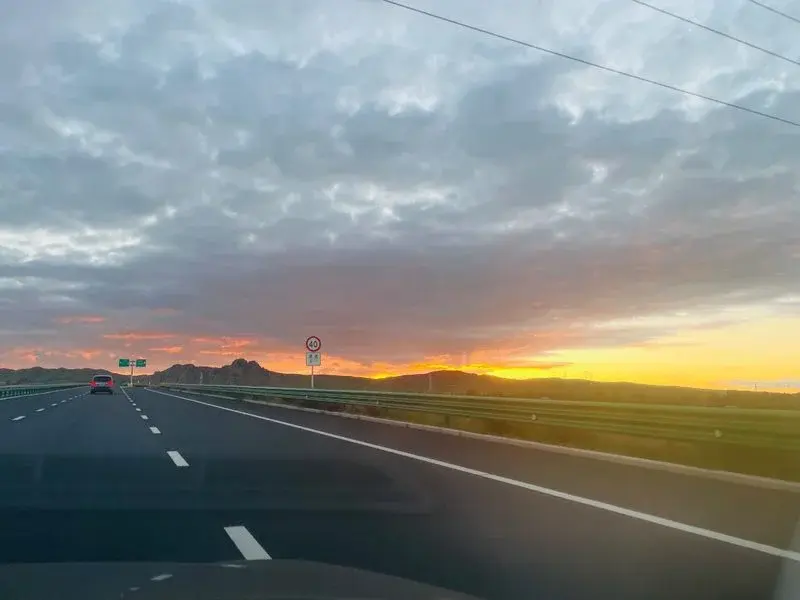
For grassland and desert day trips, the standard local pattern is booking a private van and driver through a local travel agency, which is what we did, covering airport transfers plus multi-stop days to Xilamuren Grassland, Wulanhada, and Yinken Tara Desert in one bundled, inexpensive package. It's a very different model from renting a car yourself, and for a family without a Mandarin-fluent driver among them, it removed a lot of friction for not much money.
There are mountains in the region, but the highways out to the grassland were smooth and flat the entire way, with scenery on both sides that stayed beautiful for the whole drive.
05 — What we actually paid for, and what it bought
A private van, a driver, and three destinations, for less than a single guided day costs in a North American park town.
Everything about the grassland and desert side of this trip ran through one local travel agency: airport pickup and drop-off, a dedicated driver, and multi-day routing to Xilamuren Grassland, Wulanhada, and Yinken Tara Desert, all for a price that struck us as genuinely inexpensive relative to what an equivalent private-guide, multi-stop package would run in, say, a US national-park gateway town. We're not publishing a specific figure here because pricing varies by season, group size, and operator, and we don't want to represent a one-trip number as a stable rate — but the value, relative to comparable North American guided experiences, was real.
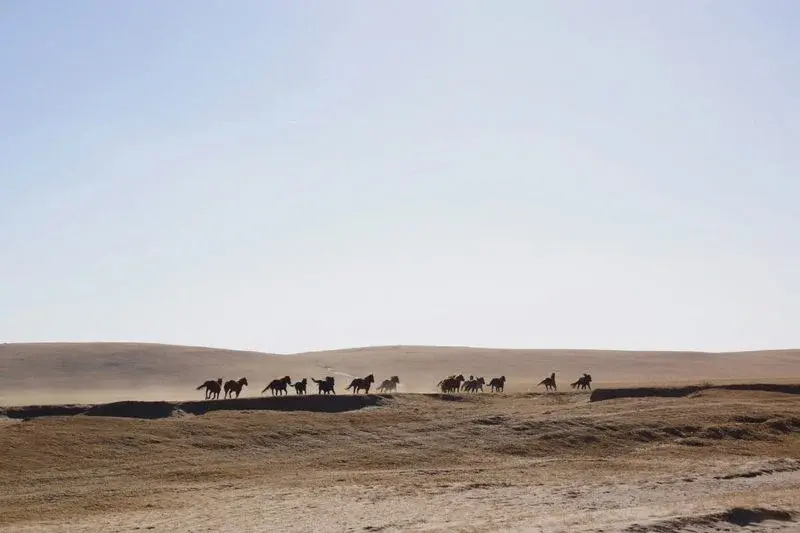
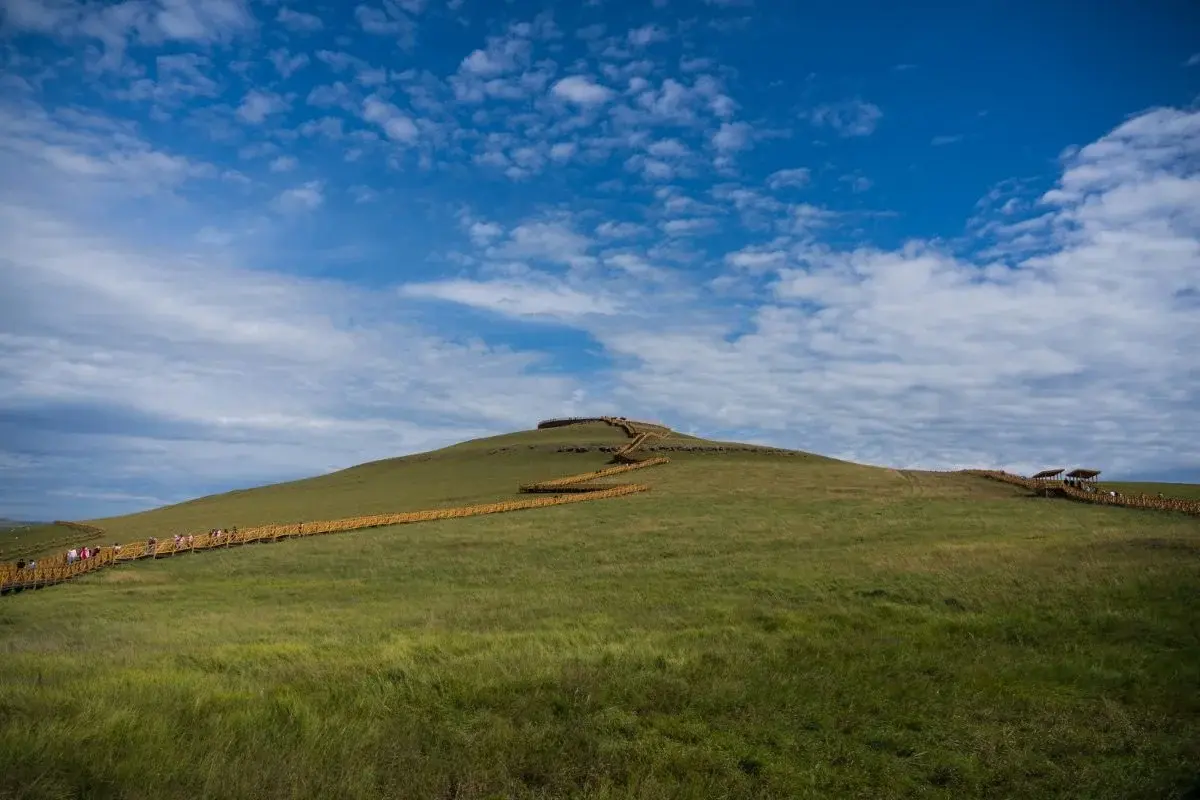
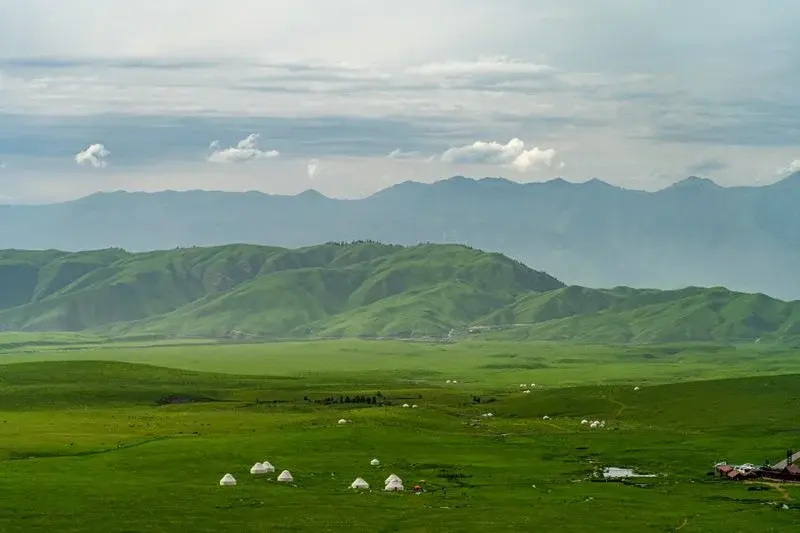
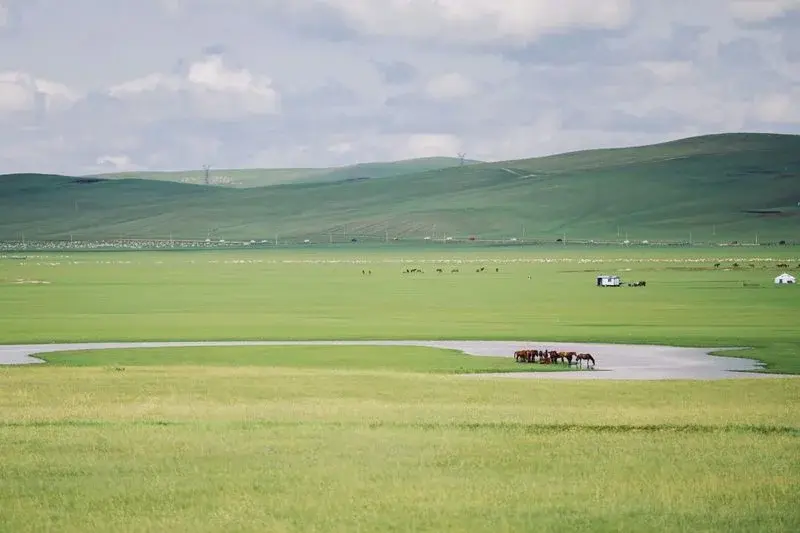
The grassland itself was the best part of the whole trip. Blue sky, green grass, scattered white clouds, the kind of view that's genuinely restorative to just stand in, and it delivers on exactly what the imagination expects of Inner Mongolia, just an hour or more outside the city rather than in it. The wind during the day was noticeably strong, and the daily temperature swing was sharp enough that layering mattered even in summer.
Yinken Tara Desert was the other highlight, fun in the way deserts are fun, dunes to climb and slide down, buggy rides, with one honest caveat: it was hot, more than we'd planned for, and worth timing around the cooler parts of the day if you go in summer.
06 — Who actually lives here, and what the city runs on
The modern skyline isn't an accident, it's dairy, energy, and data, headquartered here.
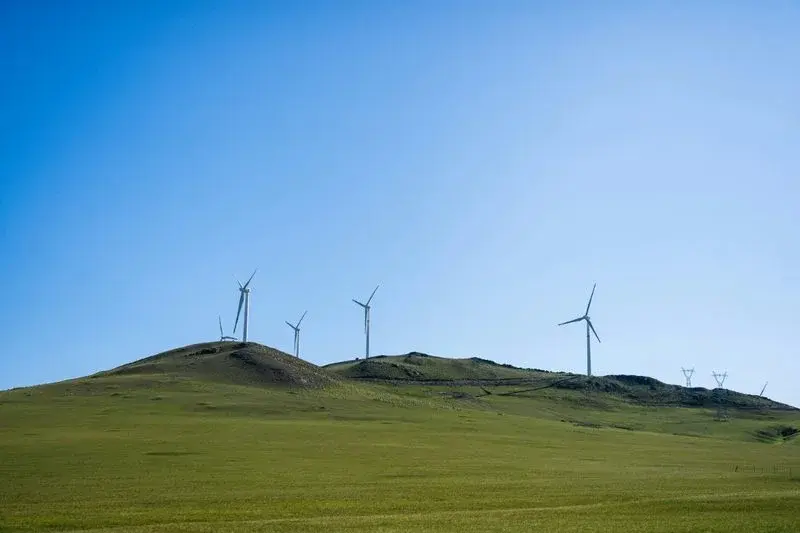
Hohhot's ordinary-looking downtown makes more sense once you know what actually drives it. It's home to the headquarters of both Yili and Mengniu — two of China's largest dairy companies. That's partly why Hohhot gets called "China's Dairy Capital." Alongside dairy, the city has built out a national-level big-data and cloud-computing base, drawing on the region's cheap land and power. There's a growing new-energy sector too. None of that is grassland-tourism income. It's the reason downtown looks like any other mid-sized Chinese business center rather than a heritage town.
| School | Standing |
|---|---|
| Inner Mongolia University | The region's flagship — a national "Double First Class" and former 211-tier university, jointly built by the Ministry of Education and the regional government |
| Inner Mongolia Normal University | Second-tier regional flagship, teacher training and humanities |
| Inner Mongolia University of Technology | Engineering-focused |
| Inner Mongolia Medical University | Founded 1956, one of the earliest medical colleges built in a minority region |
| Inner Mongolia Agricultural University | Agriculture, forestry, animal husbandry — reflecting the region's grassland economy |
| Inner Mongolia University of Finance and Economics | Business and finance |
| Hohhot Minzu College | Ethnic-affairs focused, jointly built with the National Ethnic Affairs Commission |
University standing and history: standard published institutional profiles and Chinese Ministry of Education program listings. See our full Inner Mongolia University deep-dive for costs and program details.
One honest data point for anyone weighing a move here from abroad: Hohhot's foreign resident population is small. The city's immigration authority reported processing just 8 applications for permanent residence in a full year, three of them under the "foreign talent" category. A city-run outreach event the same year hosted 30 foreign experts, teachers, and students from 11 countries — a reasonable proxy for the whole visible expat community, mostly university-linked rather than corporate. There's no Shunyi- or Liangmaqiao-style diplomatic or international-school district here, because the population that would fill one doesn't exist yet.
Permanent-residence figures: Hohhot Municipal Public Security Bureau exit-entry administration summary. Outreach-event attendance: Xinhua coverage of the "Hello Hohhot" foreign-resident program, October 2024.
The demographic picture in §01 and the economic picture here point the same way: Hohhot is a functioning regional capital first, and a cultural-heritage destination second — both are real, they're just not stacked in the order a first-time visitor tends to expect.
07 — Questions people actually ask
Quick answers
How much does a one-bedroom apartment cost in Hohhot?
A city-center one-bedroom runs about ¥1,350/month (≈$188); the same size outside the center is about ¥1,200 (≈$167). These are drawn from a very small Numbeo sample for Hohhot and should be treated as directional, not precise.
Is Hohhot a "minority city" the way outsiders picture it?
Not on the street. Han Chinese residents make up about 85% of the city's population, Mongolians about 12%, per the 2020 census. The visible skyline is thoroughly modern high-rise China; the grassland and ethnic-heritage experience is largely a day-trip out of town, not a downtown backdrop.
How close is the airport to downtown Hohhot?
Hohhot Baita Airport sits east of downtown, connected directly to Metro Line 1. Hohhot East Railway Station, the newer of the city's two rail stations, is closer to the airport than the older main railway station.
What does a Naadam-style banquet (诈马宴) actually cost and involve?
It's a ceremonial multi-course lamb feast bundled with a live show — throat singing, morin khuur (horsehead fiddle), and dancers — usually sold as part of a grassland day-tour package rather than priced separately. It's a tourist-experience cost, not a reflection of everyday Hohhot food spending.
Is it easy to arrange a grassland or desert day trip from Hohhot?
Yes — private-van day tours to sites like Xilamuren Grassland, Wulanhada, and Yinken Tara Desert are commonly booked through local travel agencies, bundling airport transfer, driver, and multiple stops for a price well below what a similar private-guide day would cost in most North American national-park towns.
If you're thinking of going
Hohhot, for someone actually considering it.
- Don't book downtown expecting the postcard. If the grassland and the ethnic-heritage experience are why you're coming, plan a multi-day itinerary that gets you out of the city — Xilamuren, Wulanhada, Yinken Tara Desert — rather than assuming it's woven into everyday downtown life.
- Trust the rent numbers less than usual. Hohhot's Numbeo sample is tiny. If a specific rent figure matters to a real decision, verify against current local listings rather than the ledger in §02 alone.
- A private van and driver, booked locally, is the easy way to see the region. It removed language and logistics friction for our family and felt inexpensive relative to comparable North American guided experiences — worth booking through a local agency rather than trying to self-drive unfamiliar rural roads.
- Pack for a temperature swing, even in summer. The wind on the grassland is real, and daily highs and lows differ sharply — bring a layer even if the forecast looks warm.
- Still deciding? Not sure if Hohhot is the right fit? Browse cities by what matters to you → or answer 7 questions to find your city →
The bottom line
Should you visit — or consider living in — Hohhot?
As a visit, unreservedly yes. The grassland delivers exactly what the imagination promises — blue sky, green grass, a wind that clears your head — and the zhamayan feast, with its throat singing and horsehead fiddle, is the kind of evening you don't get in a normal Chinese city. It's just not sitting on the street corner downtown; you have to go get it, and the going is easy and cheap by the standards of comparable North American experiences.
As a place to live, we don't have enough of our own first-hand material yet to give you the deep, lived-in read we give Dalian or Chengdu — this trip was a week of grassland and desert side trips, not months of daily life downtown. What we can say honestly: the cost-of-living numbers, thin as the sample is, point toward one of the more affordable regional capitals in the country, and the city's dairy, energy, and data economy suggests it isn't a backwater propped up by tourism alone.
We'll keep building this page out as we get better-sourced rent, utility, and grocery data — and as we spend more time in the city itself rather than just its surrounding grassland.