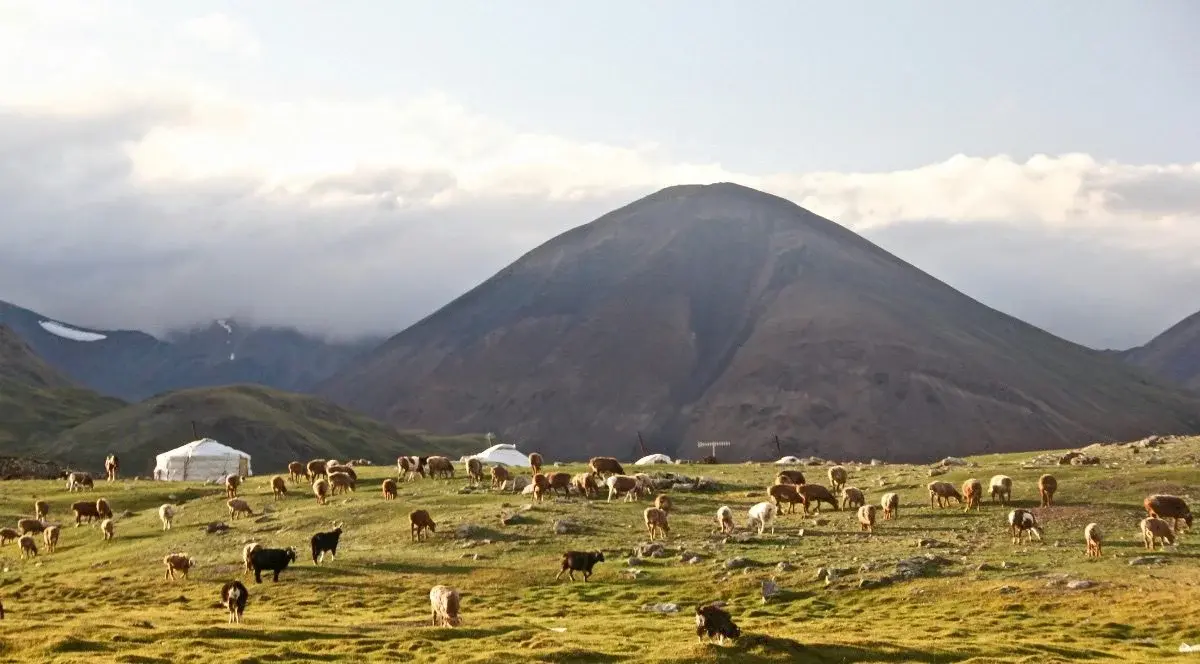

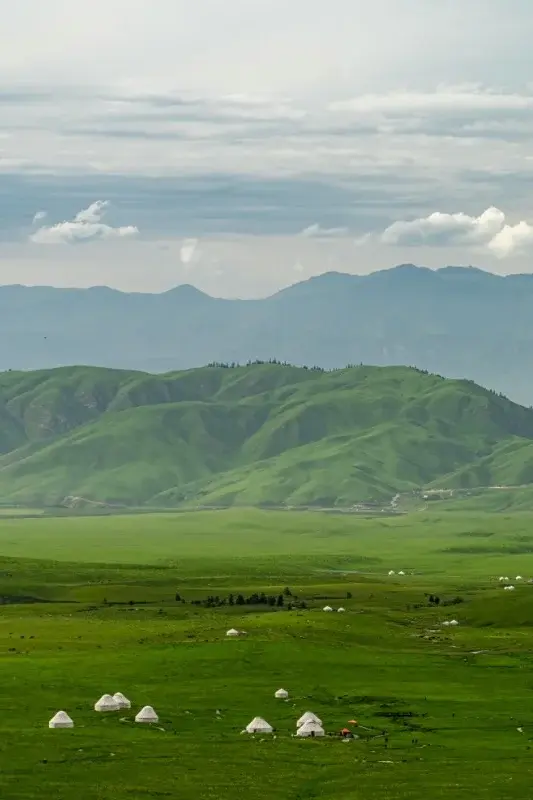
Put these two cities side by side and the resemblance starts with the name. Hohhot means "blue city" in Mongolian; Calgary was founded in 1875 as a North-West Mounted Police fort, at a site the Blackfoot and Stoney Nakoda had used for millennia and that early settlers first proposed calling "Fort Brisebois." Both names promise a frontier, grassland, pastoral place. Neither city's downtown delivers on that promise anymore — and that's the point of putting them next to each other.
Hohhot's economy runs on dairy giants Yili and Mengniu, a national-level big-data base, and a growing new-energy sector. Calgary's runs on oil and gas — historically the dominant industry, though the city has spent the past decade pushing to diversify into finance, tech, and logistics. Neither city is what a first-time visitor pictures when they hear "grassland capital." Both are, underneath, something closer to an industrial or data-processing hub with a pastoral name still attached.
 Hohhot
 Calgary
01 — The rent number, and why it inverts
Hohhot vs Calgary: 25% vs 41% of wages on rent.
Hohhot's city-center one-bedroom runs $188 a month, roughly 25% of the median after-tax wage of $764. Calgary's center one-bedroom runs $1,363 a month, about 41% of its median after-tax wage of $3,170. In dollar terms, Calgary's rent is seven times higher. But flip it against income, and something less obvious happens: Hohhot's rent burden is the lighter one. Calgary's wages are dramatically higher in absolute terms, but its rent has run up faster than that wage advantage can absorb. The real story of this pairing is what pays the bills in each city. Hohhot runs on dairy, big data, and new energy — Yili and Mengniu, both headquartered here. Calgary runs on oil, gas, and a diversifying finance sector. Neither city's paycheck comes from the grassland postcard its name promises. Both are something else entirely now.
not tracked for Hohhot — see note—C$1,900 · $1,363
Hohhot rent, salary, and sample size: Numbeo, last updated September 2025 — a very small sample, treat as directional. Calgary rent, salary, and sample size: Numbeo, updated August 2026 (1,099 entries, 167 contributors — one of the deepest samples on this site). Converted at ¥7.2 = $1 and C$1 = $0.72 (mid-market, mid-August 2026). Calgary's after-tax pay is a representative individual figure derived from the city's average salary (≈C$64,600–72,800/yr per Statistics Canada and Numbeo-based calculators) and Alberta's provincial tax brackets, not a single tracked Numbeo "median wage" line.
The absolute gap is enormous — Calgary's city-center rent runs more than seven times Hohhot's. But flip it against income and something less obvious happens: Hohhot's rent burden is the lighter one. A Hohhot renter spends roughly a quarter of take-home pay on a city-center 1-bed; a Calgary renter spends closer to 41–45%. Calgary's wages are dramatically higher in absolute terms, but its rent has run up faster than that wage advantage can absorb.
Two caveats worth sitting with before drawing a conclusion. First, Hohhot's number rests on a genuinely thin sample — three data points, not the kind of figure you'd want to bet a real decision on. Second, Calgary's number rests on the opposite problem: over a thousand entries, which makes it one of the more reliable rent figures on this whole site, but also means it's capturing a much more competitive, much more expensive rental market than Hohhot's economy has produced. The comparison is real, but the confidence behind each side isn't equal. What neither number explains, though, is why that rental market looks the way it does in each city — for that, start with what each economy is actually built on.
Same city, different lifestyle — the bill gap can outrun the city gap →
02 — Two capitals, two invisible industries.
Hohhot vs Calgary: dairy and data vs oil and gas.
Hohhot's paychecks flow from dairy processing, big-data server farms, and new-energy infrastructure — Yili and Mengniu, two of China's largest dairy companies, are both headquartered here, and the region's cheap land and power have drawn a national-level cloud-computing and data-center base. None of it is visible from the street the way a factory or a mine would be. It's server racks and processing plants, not smokestacks.
Calgary's paychecks have historically flowed from oil and gas — the city is the headquarters town for Canada's energy sector, the reason its downtown skyline exists at all — though the past decade of price volatility in that industry has pushed a real, if partial, diversification into finance, logistics, and tech. Both economies are essentially invisible from a tourist's eye level. No one visiting either downtown for a weekend would guess what's actually generating the income around them.
And underneath both cities sits the literal animal each one's name evokes — dairy cattle in one case, ranching cattle in the other — real industries, not decoration.
 Hohhot
 Calgary
Neither of those two animals is where the money actually concentrates today, though. That happens somewhere much less pastoral — a downtown office tower, or a data center on the edge of town — and the people who staff those buildings didn't move there for the grassland either.
03 — Who actually moves here, and why
Hohhot vs Calgary: who actually moves here and why?
Hohhot barely registers as a destination for outside migration at all — domestic or foreign. Its own foreign-resident population is tiny (Hohhot's immigration authority processed just 8 permanent-residence applications in a full year), and it doesn't appear on China's "new tier-1" city rankings the way Chengdu, Hangzhou, or Chongqing do. Whatever growth the city sees is largely organic, tied to its own dairy and data economy rather than people relocating there for opportunity.
Calgary is a different story — it's one of the more common destinations for interprovincial migration within Canada, particularly for people retraining into fields where Alberta's licensing or job market is simply more accessible than in Ontario or Quebec. A friend of the author's went through exactly this path: settled first in Montreal, retrained in finance, then relocated to Calgary specifically because Alberta's job market and licensing process were easier to break into than Quebec's or Ontario's — a pattern common enough among internal Canadian migrants that it's practically a genre. Energy-sector volatility means the pull isn't guaranteed work, but it's a real, recurring one.
This is one specific family's path, not a claim about migration patterns generally — but it's a useful illustration of what actually draws people to Calgary. Not the ranchland image, and not a lower cost of living (rent burden runs heavier here than in Hohhot, per §01), but a specific industry's labor market and an easier professional-licensing path than in some other provinces.
04 — Grassland name, downtown skyline
Hohhot vs Calgary: grassland name, downtown skyline.
Here's where the resemblance is most useful — and most misleading. Both cities carry an identity built on open land and livestock. Neither delivers it downtown.
 Hohhot
 Calgary
Hohhot
A skyline surprise
85% Han Chinese, modern high-rises
the grassland is an hour's drive out
Visitors expecting a "minority city" find a mid-sized regional capital instead — glass towers, a two-line metro, wide boulevards. The Mongolian heritage is real, but it's concentrated in specific temples, festivals, and grassland day-trips, not spread through the everyday streets.
You have to leave downtown to find the postcard.
Calgary
An energy city
headquarters town for oil and gas
the Stampede is one week a year
Calgary's cowboy identity peaks for ten days every July, at the Stampede. The other 355 days, the city runs on office towers full of energy-sector analysts and engineers, a downtown built by oil money rather than ranching, and a diversifying finance and tech sector working to outlast the next commodity slump.
The ranchland is real — it's just not what pays the mortgage.
Both cities' reputations point at grassland and livestock. Both cities' paychecks point somewhere else entirely.
Neither city's paycheck comes from the postcard on its tourism website. What it actually costs to live there, though, is measurable — and that's a much less photogenic question than a skyline or a Stampede.
05 — The everyday layer
Hohhot vs Calgary: utilities, groceries, and transit.
Rent set the widest gap on this page. Meters, groceries, and a phone bill tell a somewhat closer story — though Calgary still runs meaningfully more expensive across nearly every line.
Utilities, water, and groceries
Hohhot: elec+water+gas tiers; Calgary: Numbeo bundle — see note≈¥195 · $27≈C$270 · $194
Hohhot: same-region estimate; Calgary: Numbeo weekly total ×~4.3≈¥1,800 · $250≈C$414 · $297
Hohhot utilities are this site's own standardized single-occupant baseline (220 kWh electricity + 15 m³ water + 25 m³ gas) run against the official Hohhot tiers already published on the Hohhot deep-dive. Hohhot grocery and dining figures are same-region estimates, not a school- or city-specific wet-market survey — flagged as such on the city page too. Calgary utilities, grocery, dining, and mobile figures are Numbeo averages for Calgary, updated August 2026; Numbeo's own Calgary contributors note that renters typically only pay their own electricity separately (closer to C$40/month) since water, heat, and garbage are commonly bundled into rent there — a caveat this page is passing along rather than resolving. *Hohhot's dining figure is a same-region estimate, not independently confirmed for Hohhot restaurants specifically.
The surprise in this layer
The rent gap between these two cities runs roughly 7×. Nothing in the everyday layer comes close to that multiple — utilities run about 7× apart too (roughly matching rent, unusually), but groceries land closer to 1.2×, dining around 3×, and mobile around 10×. The pattern isn't as clean as a straightforward North America-is-more-expensive story: Calgary's grocery basket, in particular, isn't as dramatically higher than Hohhot's as the rent gap alone would predict.
Getting around
Both cities run young, two-line rail systems relative to their country's biggest networks — though "young" means something very different in each case.
Hohhot Metro route length, station count, and opening dates: Hohhot Metro Operation Co.'s own published information — see the Hohhot deep-dive for the full fare schedule. We did not find a confirmed current annual-ridership figure for Hohhot's network and are leaving it blank rather than estimating one. Calgary CTrain figures — route length, station count, 1981 opening, and 2024 annual ridership — are from Wikipedia's CTrain infrastructure entry citing Calgary Transit's own data. Calgary's fare is a flat 90-minute unlimited-transfer ticket rather than Hohhot's distance-tiered structure, so the two systems price rides on fundamentally different logic — a single Calgary fare covers a much longer average trip than a single Hohhot fare does.
Two almost identically sized two-line systems, opened 39 years apart. Calgary's CTrain has been running since 1981 — genuinely old infrastructure by North American light-rail standards, and notable for running on 100% wind power. Hohhot's network is barely five years old and still expanding. The station counts converge almost by coincidence; the maturity of what's behind them doesn't.
Meters and fares run all year. One thing doesn't: Calgary spends ten days every July hosting the Stampede, and Hohhot spends a comparable stretch each summer on Naadam-adjacent grassland tourism — both cities' one big annual production of the pastoral identity their downtown otherwise doesn't show.
 Hohhot
 Calgary
Neither city's one big festival changes the argument this page is actually making, though — and before closing, that argument needs three qualifications.
06 — The honest brake
Hohhot vs Calgary: three honest caveats.
First, the two rent samples are not equally trustworthy, and I won't pretend otherwise. Hohhot's rent figure rests on three data points; Calgary's rests on over a thousand. Treat the 7× rent gap in §01 as directionally real but not precisely measured — it could be somewhat smaller or larger once Hohhot's own sample deepens.
Second, the "grassland capital" framing has real limits. Hohhot's Mongolian heritage is a matter of regional identity and, for some residents, ethnicity and language; Calgary's ranching heritage is largely commercial and cultural rather than a living Indigenous practice — the deeper Blackfoot and Stoney Nakoda history of the land predates and outlasts the cowboy branding built on top of it. Don't read this page as claiming the two heritages are equivalent; they aren't.
Third, and this is a limit on me: I've been to Hohhot once, for a family trip, and I have never set foot in Calgary. The Calgary side of this page is read entirely from data — Numbeo, Statistics Canada, Calgary Transit's own published materials. Weigh that column as research, not a sidewalk.
Both cities borrowed their identity from an animal on the grass. Neither city's paycheck comes from it anymore.
If you're choosing between them
Deciding on more than the rent
- Rent alone favors Hohhot overwhelmingly — but weigh the sample sizes. A 7× rent gap sounds decisive; a 3-entry Hohhot sample means that number could move. Verify current Hohhot listings before treating it as settled.
- Calgary's higher wages don't fully offset its higher rent burden. On rent-to-income, Calgary is the heavier city, despite its wages running 5–6× higher in absolute terms — the opposite of what the wage gap alone would suggest.
- Neither city's pastoral reputation is where the jobs are. If you're moving for the grassland or the cowboy image, both cities will disappoint downtown. If you're moving for dairy/data/new-energy work or for the oil-and-gas/finance sector respectively, that's a more honest reason to go.
07 — Questions people actually ask
Quick answers
How does Hohhot rent compare to Calgary rent?
A city-center one-bedroom runs about ¥1,350 a month (≈$188) in Hohhot vs roughly C$1,900 (≈$1,363) in Calgary — Calgary rent runs about 7 times higher in dollar terms. But Hohhot's rent figure comes from a very small sample and should be treated as directional.
Is Hohhot cheaper than Calgary overall?
Yes, by a wide margin in absolute terms — but Calgary wages run roughly 5–6 times higher than Hohhot's, so the affordability gap narrows once income is factored in, though it doesn't close.
What do Hohhot and Calgary actually have in common?
Both are provincial/regional capitals with a pastoral, grassland-and-ranching reputation that doesn't match their actual downtown economies — Hohhot runs on dairy, big data, and new energy; Calgary runs on oil, gas, and an increasingly diversified finance and tech sector.
Which city has a bigger rent burden relative to income?
Calgary, somewhat surprisingly — its city-center 1-bed rent eats a larger share of average take-home pay than Hohhot's does, despite Calgary's far higher absolute wages.
Has the author of this page lived in Calgary?
No. The Hohhot side draws on a single family trip in 2025; the Calgary side is researched entirely from public data, and the text says so throughout.