

Excuses are useful things. The most common explanation for why northeastern China is emptying out is the one that requires no thought at all: it's too cold up there. People go south because the winter is unbearable, and no city could hold them.
Minneapolis is the reason that explanation fails.
Population: falling
Population: growing
These aren't comparable climates in the loose sense of "both cold." They're near-twins: two cities that freeze hard enough to walk across their rivers in January, then bake above 40°C in July. Whatever's happening to Harbin, the thermometer isn't doing it.
Before the numbers, here's what each city actually built while waiting out the winter.


Two skylines shaped by two very different arrivals — a Russian railway concession in one case, a century of Scandinavian and German settlement in the other. Both left a lot of church spires behind. Now for the numbers.
01 — Side by side
Harbin vs Minneapolis: 49% vs 43% of wages on rent.
Harbin's city-center one-bedroom runs $423 a month, roughly 49% of the median after-tax wage of $857. Minneapolis's center one-bedroom runs $1,796 a month, about 43% of its median after-tax wage of $4,147. The expensive city is the one where the people living there have more room to breathe. But the real story of this pairing is not the rent gap. It is what each city built while waiting out the winter. Harbin sells its ice — 200,000 cubic metres cut from the river, stored ten months, rebuilt as the world's largest ice theme park. Minneapolis uses its winter — lakes as public rinks, the cold as a shared project rather than a private ordeal. One city is emptying out; the other is growing. The thermometer is not the variable. The structure underneath is.
Both sides estimated — see note$689$2,3253.4×
Both sides estimated — see note$396$1,7214.3×
Look at the last row, then look at the ones above it. This is where the comparison stops behaving.
Same city, different lifestyle — the bill gap can outrun the city gap →
02 — The honest part
Harbin vs Minneapolis: the multiples don't cancel.
In every previous pairing on this site — Dalian against Seattle, Chengdu against Austin — the American city cost roughly five times more and paid roughly five times more. The multiple cancelled. Life inside each city felt about the same.
Not here. On the core figures — a one-bedroom near the center, and the all-in monthly total — Minneapolis costs about 4.2 to 4.7× what Harbin costs. It pays about 4.8×. The income multiple is still slightly larger than the cost multiple on those two figures, though the margin is thinner than an earlier version of this page reported. One of the newly added rows (2-bed, city center) actually inverts it. Even so, the result shows up in the only ratio that matters to somebody who lives there:
The expensive city is the one where the people living there have more room to breathe.
That's the finding, and it's not a flattering one for the city I know best. Harbin is, in absolute terms, one of the cheapest places measured on this site. It's also, measured against its own wages, the hardest. If you want to run this math against your own salary instead of the city average, the should-you-move calculator does just that.
One number that cuts the other way
Before this becomes a simple story, here is the fact that complicates it — and it complicates it in China's favour.
Staying warm is cheaper in the colder city
Harbin heats its buildings centrally, on a municipal schedule, at a flat rate per square metre. A typical 85m² flat pays roughly $452 once, and is warm from 20 October to 20 April — six months.
In Minneapolis, winter heating is an individual bill, running around $240 a month on top of ordinary utilities. Across a heating season that comes to something like $1,200.
So the richer city pays roughly two and a half times more to survive a shorter, milder winter. Whatever else the Chinese city does badly, district heating at scale isn't one of them.
Hold on to that. It's the reason this isn't a story about one system beating another. Rent and heating are the two lines that actually decide whether a move works — but a household's month is built from smaller charges too, and those are worth a look before moving on to the ice.
03 — The everyday layer
Harbin vs Minneapolis: utilities, groceries, and transit.
Both cities settle their utilities differently — Harbin tiers electricity, water, and gas, billing them annually, the way most Chinese cities that see a real winter do; Minneapolis's Xcel Energy runs a flat monthly rate, no tiers at all.
Harbin: tier 1 of 3; Minneapolis: flat¥0.51 (≈$0.07)≈$0.172.4×
Harbin: tier 1 of 3; Minneapolis: supply only, sewer billed separately¥2.40 (≈$0.33)≈$1.334.0×
Minneapolis bills this as its own line; unclear whether Harbin's water rate already includes itNot shown separately≈$1.89—
Volume matters more than the headline rate here. Harbin's apartments are smaller and its winters push electricity use toward the district-heating bill in §02 rather than space heaters, so the per-unit gap above overstates the real gap. Even before volume, Minneapolis's water bill alone runs several times Harbin's tier-1 rate — and that's before the separate sewer charge most Chinese cities fold into one number.
The market: a basket of basics
converted from ¥4.9/500g at ≈60g/egg≈$0.99≈$4.164.2×
Eating out and staying connected
two inexpensive-restaurant meals, ¥37 each — see the Harbin city page≈$82.508.1×
One story, several multiples
Eggs run about 4×, a stand-in for pork about 5×, a restaurant meal about 8×. None of that is really about food — it's the same American labor and commercial-rent base that sets Minneapolis's rent above Harbin's, showing up again in every till receipt. Harbin's everyday layer stays cheap for the same structural reason its rent does: wages never caught up, and neither did prices.
Getting around
Harbin's metro — China's first purpose-built cold-region system, opened 2013, partly reusing a 1970s civil-defense tunnel network — charges a ¥2 flat entry fare rising by distance. The full fare ladder and history are on the Harbin city page; the urban transportation systems page covers how metro fits alongside buses and shared bikes across Chinese cities generally. Minneapolis's METRO system — two light-rail lines, roughly 37km combined, and about 12.8 million rail rides in 2025 — charges a flat $2 for any ride with a two-and-a-half-hour transfer window, or about $90 for an unlimited monthly pass.
Harbin's fare rises by distance; Minneapolis's does not¥6+ (≈$0.83+)$2.00≈2.4×
A single ride costs about the same order of magnitude at the turnstile in the short-trip case; a regular commuter's monthly spend does not, and that gap follows the same wage-versus-cost story as everything else in this section. The bridges below are a more literal answer to "getting around" than the metro fare table — two structures that both exist to get people across a river that spends months a year frozen solid.
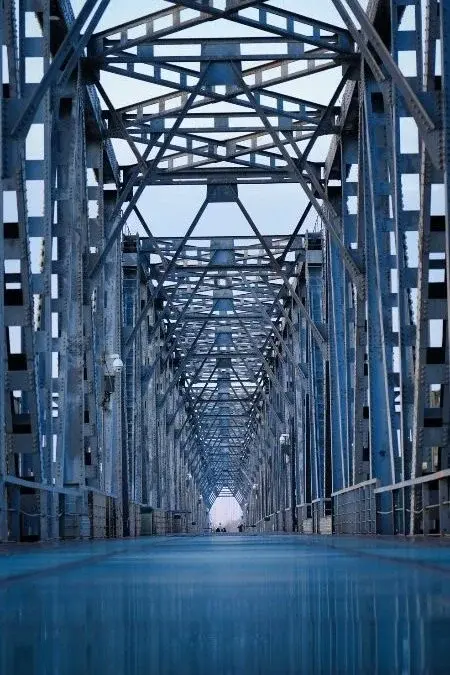

None of that — the meter, the market, the fare gate — is what either city is actually known for. What both are known for is what's outside the window six months a year.
04 — What each city does with the ice
Harbin vs Minneapolis: selling ice vs using winter.
Both cities have more winter than they know what to do with. What they do with it couldn't be more different.
Harbin sells it
Two hundred thousand cubic metres cut from the Songhua, stored ten months, rebuilt each December as the largest ice-and-snow theme park on earth — 810,000m², a Guinness record, three million visitors in a single New Year holiday. The winter is an industry; the customer is a stranger.
Minnesota uses it
Nobody harvests the lakes. People skate on them, play pick-up hockey on them, drag shanties onto them and spend the afternoon. The winter is a common — free, local, unbranded. The customer is your neighbour.


It would be easy to make Harbin the loser of that comparison. Don't. A city that turns its single overwhelming surplus into a global brand has done something genuinely difficult, and it did so after four decades of watching its people leave. The ice festival is not the problem. It's one of the few things that worked.
But a festival, however successful, isn't an economy. To understand why one city needed to sell its winter and the other didn't, look underneath both of them.
05 — So what actually decides it?
Harbin vs Minneapolis: what actually decides a cold city's fate?
Minneapolis sits in a wealthy state with a diversified private economy — corporate headquarters, healthcare, retail, food, finance — built up over a century by firms that answered to markets rather than to a plan. Unemployment runs low. People move there knowing about the winter, because the jobs are worth the parkas.
Harbin was China's industrial firstborn, and its economy was assembled from the top down: central investment, national allocation, state-set prices. It worked brilliantly. Then reform arrived, and the circuit had no local market, no private capital, and no habit of enterprise to fall back on. Two or three generations had organised their entire lives around the work unit. When it receded, there was nothing underneath.
The young left for the south. The province lost 6.46 million people between the 2010 and 2020 censuses — the steepest fall in China — and about eight million across fifteen years. None of them left because of the thermometer. They left because there was no work.
Cold is not destiny. Cold is a condition. What a city is built on decides whether the condition is survivable.
06 — Where the analogy breaks
Harbin vs Minneapolis: where the analogy breaks.
The pairing is genuinely instructive. It also compares things that aren't the same size or shape, and pretending otherwise would be dishonest.
Three places this comparison strains
- Scale. Harbin is a city of roughly ten million, the capital of a province of thirty million. Minneapolis proper holds around 430,000 people, with a metro of about 3.7 million. A shrinking megacity and a stable mid-size metro are different animals.
- National tide. Minnesota sits inside the world's largest economy; Heilongjiang sits at the far end of a country whose growth has run overwhelmingly along the coast. Harbin is not only losing to Minneapolis — it is losing to Shenzhen.
- What the numbers mean. "Average take-home pay" in a US city and "median after-tax salary" in a Chinese one are built from different surveys, tax systems and informal-work assumptions. The 49% and the 43% are directionally solid and should not be read to the decimal.
What survives the caveats is the part worth carrying: a cold city can thrive. Minneapolis proves it every February, with a rink on every lake and a hiring market that doesn't apologise for the wind chill. Harbin's difficulty was never the winter. It was what happened to the thing the winter was built on.
07 — Who each city is really for
Harbin vs Minneapolis: who each city is for?
Harbin makes sense if…
You earn in a strong currency and want an astonishingly cheap, architecturally strange, deeply hospitable northern city — and you want to see what an ice festival looks like when a whole economy leans on it. It's cheap for you. It's not cheap for the person renting next door.
Minneapolis makes sense if…
You want a cold city that works. Wages outrun costs, the lakes are public, the winter is a shared project rather than a private ordeal — and you can spend a February afternoon on the ice without buying a ticket.
08 — Questions people actually ask
Quick answers
How much cheaper is Harbin than Minneapolis?
A city-center one-bedroom runs $423 a month in Harbin vs $1,796 in Minneapolis (4.2x); all-in monthly cost for one person is $655 vs $3,082 (4.7x).
Do Harbin and Minneapolis have similar climates?
Yes — both are northern cities that swing about 80°C across a single year between summer highs and winter lows.
Does the similar cold mean similar fortunes for the two cities?
No — despite sharing an extreme climate swing, Harbin's population and economy have been shrinking for decades, while Minneapolis ranks among America's most livable cities.
What does a transit ride cost in Harbin vs Minneapolis?
About $0.28 in Harbin vs $2.00 in Minneapolis — a 7.1x gap.
What actually decides a cold city's economic fate?
Not the temperature itself — the underlying economic structure of each city determines whether a harsh climate becomes a manageable feature or a driver of decline.